
Life Tips & Miscellaneous Travel and History Zen Philosophy and History Art and Sport Navigation of this blog
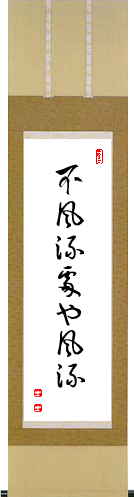
The place that is not elegant is also elegant.
The phrase “Fu-ryu doko ya furyu,” which translates to “Even if it is not furyu, it is also furyu,” is one of the words found in the Zen koan collection “Hekiganroku. It is said to be the origin of the word “furyu.
In the chapter “Enjoying Fluctuation” in his book “Zen-teki Seikatsu,” Munehisa Gen’yu, the Akutagawa Prize-winning author and abbot of Fukujuji Temple in the Rinzai sect of Zen, writes that “furyu” is “fluctuation” like that of willow trees in the wind, and the ability to enjoy this fluctuation is the most exquisite pleasure that only humans have.
Fluctuation” is unpredictable movement, and people sometimes feel “lack” or “pain” when they cannot control something they cannot control. The theory that enables us to grasp such uncontrollable things is the theory of probability, as described in “Possible Worlds, Logic, Probability, and Artificial Intelligence.
The mind that loves such fluctuation leads to the idea that “even those who seem to be enjoying their lives by making the most of their destiny have human aspects such as worries, conflicts, and self-questioning, and that life is not as simple as it seems. This uncertainty may be what makes life worth living.
The creation of great art, seeing and hearing beautiful things, and enjoying the uncertainties of life are all expressed in the phrase “fufu-ryu dorya furyu,” which means “to enjoy the uncertainty of life.

Fluctuation and entropy
Prigogine, who was awarded the Nobel Prize in Chemistry in 1977, in his “Theory of Dissipative Structures,” which he assembled, draws significance from the second law of thermodynamics, the law of entropy.
The law of entropy states that all matter moves from order to disorder unless new energy is added, in other words, the rate of disorder increases, just as, for example, when sugar is added to water, the sugar molecules diffuse more and more uniformly and eventually settle down to an equilibrium state, according to Prigogine, Prigogine thought that there might be molecular motions in natural phenomena that recrystallize (order) against increasing entropy (increasing disorder rate), albeit with a small probability, and called this possibility “fluctuation”.


From birth to death, we humans follow the law of entropy, and aging can be explained by this law. However, the various mechanisms of creation, such as the process from fertilization to birth, the birth of a star in the universe, or the moment art is created, can be described as ordering, or negative entropy. The structure of the system that is full of such fluctuations necessary for the creation of things can be said to be a “dissipative structure.
Entropy is the “force toward equilibrium,” while Prigogine’s “fluctuation” is the “force toward nonequilibrium. In the world of psychology, it is said that there is no absolute comfort in this world, even if one seeks it, but only in the state of death, where entropy is at max, and this is in opposition to the “force toward non-equilibrium” of life.
The stance of enjoying “fluctuation” and “wind style” means stepping into the world of “creation” that “moves toward non-equilibrium,” and the way of life of enjoying the unfamiliar can be the driving force for living (=creating).
Conditions for Enjoying Fluctuation
When considering “fluctuation,” the width of the fluctuation is an important factor. Fluctuation refers to a very small range of movement, not to a state of drastic change. When the “deviation from equilibrium” becomes large, it is no longer a “fluctuation” but a “movement. Frequent movement tires a person and, as mentioned above, creates a craving for equanimity that has no final answer.


So, how can we find the “fluctuation” that we can enjoy? In the world of Zen, the first step is to think of a “will” that does not waver at all, a life and work that are steady, and a habitual self that is not swayed by fame or fortune, and the slightest fluctuation in this self is the “fluctuation” that leads to “furyu. In other words, it is also elegant for people who seldom laugh to laugh, and it is also elegant for people who seldom cry to cry. It is also “elegant” for people who rarely get angry to get angry, and for people who never fall down to fall down.
At this time, the unwavering part at the center is called “shi,” and it is another maxim of the Zen world that the more settled one’s life and work are, the more fulfilling one’s life is. The state of enlightenment that is sought before is seen in a sense as a world of total rest, but stopping there is not the true goal, and from there one returns to a world of “fluctuation,” as described in “Artificial Anencephalon Speaks of Zen and Buddabodhi” in “The Sage, the Ten Oxen, Enlightenment, and Meaning. Enjoying this world of “fluctuation” also leads to the act of observing the world as described in “Meditation, Enlightenment (Awareness), and Problem Solving.
Fluctuation and Japanese Art
Lord Matsudaira Fumi, lord of Matsue Castle and famous tea master of the late Edo period (1603-1868), said, “If you know that there is enough, you can make tea and enjoy the lack. This is said to mean that the way of tea is not only to learn to be satisfied without being trapped by infinite desires, which is the Zen “shisoku (to know enough),” but also to enjoy what is lacking.


In the world of tea ceremony, this leads to the uniquely Japanese aesthetic of loving “lack,” “distortion,” “imperfection,” and “fragility,” as described in “Art of Meiji Era: Fenollosa, Okakura Tenshin, and Tea Books” as well as the shimmering beauty of Japanese-style painting and calligraphy as described in “The Beauty of Fluctuation – Japanese Painting and Japanese Calligraphy. and the love of “earthenware” vessels with a uniquely Japanese wabi-sabi aesthetic, as described in “Kaido yuku Echizen no Moromichi (Fukui)” (Japanese only).


Lack,” “distortion,” “imperfection,” “fragility,” or “dirtiness” can fall outside what is neither decorative nor beautiful in appearance from a Western perspective. Japanese beauty is based on the value of “furyu doryu dorya furyu,” which means that beauty includes the concept that what should be furyu should be non-furyu, in other words, not only in appearance and form, but also in essence and inwardly.
The word “furyu” actually refers to elegance, refinement, and beauty, and expresses a uniquely Japanese sense of beauty that appears in art, culture, customs, etc. As described in “Kaido yuku Sakai/Kishu Kaido” this term was popular among wealthy merchants in the Kinki region from the late Muromachi period (1336-1573), and is now an important expression of the Japanese spirit and sentiment. Today, it is deeply rooted in Japanese culture as an important concept that expresses the spirit and sentiment of harmony.
In other words, “fufu-ryu dorya furyu” means that one should not pursue only apparent external beauty and elegance, but value true elegance and beauty that lies within and at a deeper level, that one should look deeply into things, understand their essence and the emotions and philosophy behind them, and emphasize not only their superficial appearance but also their inner value. This is not only about superficial appearance.
Reference
1. Matsuo Bashō and Haikai Aesthetics (Directly Related)
-
Makoto Ueda, Matsuo Bashō
A foundational English study of Bashō’s life and poetic philosophy, including his transformation of fūryū from refined elegance to an aesthetic that embraces the ordinary and the seemingly inelegant. -
Haruo Shirane, Traces of Dreams: Landscape, Cultural Memory, and the Poetry of Bashō
An in-depth analysis of Bashō’s poetic landscapes, showing how elegance emerges from everyday, rustic, and “non-poetic” scenes—central to the idea of “non-fūryū as fūryū.” -
Donald Keene, World Within Walls: Japanese Literature of the Pre-Modern Era, 1600–1867
Provides cultural and literary context for Bashō and haikai, emphasizing the reversal of high/low and refined/vulgar aesthetics.
2. Japanese Aesthetics and the Beauty of the Non-Beautiful
-
D. T. Suzuki, Zen and Japanese Culture
Explains how Zen thought shaped Japanese aesthetics, particularly the idea that true beauty appears where conventional beauty is absent. -
Kakuzō Okakura, The Book of Tea
A classic exposition of Japanese aesthetics that values simplicity, imperfection, and understatement—closely aligned with Bashō’s aesthetic reversal. -
Shūzō Kuki, The Structure of Iki
A philosophical analysis of iki, highlighting restraint, tension, and anti-ornamentation as aesthetic virtues.
3. Wabi-Sabi and Imperfect Beauty
-
Leonard Koren, Wabi-Sabi for Artists, Designers, Poets & Philosophers
A clear and influential introduction to wabi-sabi, articulating how incompleteness, roughness, and impermanence become aesthetic values. -
Andrew Juniper, Wabi Sabi: The Japanese Art of Impermanence
Explores the historical and spiritual roots of wabi-sabi, resonating strongly with the idea that “non-elegance” can itself be elegant.
4. Zen Paradox and Aesthetic Negation
-
Alan Watts, The Way of Zen
Introduces non-dualistic thinking, dissolving oppositions such as beautiful/ugly or refined/crude. -
Eugen Herrigel, Zen in the Art of Archery
Demonstrates how meaning and beauty arise when intention and technique are abandoned—an aesthetic parallel to Bashō’s thought.
5. Comparative and Contemporary Aesthetic Thought
-
Byung-Chul Han, The Saving Power of the Beautiful
A modern philosophical reflection on negativity, rupture, and resistance to smooth, consumable beauty. -
George Steiner, Real Presences
Argues that meaning and value emerge from silence, absence, and restraint—ideas that can be read in dialogue with Bashō’s poetics.


コメント