
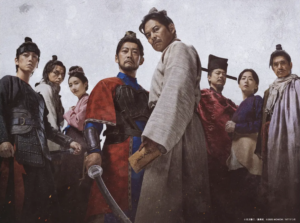
Recently, seeing Kitakata Kenzo’s version of Suikoden being broadcast on WOWOW

reminded me of this work for the first time in a while.
In fact, I had just finished reading the entire series not long ago.
Suikoden (19 volumes + 1),
Yōryōden (15 volumes + 1),
Gakuhi-den (17 volumes)


This series is, above all, incredibly long.
It begins with Suikoden, continues through Yōryōden, and then into Gakuhi-den.
Altogether, it spans dozens of volumes—a true epic.
If you start reading it with the mindset of a typical historical novel, you may find yourself overwhelmed by its sheer scale.
And yet, as you continue, you gradually find it difficult to leave this world behind.
Kitakata Kenzo’s Interpretation of Suikoden
The original Suikoden (a Chinese classical novel) is known as one of the Four Great Classical Novels of China.
Kitakata Kenzo reinterprets this classic not as a simple tale of adventure, but as a grand narrative centered on
politics, strategy, and the nature of the state.
At the heart of the story are the 108 outlaws gathered at Liangshan Marsh.
However, this is not merely a story of heroes.
Questions such as
What is a state?
What is order?
How freely can humans truly live?
are repeatedly explored throughout the long narrative.
The Setting: The Song Dynasty
Suikoden is set during the Song Dynasty.
The Song period occupies a somewhat unique position in Chinese history.
Rather than a militaristic state, it is more accurately described as a cultural civilization.
Cities developed, commerce expanded, and culture flourished.
At the same time, however, the era was marked by
political corruption, military weakness, and social inequality.
Liangshan, in Suikoden, emerges from these distortions of society.
It represents another form of order—one that exists outside the state.
The Influence of Song Culture on Japan
The Song Dynasty was also a profoundly important period for Japanese culture.
During this time in China, the following flourished:
Zen Buddhism
Ink painting
Ceramics
Literati culture
At the center of this was what I have also discussed in ‘Zen, Metacognition, and AI.’
Zen.
This Zen culture was transmitted to Japan and had a deep influence on later Japanese cultural traditions.
In particular, practices such as
the tea ceremony,
karesansui (dry landscape gardens),
and ink painting
developed within this cultural flow.
The Roots of Wabi-Sabi
When discussing Japanese culture, the concept of wabi-sabi often arises.
It refers to an aesthetic of
quietness, simplicity, and the beauty of imperfection.
Part of its origin can be traced back to Song culture.
For example, Song ceramics emphasized
subtle colors and simple forms,
rather than elaborate decoration.
This aesthetic later influenced the development of the Japanese tea ceremony.
Fierce Heroism and Quiet Aesthetics
What is particularly fascinating is that from the same Song period emerged two completely different cultural expressions.
One is
the intense, rebellious story of the heroes of Liangshan.
The other is
the quiet spiritual culture represented by Zen and wabi-sabi.
One is a story of struggle and freedom.
The other is a culture of silence and introspection.
Yet both arose from the same historical atmosphere.
After Finishing This Long Journey
The Suikoden series by Kitakata Kenzo is undeniably long.
But as you read, history, politics, culture, and humanity begin to merge into a single, unified world.
By the time you finish, it feels less like you have read a story,
and more like you have traveled through an entire era.
Watching the WOWOW broadcast now, there are surely many who are reminded of this long journey.
And if you have not yet read it,
it may be a long journey—
but it is one well worth taking.


AIシステム設計・意思決定構造の設計を専門としています。
Ontology・DSL・Behavior Treeによる判断の外部化、マルチエージェント構築に取り組んでいます。
Specialized in AI system design and decision-making architecture.
Focused on externalizing decision logic using Ontology, DSL, and Behavior Trees, and building multi-agent systems.


コメント