Artificial Intelligence Technology Web Technology Knowledge Information Processing Technology Ontology Technology Search Technology Database Technology User Interface Technology
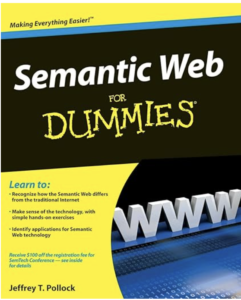
From “Semantic Web For Dummies“.

The book starts with the concept of Semantic Web technologies (Part 1), the handling of metadata in the enterprise (Part 2), a brief overview of Semantic web technologies such as RDF, Ontology, SPARQL, etc. (Part 3), a checklist of items to consider when applying them in practice, and an introduction to vendors (Part 4). The final part (Part 5) provides the steps to actually build a Semantic Web system, and answers the question “How is it different from existing systems? The final part (Part 5) is about the steps to actually build a Semantic Web system and answers the question, “How is it different from existing systems? The table of contents is as follows.
Part1 Welcome to the Future of Data and Web

  Chapter 1 Getting Gist of the Semantic Web

     Exploring Different ways of Looking at the Semantic Web
     Finding the Connection to Web 3.0
     Exploring the Business Side of Semantics
     Setting Information Free
     Rebirthing Artificial Intelligence
     Checking Out the Semantic Web's Origin
     Unpacking Semantic Web Baggage
     Instilling Simplicity in Complex Data
     Seeing the Semantic Web's Starring Role in Web 3.0 Showcase Application
     Recognizing Compelling Reasons for the Semantic Web


  Chapter 2 Semantic Web in Your Life

     Taking a Look at How the Web Is Used Daily
     Exploring the Web 2.0 Movement and What It Means
     Defining the Feature of Web 3.0 - the Semantic Web
     Checking Out Some Ahead-of-the-Curve Semantic Web Sites
     Peering into the Crystal Ball of the Semantic Web


  Chapter 3 The Data Web at Work for Business

     Getting a Handle on Enterprise Data Challenges and Opportunities
     Understanding the Difference between Information and Data
     Evaluating the web in Your Current Syatems
     Grasping the Vision of the Semantic Web at Work
     Flourishing in a Semantic Web Utopia
     Discovering Why Semantics Are for Everyday Businesspeople
     Making the Semantic Web Choise Now


Part2 Catch the Wave of Smart Data Today

  Chapter 4 A Quick Semantic Web Primer

     Getting Started with RDF Data
     Exploring the Semantic of RDF
     Discovering Languages That Use RDF
     A Little Semantics Goes a Long Way

  Chapter 5 Why the Semantic Web Is New Technology, Not Hype

     Tracing the Roots of the Semantic Web
     Realizing That the Internet Is Made Up of Pages, Not Data
     Realizing That Web 2.0 Is for People, and Semantic Web Is for Software
     Database Mean Business; So Does Semantic Web
     Grasping Why SOA/Integration Is for Messages, Not Data Structure
     Realizing That XML Is Documents, Not Data
     Seeing Why Object Orientation Is a Heuristic
     Seeing a New Beginning for Artificial Intelligence
     Grasping How Semantic web Is New and Different

  Chapter 6 The Problem with Metadata

     Gasping the Basics of Data and Information
     Devising a Framework for Classifying Metadata
     Logic and Rules in your Metadata
     Discovering the Many Types of Metadata
     Semantics and Metadata
     Seeing the Semantic Web as a Superset for Metadata

Part 3 Building the Semantic Web

  Chapter 7 Using the Resource Description Framework(RDF)

     Breaking It Down to the R, to the D, to the F
     viewing RDF Data as a Graph
     Understanding That RDF Is XML
     Using Typed Literals
     Identifying the Type of Resource
     Describing Stuff with RDF Schema
     Discovering Other Triple Formats: N3,Turtle, and N-Triples
     Specializing in Microformats, RDFa, eRDF, and GRDDL
     Getting to Know the Strengths of RDF
     Seeing Why RDF Is Only the Tips of Iceberg

  Chapter 8 Speaking the Web Ontology Language

     Introducing OWL
     Discovering the Various Species of OWL
     Exploring the Foundations of OWL
     Understanding OWL Essentials
     Making Simple Assertions
     Inconsistency
     Examining Property Characteristics
     Complex Classes
     Distinguishing Necessary from Necessary and Sufficient
     Understanding Why OWL Is Different
     Developing OWL Ontologies

  Chapter 9 Exploring Semantic Web Enablers

     Revisiting the Semantic Web Stack
     Digging a Bit Deeper into SPARQL
     Developing Easy RDF Models
     Finding Out Why Business Rules Are a Good Thing
     Grasping with Natural Language Processing(NLP)
     Enabling New Operational Models
     Setting the Truthiness Dial

Part4 Putting the Semantic Web Work

  Chapter 10 The Rise of the Information Worker

     Taking a Look at Global 2000
     Understanding the Tactical Role of Information in Business Economics
     Getting to Know the Types of Information Workers
     Understanding the Needs of the Information-Centric Company
     Aiding Information Workers with the Semantic Web
     Forecasting the Information Worker of tomorrow

  Chapter 11 Discovering the Enterprise Semantic Web

     Discovering the Roles within the Software Industry
     Creating Semantics for Enterprise Systems
     Discovering a Single Source of Truth for the Enterprise
     Exploring Some Enterprise Semantic Web Use Cases

  Chapter 12 Scalable Architecture

     Recognizing That This Is Not Your Father's Database
     Noting Semantics Web Tool Patterns
     Scaling Semantic Web Tools
     Understanding Patterns of Architectural Usage
     Buyer Beware!

  Chapter 13 Assessment Strategies

     Understanding the Business Problem
     Avoiding Common Traps in Planning Your Semantic Web Application
     Identifying Semantic Web Opportunities
     Reviewing Your Assessment Checklist
     Scoring the Checklist and Understanding Benefits
     Making the Decision

  Chapter 14 Exploring the Limitations of the Semantic Web

     Staying Within the Standard
     Straying Outside the Standard
     Realizing the Implication of a Complete Semantic Web Solution
     Making Good Choices
     Sticking to Best Practices

  Chapter 15 A Guide to Essential Vendor Implementations

     Consumer Web Sites
     Business Software

Part5 The Part of Tens

  Chapter 16 Ten Myths About the Semantic Web

          The Semantic Web Is Science Fiction
     The Semantic Web Is for Tagging Web Site
     The Semantic Web Will Put Google Out of Business
     The Semantic Web Is Too Complex to Succeed
     The Semantic Web Is a Catalog Syatem
     The Semantic Web Is an Ivory Tower Design
     The Semantic Web Is Description Logic
     The Semantic Web Is Artificial Intelligence
     The Semantic Web Is a $20-Billion Industry
     The Semantic Web Hasn't Changed The World

  Chapter 17 Ten Things to Look Forward to Beyond Web 2.0

     More Cool Features on the Web Sites and Browsers You Already Use
     Dramatically More Scalable Digital Knowledge and Machine Intelligence
     Widespread Embedding in Enterprise Software
     New Semantic Web Technical Standard
     Greater Expressivity for Core Languages
     Simple-to-use Tools Launching Your Own Personal Ontology
     Developers Scrambling to Take Semantic Web Training
     Semantic Advertising and Marketing Schemes
     Technology Managers Planning for New Supporting Workflows
     Explaining Web 3.0 to Your Grandmother

  chapter 18 Ten Next Steps to Take from Here

     Try Twine
     Explore Yahoo! SearchMonkey
     Check Out Calais
     Read Up on RDF and OWL Modeling on Attend Training
     Read The RDF and OWL Specifications
     Contact Your Trusted Vendors
     Write Down and Assess New Ideas
     Ask Zepheira
     Prototype Using Open-source and Free Software
     Sell Your Boss on the Idea!

コメント