
Why Are We Asking These Questions Again?
With the rise of generative AI, we find ourselves confronting some very old questions once again:
What is meaning?
What is understanding?
What is intelligence?
For a long time, we have treated possessing knowledge and understanding as almost the same thing.
We know the meanings of words.
We acquire knowledge by reading books.
We deepen our understanding through experience.
And we have tended to think that the accumulation of such knowledge and experience constitutes intelligence itself.
However, the emergence of large language models such as ChatGPT has begun to challenge these assumptions.
Generative AI can write documents,
summarize information,
translate languages,
engage in discussions,
generate software code,
and sometimes handle vast amounts of knowledge faster than humans.
Yet, does AI truly “understand”?
Does it understand what trust means?
Does it know the meaning of freedom or love?
Or is it simply learning an enormous number of linguistic patterns?
And if AI can behave as though it understands without actually understanding, then what does it mean to understand in the first place?
Is intelligence something that exists inside an individual entity?
Or is it something that emerges through relationships with other people and society?
In fact, these questions are not new.
More than half a century ago, the twentieth-century philosopher Ludwig Wittgenstein approached the question of meaning from a radically different perspective.
His answer is captured in one of his most famous ideas:
“The meaning of a word is its use.”
This simple statement would profoundly change the way we think about language, understanding, and perhaps even intelligence itself.
Where Does Meaning Come From?
In everyday life, we tend to assume that words inherently possess meaning.
For example, we think that the word “thank you” means gratitude, and that the word “promise” means a commitment to honor a future action.
In other words, we often assume that words and meanings correspond to each other in a one-to-one fashion.
But if we pay closer attention to how language is actually used, things turn out to be far more complicated.
Even the same word can have different meanings depending on the situation in which it is used.
Take the phrase “thank you.”
It does not always mean the same thing.
When a waiter says, “Thank you very much,” in a restaurant, the phrase functions as an expression of gratitude and professional courtesy.
However, if someone says, “Thanks a lot,” after being inconvenienced, the same words may express sarcasm or frustration rather than genuine appreciation.
Likewise, when someone writes, “Thank you so much!” on social media, the phrase may convey excitement, empathy, or admiration rather than simple politeness.
In other words, the meaning of a word cannot be determined by looking at the word alone.
Who said it?
To whom was it addressed?
In what situation was it spoken?
What kind of relationship existed between the participants?
What assumptions were shared by the people involved?
Only within such a context does meaning emerge.
This was a point that Ludwig Wittgenstein considered extremely important.
He famously argued:
“The meaning of a word is its use.”
Meaning does not exist as something fixed inside a dictionary.
Rather, meaning arises from the ways in which people actually use words in their everyday lives.
Consider a shogi piece.
Viewed merely as a piece of wood, it is just a physical object.
Yet once it is called a “King,” a “Rook,” or a “Pawn,” and placed within the rules of the game, it acquires meaning and function.
Language works in much the same way.
Words do not possess meaning by themselves.
They derive meaning from human activities, relationships, rules, and shared understandings.
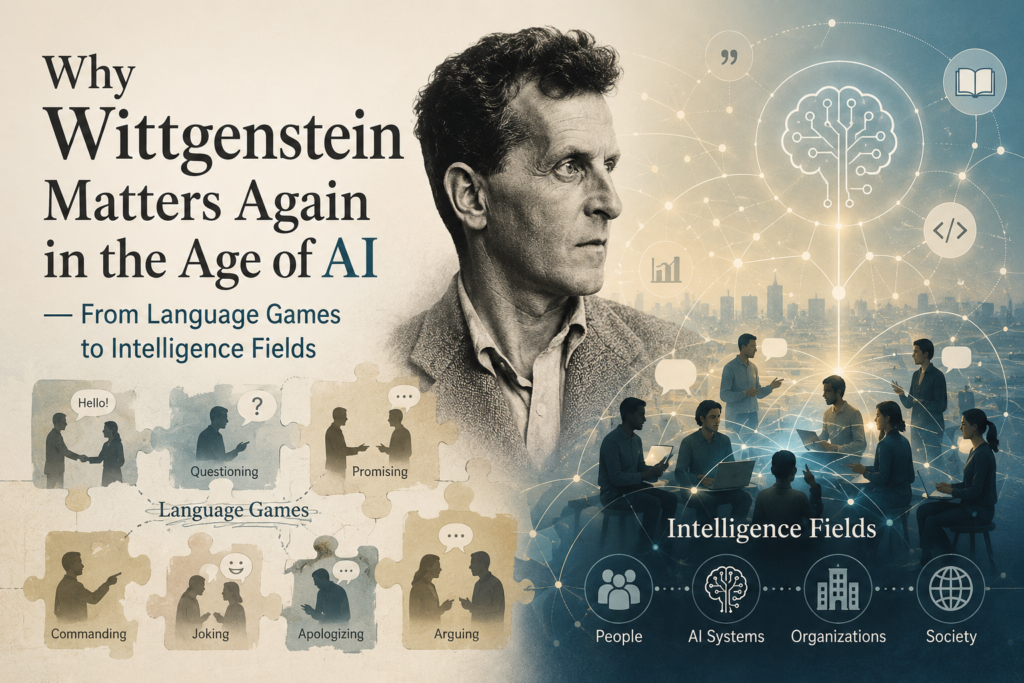
Wittgenstein referred to these patterns of language use as language games.
He used the term “game” because language, like games, involves rules, roles, participants, and shared forms of understanding.
Greeting.
Questioning.
Commanding.
Promising.
Joking.
Apologizing.
Arguing.
These are all different kinds of language games, each governed by different rules.
And although we rarely state those rules explicitly, we navigate them naturally in everyday life.
Meaning, therefore, is not locked inside words themselves.
Meaning emerges through the situations in which people live together, interact, and act.
This insight becomes particularly important when we begin thinking about intelligence fields.
For if meaning arises not inside isolated minds but through relationships, then perhaps intelligence itself is not something contained within individual entities either.
Perhaps intelligence, too, emerges through the relationships among humans, AI systems, organizations, and society.
And if that is the case, intelligence may ultimately belong not to isolated individuals, but to the relational spaces that connect them.
Human Society Is Composed of Countless Games
When people first hear Wittgenstein’s idea of “language games,” they might assume that he was simply referring to the rules of conversation.
But the “games” he had in mind were far broader than conversational techniques.
For Wittgenstein, human society itself consists of a multitude of games.
In our everyday lives, we inhabit many different worlds.
We conduct scientific research.
We work in organizations.
We talk with family members.
We interact with friends.
We obey laws.
We participate in economic activities.
We fall in love.
We receive education.
Yet each of these worlds operates according to different principles.
Different answers are given to questions such as:
What is true?
What is valuable?
How should one behave?
In science, truth is paramount.
Can an experiment be reproduced?
Can a hypothesis be tested?
Can an explanation be logically justified?
No matter how prestigious a person may be, their claims must be revised if experiments contradict them.
In the legal world, however, truth itself is not enough.
What matters is legitimate procedure and the rules of law.
“It might have happened that way” is insufficient.
Judgments are made through evidence,
testimony,
legal procedures,
and precedents.
In economics, value and price become central.
No matter how excellent a technology may be, if the market does not recognize its value, it will fail as a product.
Within families, love, trust, and tacit understanding matter more.
In romantic relationships, there are forms of value that cannot be explained solely by logic or market principles.
In other words, we do not live within a single world.
We move constantly among
the game of science,
the game of law,
the game of economics,
the game of education,
the game of family,
the game of organizations,
the game of religion,
and the game of love.
And each of these games possesses its own
rules,
values,
assumptions,
meanings of words,
and standards of judgment.
Even a word like “responsibility” carries different meanings depending on the context.
Legal responsibility.
Corporate responsibility.
Family responsibility.
Moral responsibility.
Meaning cannot be determined by dictionaries alone.
It depends upon the game within which the word is being used.
Wittgenstein referred to this broader structure of human existence as a Form of Life.
A Form of Life is not merely a collection of habits.
It is an entire world in which people share rules,
values,
and ways of understanding one another.
We do not first understand the world and then begin to use language.
Rather, we come to understand meaning by living within communities,
interacting with others,
and participating in these various games.
Meaning is therefore not something locked inside individual minds.
It arises from the activities of communities themselves.
And this idea turns out to be remarkably relevant today.
Because in the age of AI, intelligence itself may need to be understood in a similar way.
Perhaps intelligence does not reside solely inside isolated individuals.
Perhaps it emerges from the interactions among
humans,
AI systems,
organizations,
communities,
and society.
If meaning arises through relationships,
then perhaps intelligence does as well.
And the relational space woven by those interactions is what we may call an Intelligence Field.
AI as a Participant in a Vast Language Game
Wittgenstein’s famous idea that “the meaning of a word is its use” offers remarkable insights for understanding generative AI.
Large language models such as ChatGPT and Claude do not learn meanings by reading dictionaries.
They do not contain fixed definitions such as:
“This is what trust means.”
“This is what freedom means.”
“This is what gratitude means.”
Words are not stored as isolated units with predetermined meanings.
Instead, AI learns from enormous amounts of text.
It learns
how words are used,
which words appear together,
what kinds of questions they answer,
and what kinds of responses they tend to evoke.
Take the phrase “thank you.”
It appears in situations of gratitude.
It can also be used sarcastically.
It may express excitement or shared emotion.
On social media, it can even become a form of admiration or praise.
Through countless examples, AI learns the contexts and roles associated with the phrase “thank you.”
In this sense, AI is not simply memorizing words.
It is learning the vast network of language use accumulated by human society.
In other words, AI is built upon the enormous collection of language games created by humanity.
Scientific writing.
Legal texts.
Business documents.
Everyday conversations.
Novels.
Social media posts.
Arguments.
Explanations.
Apologies.
Requests.
Commands.
Suggestions.
Each of these domains involves different ways of using language.
AI learns across all of them and estimates how language should be used within different games.
In this sense, AI can be understood as a participant in a vast language game.
However, there is an important difference.
AI does not inhabit the world in the same way that humans do.
It does not possess a body.
It does not live within families.
It does not carry organizational responsibilities.
It does not experience pain, failure, or the loss of trust as human beings do.
Therefore, even though AI appears to participate in language games, its participation differs fundamentally from ours.
AI does not live within human forms of life.
Rather, it learns the traces of language produced by those forms of life.
And this raises one of the most important questions of the AI era.
AI appears capable of handling meaning.
It can converse with people,
provide explanations,
offer advice,
and generate texts.
Yet meaning does not reside entirely within the AI itself.
Meaning emerges through interaction.
Humans ask questions.
AI responds.
Humans interpret those responses.
They revise them when necessary.
They integrate them into decisions made by individuals and organizations.
Only through this process do AI outputs acquire meaning.
The real transformation brought about by the age of AI is therefore not that AI has suddenly become an independent intelligence.
Rather, the locus of intelligence is beginning to shift.
From intelligence residing solely within individuals,
toward intelligence emerging through interactions between humans and AI.
Traditionally, intelligence was understood as something located inside the human mind,
or perhaps inside AI models themselves.
But in the age of generative AI, intelligence increasingly emerges between humans and AI.
Humans formulate questions.
AI generates responses.
Humans exercise judgment.
Systems record experiences.
Organizations share knowledge.
Communities learn collectively.
Within this entire web of relationships, intelligence takes shape.
From this perspective, AI is neither merely a tool nor an autonomous replacement for human intelligence.
AI is a participant in humanity’s language games.
Together with humans, it contributes to the creation of new meanings and new forms of judgment.
And as these interactions accumulate over time,
knowledge,
experience,
trust,
and decisions begin to circulate.
Gradually, a relational space emerges.
A space in which intelligence is not contained within isolated entities, but arises through their interactions.
That relational space is what we may call an Intelligence Field.
Intelligence Does Not Reside Inside Individuals
For a long time, we have tended to think of intelligence as something that exists inside individual minds.
A smart person.
Someone with deep understanding.
Someone with a good memory.
Someone with sound judgment.
In this view, intelligence is regarded as an ability possessed by individuals.
The same assumption has shaped our understanding of AI.
Smarter models.
Larger models.
More powerful models.
More accurate models.
For decades, AI research and development have largely treated intelligence as an internal property of models.
But real intelligence is far more complex.
Even when a person makes an excellent decision, that decision does not arise solely from the contents of their own mind.
Past experiences.
Knowledge learned from others.
Organizational rules.
Cultural assumptions.
Relationships of trust.
Available tools.
The circumstances of the moment.
Only through the interaction of all these elements does judgment emerge.
Intelligence, therefore, is not something confined within a single individual.
People talk to each other.
People consult organizational rules.
People ask questions to AI.
AI systems collaborate with other AI systems.
Past experiences shape present decisions.
Shared knowledge gives rise to new ideas.
Trust makes open discussions possible.
Culture and values determine what matters.
Through these interactions, intelligence emerges.
Consider how good ideas arise in meetings.
They are rarely born entirely inside the mind of a single individual.
One person offers an observation.
Another senses something inconsistent.
Someone else recalls a past example.
AI organizes relevant information.
Participants reflect upon organizational goals and constraints.
Gradually, ideas begin to take shape.
The intelligence that emerges in such situations is neither individual intelligence nor the intelligence of AI alone.
It is relational intelligence, generated through the interactions among humans, AI, organizations, experiences, knowledge, trust, and rules.
For this reason, it is no longer sufficient to think of intelligence merely as a capability.
What matters is:
What kinds of relationships give rise to intelligence?
What kinds of environments generate good questions?
What kinds of trust enable honest dialogue?
What kinds of rules support safe decision-making?
What kinds of records contribute to future learning?
These questions become increasingly important.
In the age of AI, what matters is not simply how intelligent individual AI systems become.
What matters is how humans and AI interact,
how organizations learn,
how experiences are shared,
and how trust is cultivated.
Intelligence is not a static capability stored inside isolated entities.
It is something that emerges,
is exercised,
and continuously evolves through relationships.
From this perspective, intelligence is not something we possess.
It is something we form.
And the relational space in which intelligence is formed is what we call an Intelligence Field.
The Idea of Intelligence Fields
From this perspective, intelligence is not merely a capability possessed independently by individuals or AI systems.
Rather, intelligence can be understood as something that emerges through the interactions among humans, AI systems, organizations, and communities.
We may call the relational space in which this intelligence emerges an Intelligence Field.
An Intelligence Field is a relational space in which
humans think,
AI responds,
organizations make judgments,
communities share experiences,
and, as a result, new knowledge and trust are created.
Within such a field, intelligence does not belong to any single individual.
It is not produced solely by brilliant people.
Nor is it generated solely by powerful AI models.
Humans formulate questions.
AI organizes information.
Others sense inconsistencies.
Organizations provide criteria for judgment.
Past experiences are consulted.
The results are fed back into future learning.
It is through this entire cycle that intelligence takes shape.
Consider a situation in which an organization must make a strategic business decision.
Someone observes changes in the market.
AI organizes relevant information.
Teams discuss alternatives.
Past failures are recalled.
Customer feedback is incorporated.
Management makes decisions.
The outcomes are recorded and later used to inform future decisions.
The intelligence produced in such a situation does not reside solely inside the mind of an individual.
Nor does it come from AI outputs alone.
Nor is it simply a consequence of organizational rules.
It emerges through the connections among humans, AI, experiences, knowledge, trust, judgments, and records.
This is what we mean by an Intelligence Field.
What matters in an Intelligence Field is not merely the accumulation of knowledge.
What matters is that knowledge is used.
Experiences are shared.
Trust is formed.
Judgments are made.
Results are recorded and fed back into future actions.
It is because of this continuous circulation that intelligence grows within the field.
In other words, an Intelligence Field is not a repository of knowledge.
It is a living relational space in which knowledge, experience, trust, and judgment continuously circulate.
This idea is deeply connected to Wittgenstein’s philosophy.
Wittgenstein argued that
“The meaning of a word is its use.”
Meaning does not exist as something fixed inside dictionaries.
It emerges through the ways people use language in everyday life, understand one another, and participate in shared activities.
Likewise, intelligence should not be understood as a fixed capability residing inside isolated entities.
Intelligence emerges when humans and AI interact,
when organizations accumulate experience,
when communities share knowledge,
and when judgments are made within relationships of trust.
Just as Wittgenstein believed that
meaning exists in use,
we may say, in the age of AI, that
intelligence exists in relationships.
If meaning emerges through language games,
then intelligence emerges through the relational games between humans and AI.
And the space in which those relational games continuously unfold is what we call an Intelligence Field.
What Will Matter in the Age of AI
As AI continues to evolve, knowledge itself is rapidly becoming commoditized.
For a long time, possessing knowledge was a major source of value.
Knowing information.
Having specialized expertise.
Writing documents.
Summarizing information.
Conducting research.
These capabilities have traditionally been at the center of intellectual work.
However, with the emergence of generative AI, many of these capabilities are becoming widely accessible.
AI can write documents, conduct research, summarize information, translate languages, generate ideas, and write code.
The cost of retrieving knowledge—and even generating knowledge-like outputs—has fallen dramatically.
Of course, larger models, faster inference, and more parameters remain important.
As AI performance improves, the range of possible applications continues to expand.
But as AI becomes more capable, another set of questions moves to the forefront.
Can this knowledge be trusted?
Who is responsible for its use?
How much should be delegated to AI?
Where should humans intervene?
How can agreement be achieved among different people and organizations?
These are the questions that increasingly matter.
And with them, a different set of priorities emerges:
Trust.
Co-creation.
Boundaries.
Responsibility.
Explainability.
Coordination.
Relationships.
These qualities do not arise from AI models alone.
No matter how powerful an AI system may be, trust does not automatically emerge.
No matter how accurate an answer may be, responsibility remains ambiguous if nobody determines how that answer should be used.
No matter how brilliant a proposal may be, it creates little value unless it is accepted and integrated within human and organizational relationships.
What matters in the age of AI is not merely what AI knows.
What matters is:
How humans and AI relate to one another.
How AI outputs are evaluated.
Where humans intervene.
What rules organizations establish.
How failures become opportunities for learning.
In other words, what matters is the design of relationships.
For this reason, it is no longer sufficient to view AI simply as a tool.
AI must be understood as a participant in the formation of intelligence through its interactions with humans, organizations, and communities.
And if these relationships are to remain safe, sustainable, and trustworthy, they require an underlying foundation.
That foundation is what we call Trust Infrastructure.
Trust Infrastructure is the set of structures that support trustworthy relationships between humans and AI.
It addresses questions such as:
Who made which decisions?
On what basis did the AI generate its outputs?
Where did humans review and intervene?
At what boundaries should decisions be halted?
How are outcomes recorded?
How are lessons incorporated into future learning?
Trust Infrastructure makes these relationships visible, traceable, and accountable.
And upon this foundation, humans, AI systems, organizations, and communities continuously interact.
Knowledge circulates.
Experiences accumulate.
Trust develops.
Judgments evolve.
Through these ongoing interactions, a relational space begins to emerge.
That space is what we call an Intelligence Field.
Thus, what truly matters in the age of AI is not merely building smarter AI systems.
It is enabling humans and AI to work together through trust,
to think together,
to share responsibility,
to design boundaries,
and to transform experience into future wisdom.
An Intelligence Field is the space in which such relationships continuously emerge and evolve.
And Trust Infrastructure is the foundation that makes those Intelligence Fields possible.
From Language Games to Intelligence Fields
Wittgenstein argued that
“The meaning of a word is its use.”
In other words, meaning is not something fixed inside words themselves.
Meaning emerges when people use language in their everyday lives,
respond to one another,
understand one another,
and participate in shared activities.
Words do not possess meaning in isolation.
They acquire meaning only within
contexts,
relationships,
purposes,
rules,
and shared assumptions.
If we extend this insight into the age of AI, perhaps the same can be said about intelligence.
Intelligence, too, does not exist in isolation—
neither inside individual minds nor inside AI models themselves.
Humans formulate questions.
AI generates responses.
Others interpret those responses.
Organizations make decisions.
Experiences are recorded.
Trust is established.
Those outcomes influence future questions and future decisions.
Through this chain of relationships, intelligence emerges, is exercised, and continuously evolves.
In this sense, we may say that, in the age of AI,
Intelligence emerges through participation in relationships.
No matter how powerful AI becomes, intelligence does not automatically acquire social value.
What matters is
who receives AI outputs,
how they are interpreted,
in what situations they are used,
who takes responsibility,
and how the outcomes contribute to future learning.
Only through these relationships do AI capabilities become meaningful intelligence.
Intelligence is not confined within standalone AI systems.
It emerges through the relationships among
humans and AI,
organizations and communities,
knowledge and experience,
trust and co-creation,
judgment and responsibility.
If this is true, then what matters most in the age of AI is not merely building smarter models.
Of course, advances in model performance remain important.
But even more important is the design of relationships.
How do humans and AI interact?
How do organizations learn?
How is trust formed?
How do people with different perspectives collaborate and co-create?
These questions matter more than ever.
Not bigger models,
but richer relationships.
Not faster inference,
but deeper cycles of understanding.
Not more knowledge,
but knowledge that is better shared, used, and renewed.
Intelligence in the age of AI grows through such relationships.
And the entire network of interactions among humans, AI systems, organizations, and communities—
through which knowledge, experience, trust, and judgment circulate—
is what we call an Intelligence Field.
Just as Wittgenstein saw meaning not within individual minds, but within human life and language in use,
we, in the age of AI, may need to see intelligence not merely inside AI models, but within the relationships through which humans and AI live, think, and make decisions together.
From Language Games to Intelligence Fields.
It is an attempt to extend Wittgenstein’s insight—
“Meaning exists in use”
into a new principle for the age of AI:
“Intelligence exists in relationships.”
Chinoba
Runtime Society and Coordination Systems

Chinoba
Intelligence as Relationship
Research Platform
founded by
Masao Watanabe
AI Systems Architecture
Decision Trace
Human–AI Coordination
Algorithmic Governance
Related Research
This topic is part of the Chinoba Knowledge Base.

コメント