🎥 The YouTube version is also available
The Relationship Economy: How AI Is Transforming Value, Trust, and Business

Introduction
For a long time, we have thought of the economy as being fundamentally about transactions.
Buying products.
Using services.
Paying money.
Companies earning profits.
The idea that the economy is built through the accumulation of transactions has been one of the basic assumptions of modern economics.
Of course, this view is not wrong.
However, as AI begins to play an increasingly important role in society, many phenomena are emerging that cannot be fully explained by this assumption alone.
The source of corporate value is gradually shifting away from simply selling products and toward building continuous relationships among people, companies, AI systems, and communities.
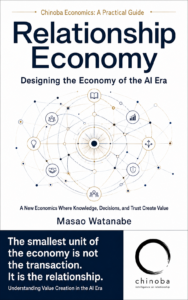
In this article, we call this new approach to value creation the Relationship Economy and introduce its basic concept.
Why Has Economics Traditionally Focused on Transactions?
In conventional economic activity, value has generally been understood as something created at the moment of a transaction.
For example:
- Purchasing a product
- Eating at a restaurant
- Staying at a hotel
- Subscribing to a service
Each of these is an individual transaction.
Companies have increased their revenue and generated profits by increasing the number of transactions.
Marketing and sales have also been primarily designed to generate the next transaction.
Even after Customer Relationship Management, or CRM, became widespread, much of it developed as a mechanism for increasing transactions more efficiently.
In other words, the traditional economy has been designed around the following model:
Transaction → Revenue
What Changes in the Age of AI?
The emergence of generative AI is beginning to transform this structure significantly.
AI does more than simply answer questions.
It is evolving into something that can:
- Understand an organization’s knowledge
- Understand a user’s situation
- Make appropriate decisions
- Support human action
AI agents will also increasingly work not only with humans but with other AI systems.
In other words, AI is no longer merely a tool for improving operational efficiency. It is becoming an active participant in economic activity.
In such a world, the value of a company will increasingly depend not on individual transactions, but on:
What kind of continuous relationships it is building.
What Are Amazon and Rakuten Really Selling?
Is Amazon a company that sells products?
Is Rakuten a company that provides reward points?
Of course, these are parts of their businesses.
However, people do not use Amazon simply because they want to buy a product.
They search.
They compare.
They purchase.
The product arrives the next day.
They write reviews.
They watch videos.
They listen to music.
They use cloud services.
All these activities are connected through a single account and a unified experience.
Rakuten follows a similar model.
Shopping, travel, banking, securities, mobile services, sports, and many other services are connected through a single identity.
People do not continue using these services only because of reward points.
Nor is convenience the only reason.
They continue because their relationship with the service has accumulated over time.
The true value provided by these companies is not merely the product.
It is the continuous relationship.
Relationships Are the True Source of Value
In the age of AI, this trend will become even stronger.
Value is not created by a single transaction.
Consider relationships such as:
- The relationship between users and companies
- Communities formed among users
- Collaboration between companies
- Cooperation between AI and humans
- Connections between regions and their residents
- The relationship between knowledge and decision-making
New forms of value emerge through the accumulation of these relationships.
The true essence of regional reward points is not the points themselves.
Digital transformation is not simply about improving operational efficiency.
AI in manufacturing is not merely a tool for optimizing equipment.
What matters is how people, organizations, AI systems, and services are connected—and how they create value for one another.
In other words, the source of value is shifting away from physical goods and data toward relationships.
The Concept of the Relationship Economy
We call this new mechanism of value creation the Relationship Economy.
In the Relationship Economy, the economy is understood as the following cycle:
Knowledge
↓
Relationship
↓
Decision
↓
Trust
↓
Community
↓
Value
↓
Economy
From this perspective, money is not the starting point of value.
It emerges as a result of value circulating through this cycle.
This changes what companies need to design.
Until now, companies have designed transactions.
From now on, they must design relationships.
AI will become an essential foundation for understanding, supporting, and nurturing these relationships.
Conclusion
With the emergence of generative AI, we are moving beyond the stage of discussing how to use AI.
We are entering a stage in which we must consider how AI will transform the economy itself.
From a transaction-centered economy to a relationship-centered economy.
From an economy focused primarily on efficiency to one in which knowledge, decision-making, and trust generate value.
We call this new field of economics Chinoba Economics.
It is not merely a theory.
It is a framework for economic design that can be implemented across many fields, including business, regional communities, public services, and manufacturing.
Over the next several articles, we will introduce the core ideas of Chinoba Economics.
The next article will explore the theme:
“Knowledge Is the New Capital.”
It will examine the role of knowledge in the age of AI and explain why Knowledge Flow generates economic value.

Chinoba
Intelligence as Relationship
Research Platform
founded by
Masao Watanabe
AI Systems Architecture
Decision Trace
Human–AI Coordination
Algorithmic Governance
Related Research
This topic is part of the Chinoba Knowledge Base.

コメント