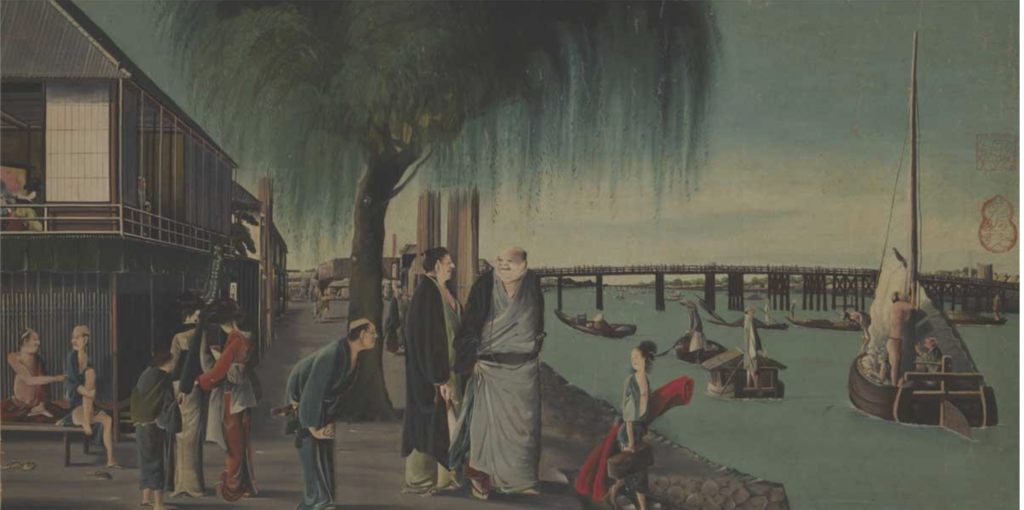
The other day, I visited an exhibition and saw works by Shiba Kōkan.

The painting depicted an Edo landscape. At first glance, it looked like a familiar Japanese scene, yet something felt different.
It looked like traditional Japanese painting,
and at the same time, like Western painting.
There was depth.
There was light and shadow.
Space existed as a three-dimensional structure.
This was because it was painted using Western perspective.
What Kōkan did was not merely the introduction of a new technique.
Its essence lies in this:
👉 He transformed the way the world is perceived.
Even when looking at the same landscape,
the way it appears can change dramatically depending on the structure through which it is understood.
Until the Edo period, many paintings in Japan arranged objects and relationships.
Mountains, rivers, buildings, people.
Each element was carefully depicted, yet:
- Where the viewpoint was located
- How far things were from each other
- How the space was connected as a whole
were not explicitly defined.
In other words:
👉 The elements existed, but the rules of space were not explicitly defined.
Western perspective, on the other hand, takes a completely different approach.
First, it fixes a viewpoint.
It determines from where the world is being seen.
Next, it defines distance.
Objects closer appear larger, and those farther away appear smaller.
Then, it organizes spatial relationships geometrically.
All lines converge toward a vanishing point, ensuring consistency across the space.
As a result:
- A consistent rule governs the entire space
- Relationships between objects become quantifiable
- A coherent world without contradiction is constructed
👉 Perspective is a technique that defines space as a structure.
What matters is that this is not simply a method for making things look realistic.
👉 It provides rules for how the world can be handled.
This distinction is not limited to art.
Many of the tasks we deal with in our daily work are also shifting:
- From arranging information
to - Understanding it as a structure
The key point is:
👉 What is not structured cannot be handled.
Information, on its own, does not carry meaning.
No matter how much data or knowledge we have,
- If the relationships are not defined
- If causes and effects are unclear
- If the perspective is not specified
then it remains nothing more than a collection of fragments.
In that state:
- Comparison is not possible
- Prioritization cannot be made
- Criteria for decision-making do not exist
👉 And therefore, it does not lead to action.
Conversely, structure provides the rules for handling information.
- What to use as a reference
- How elements relate to each other
- In what order to think
Once these are defined, what was previously fragmented
👉 emerges as a coherent system with meaning.
And only then does it become possible to:
- Compare
- Decide
- Reproduce
👉 The moment structure is introduced, the world becomes something we can work with.
What becomes clear here is that even within the same world,
👉 what emerges depends entirely on the structure through which it is understood.
In Japanese painting as well, objects are not simply arranged.
Mountains, rivers, people, and buildings are positioned through:
- The flow of the viewer’s gaze
- The use of empty space
- Narrative and semantic relationships
👉 Space is constructed through meaning and relationships.
In contrast, Western perspective defines space through:
- Viewpoint
- Distance
- Position
👉 A geometrical rule-based structure.
What we see here is not the presence or absence of structure,
but rather:
👉 a difference in how the world is structured.
Is the world understood through relationships and meaning?
Or is it defined through viewpoint and rules?
What matters is that this difference is not merely a variation in artistic technique.
👉 It represents a fundamental difference in how the world is handled.
From this perspective, we can see that the work we engage with daily follows the same pattern.
Many of the problems we face are not due to a lack of information,
but rather:
👉 a lack of clarity about which structure to use.
- Should we understand it as relationships of meaning?
- As numerical or causal structures?
- As decision-making processes?
When the structure changes,
👉 the same subject appears differently and can be handled differently.
In other words:
👉 What matters is not the information itself, but the choice of structure.
And when the appropriate structure is applied,
what once appeared fragmented
👉 emerges as a coherent world in which decisions can be made.

Chinoba
Intelligence as Relationship
Research Platform
founded by
Masao Watanabe
AI Systems Architecture
Decision Trace
Human–AI Coordination
Algorithmic Governance
Related Research
This topic is part of the Chinoba Knowledge Base.

コメント