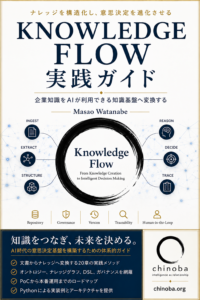
Books: Knowledge Flow実践ガイド: 企業知識をAIが利用できる知識基盤へ変換する

For a long time, we have thought of knowledge as something to be accumulated.
Store documents.
Build databases.
Construct knowledge bases.
Make them searchable.
Retrieve information when needed.
Knowledge Bases.
Wikis.
RAG.
Knowledge Graphs.
Much of today’s Knowledge Infrastructure is built upon this assumption.
But is knowledge merely something to be stored?
Looking at the origins of life reveals a very different perspective.
Where Did Life Begin?
In the study of the origin of life, Stuart Kauffman proposed a fascinating idea:
the Autocatalytic Network.
Ordinary chemical reactions do not sustain themselves.
However, if:
A produces B,
B produces C,
and C produces A again,
a closed network emerges.
Once such a network forms, the system begins to maintain itself.
The important point is that life is not a particular molecule.
Life is the network of reactions itself.
Can Knowledge Become an Autocatalytic System?
Perhaps organizational knowledge behaves in the same way.
Many knowledge bases become archives that no one uses.
Documents increase.
Search works.
But knowledge remains static.
However, suppose knowledge generates new knowledge.
Experience generates decisions.
Decisions generate actions.
Actions generate new experiences.
Then knowledge itself begins to circulate.
Knowledge becomes more than information.
It becomes an autocatalytic system.
Experience → Knowledge → Decision → Execution → Experience
Most systems today follow a one-way flow:
Input
↓
Process
↓
Output
But life and organizations are fundamentally built upon closed loops.
For example:
Experience
↓
Knowledge
↓
Decision
↓
Execution
↓
Experience
Experience creates knowledge.
Knowledge supports decisions.
Decisions produce actions.
Actions create new experiences.
Those experiences generate new knowledge.
What matters is that there is no endpoint.
The cycle itself maintains the system.
From Knowledge Base to Knowledge Flow
Traditional Knowledge Infrastructure focused on storing knowledge.
But the true value is not knowledge itself.
The true value lies in circulation.
Knowledge is used.
It becomes experience.
It supports decisions.
Results are accumulated.
New knowledge emerges.
Knowledge is not a static object.
It is a flow.
Knowledge Flow is not merely the movement of information.
It is the metabolism of knowledge.
Runtime OS as an Autocatalytic System
Consider the structure of Decision Trace Model:
Event
↓
Signal
↓
Decision
↓
Execution
↓
Log
But if logs become knowledge again,
and knowledge supports the next decision,
and decisions produce execution,
and execution creates experience,
then Runtime OS itself forms a closed loop.
Runtime OS is no longer merely an execution platform.
It becomes a self-maintaining and evolving system.
Just as life possesses metabolism,
Runtime OS may possess a metabolism of knowledge.
Self-Catalytic Knowledge Network
Perhaps we can call this structure:
Self-Catalytic Knowledge Network.
Knowledge generates knowledge.
Experience generates experience.
Decisions generate new decisions.
The entire network grows while maintaining itself.
What matters is not individual pieces of knowledge.
What matters are the relationships among them.
Just as the essence of life lies not in molecules but in reaction networks,
perhaps the essence of intelligence lies not in knowledge itself,
but in the circulation of knowledge.
Trust Sustains the Cycle
Autocatalytic systems require certain conditions.
If reactions stop, the cycle collapses.
Organizations are no different.
Experiences are not shared.
Knowledge is not utilized.
Decision rationales are not recorded.
Results are not fed back.
Then the cycle stops.
This is where Trust Infrastructure becomes essential.
Knowledge Infrastructure supports knowledge.
Decision Trace Model supports experience.
Trust Infrastructure supports relationships.
Only when these three work together can self-catalytic circulation be sustained.
Trust is not simply trust between individuals.
Trust is the medium that enables circulation.
Runtime Society as a Self-Reproducing Knowledge Lifeform
The information society was a society for accumulating knowledge.
But in the age of AI, the challenge is no longer increasing knowledge.
It is enabling knowledge to circulate.
Experiences emerge.
Knowledge is formed.
Decisions are made.
Actions are executed.
New experiences arise.
And new knowledge is generated again.
If this is true, Runtime Society is not merely an information society.
It may be a giant living system in which knowledge circulates autocatalytically,
maintaining itself,
growing itself,
and evolving itself.
And perhaps intelligence is not the possession of vast amounts of knowledge.
Perhaps intelligence emerges from the circulation through which knowledge continuously generates more knowledge.
That may be what we mean by
Self-Catalytic Knowledge Network—
a new view of knowledge for the age of Runtime Society.

Chinoba
Intelligence as Relationship
Research Platform
founded by
Masao Watanabe
AI Systems Architecture
Decision Trace
Human–AI Coordination
Algorithmic Governance
Related Research
This topic is part of the Chinoba Knowledge Base.

コメント