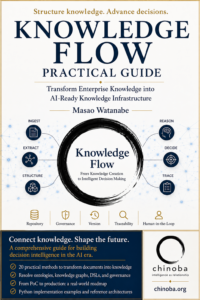

In the previous article, we introduced Knowledge Flow as:
A framework that automatically transforms enterprise documents into an AI-ready knowledge infrastructure.
In this article, we will explore how such a system can actually be implemented.
Overall Architecture
Knowledge Flow consists of five major layers.
Enterprise Documents
        │
        ▼
Document Ingestion
        │
        ▼
Knowledge Extraction (LLM)
        │
        ▼
Ontology Builder
        │
        ▼
Knowledge Graph
        │
        ▼
DSL Generator
        │
        ▼
Knowledge Repository
        │
        ▼
Decision Trace Model
        │
        ▼
Runtime OS
The entire pipeline is event-driven.
Whenever a new document is added or updated, the knowledge infrastructure is automatically refreshed.
Step 1: Document Ingestion
The first step is collecting enterprise information from various sources.
Typical data sources include:
- SharePoint
- Confluence
- Google Drive
- OneDrive
- GitHub
- Box
- Dropbox
- Slack
- Microsoft Teams
- Outlook
- PDF documents
- Microsoft Word
- Excel
- PowerPoint
- CAD drawings
- Source code repositories
- Wikis
Each document is first converted into a common representation.
For example:
Contract.pdf

↓

PDF Parser

↓

Markdown
or
Word Document

↓

DOCX Parser

↓

Markdown
Using a common intermediate format such as Markdown or JSON greatly simplifies downstream processing.
Step 2: Document Chunking
Enterprise documents are usually too large to send directly to an LLM.
Instead, they are divided into semantic units.
For example:
Maintenance Manual

↓

Chapter

↓

Section

↓

Paragraph
Each paragraph is then converted into a semantic chunk.
Paragraph

↓

Semantic Chunk
Every chunk maintains metadata such as:
{
    "id": "...",
    "source": "...",
    "author": "...",
    "version": "...",
    "timestamp": "...",
    "title": "...",
    "tags": [],
    "text": "..."
}
These semantic chunks become the fundamental processing unit of Knowledge Flow.
Step 3: Knowledge Extraction with LLMs
The LLM analyzes each semantic chunk to extract structured knowledge.
Consider the following document:
During inspection, if the defect rate exceeds 5%, notify the Quality Assurance department.
The LLM extracts:
Concepts
- Inspection
- Defect Rate
- Quality Assurance
Relationships
Inspection

↓

Defect Rate

↓

Notify

↓

Quality Assurance
Constraint
DefectRate > 5%
Event
Notify QA
This information can be represented as structured JSON.
{
  "entities": [
    "Inspection",
    "Defect Rate",
    "Quality Assurance"
  ],
  "relations": [
    {
      "from": "Inspection",
      "to": "Defect Rate",
      "type": "measure"
    }
  ],
  "constraints": [
    "DefectRate > 5%"
  ]
}
Step 4: Ontology Construction
The extracted concepts are then merged into a unified ontology.
For example,
Customer

Client

Account Holder
may all represent the same concept and are unified as:
Customer
Hierarchical relationships are then constructed.
Customer

├── Premium

├── Gold

└── Silver
Additional semantic relationships are also established.
Customer

↓

Order

↓

Invoice
Over time, this process continuously expands the enterprise ontology.
Step 5: Knowledge Graph Generation
An ontology alone is not sufficient for reasoning.
Relationships between concepts are stored as a graph.
For example:
Customer

↓

Purchase

↓

Product

↓

Factory

↓

Inspection

↓

Quality
Graph databases such as Neo4j allow sophisticated queries.
MATCH

Customer

↓

Purchase

↓

Product
This graph also serves as the foundation for Graph RAG and graph-based reasoning.
Step 6: DSL Generation
Next, business rules are extracted and converted into executable DSLs.
For example,
Contracts exceeding $100,000 require director approval.
becomes
IF Contract.Amount >= 100000

THEN Approval = Director
Likewise,
Stop the machine if the temperature reaches 80°C.
becomes
IF Temperature >= 80

STOP Machine
These DSL rules are executed by the Decision Runtime Kernel.
Step 7: Human Review
LLMs are not perfect.
Every automatically generated ontology and DSL must therefore pass through a human review process.
Ontology Candidate

↓

Human Review

↓

Approve

↓

Repository
Instead of reviewing entire documents, experts only examine:
- Newly discovered concepts
- Newly added relationships
- Modified ontology structures
- Newly generated DSL rules
This dramatically reduces the workload while maintaining high quality.
Step 8: Continuous Learning
Knowledge Flow is never a one-time process.
Whenever new documents are added,
New Document

↓

New Concepts

↓

Ontology Update

↓

DSL Update

↓

Knowledge Graph Update
the knowledge infrastructure evolves automatically.
The enterprise knowledge base remains continuously synchronized with organizational changes.
Example Implementation
A typical implementation in Python may look like this:
Document

↓

LLM

↓

Entities

↓

Ontology Builder

↓

Neo4j
Possible LLM choices include:
- GPT
- Claude
- Gemini
- Llama
Possible graph databases include:
- Neo4j
- Memgraph
- Amazon Neptune
DSLs can be stored in several formats:
- JSON DSL
- YAML DSL
- Custom Domain-Specific Languages
Integration with the Runtime OS
Knowledge Flow alone is simply a knowledge generation system.
Its real value emerges when integrated with the Decision Runtime Kernel.
During runtime reasoning, an AI agent consults:
Decision Request

↓

Ontology

↓

Knowledge Graph

↓

DSL

↓

Policy

↓

Decision Trace

↓

Decision
Knowledge Flow therefore acts as the knowledge provider for the Runtime OS.
Knowledge Flow as Enterprise Knowledge Infrastructure
The goal of Knowledge Flow is not document search.
Its purpose is to continuously transform enterprise documents, conversations, source code, design documents, and operational manuals into structured knowledge that AI can understand.
Ontologies describe what the organization knows.
Knowledge Graphs describe how those concepts are connected.
DSLs define how decisions should be made.
Together, these components transform enterprise information into reusable organizational intelligence.
Knowledge Flow continuously evolves this knowledge base and supplies it to the Decision Trace Model and the Runtime OS.
We therefore regard Knowledge Flow as the knowledge infrastructure of the AI era.
Competitive advantage in the AI era will not come from larger foundation models alone.
It will come from an organization’s ability to continuously structure, evolve, and operationalize its unique knowledge.
Knowledge Flow provides the architecture that makes this possible.

Chinoba
Intelligence as Relationship
Research Platform
founded by
Masao Watanabe
AI Systems Architecture
Decision Trace
Human–AI Coordination
Algorithmic Governance
Related Research
This topic is part of the Chinoba Knowledge Base.

コメント