■ Introduction
When I was working on providing solutions in manufacturing environments,
I realized one important fact:
The most valuable information is not
what is frequently searched.
Rather,
it exists at the very edge of the long tail.
■ Structural Limitations of Search Systems
Traditional search systems described in Search Technology fundamentally operate based on:
- frequency
- similarity
- ranking
In other words,
the more people search for something,
the easier it is to find.
However, what is truly needed in manufacturing environments is:
- defects that occurred only once in the past
- exceptions that appear only under specific conditions
- tacit knowledge known only by experienced engineers
- subtle impacts of design changes
All of these are:
extremely low-frequency information — the long tail
■ The Core Problem
The key issue is:
You cannot search for what you do not know how to ask.
Search always assumes:
- a query comes first
- information matching that query is retrieved
Which means:
👉 Search is fundamentally weak against unknown problems
■ What Actually Happens in Manufacturing
In real-world operations, situations like the following occur frequently:
- A defect occurs
- The cause is unknown
- No similar cases can be found through search
- The only option is to ask someone
At this point, what is effectively being used is:
👉 a human network search
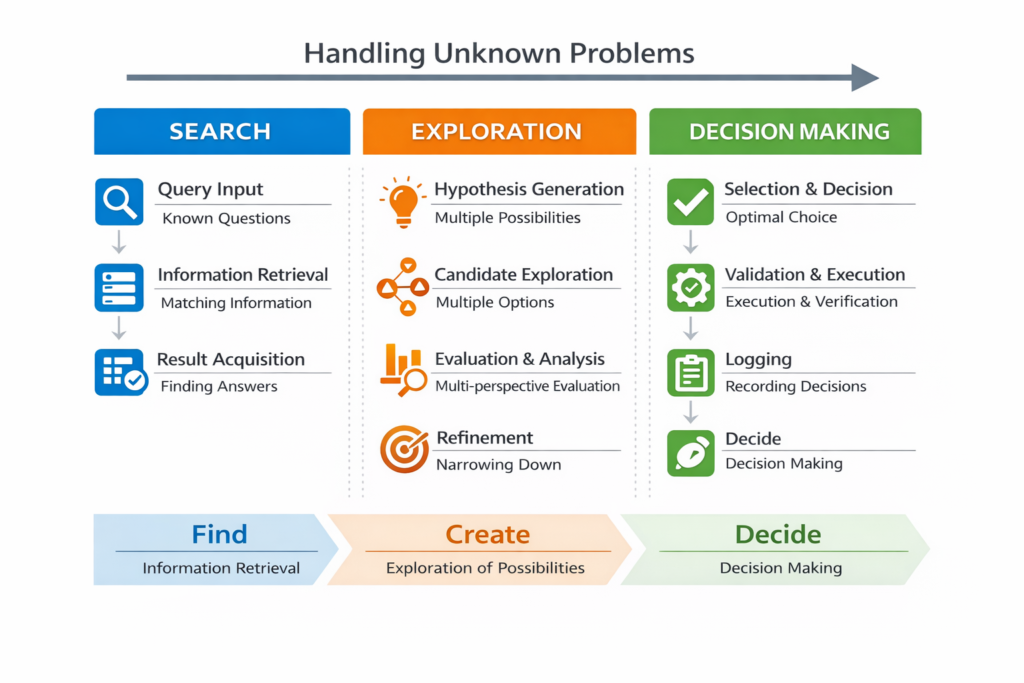
■ From Search to Exploration
Here, we need to shift our perspective.
Not Search, but:
👉 Exploration
As discussed in
“What is Cognitive Orchestration — Stability × Creativity × Variation as an extension of reinforcement learning,”
exploration is a process of:
- generating hypotheses
- producing multiple candidates
- evaluating them
- narrowing them down

■ The Role of Decision Trace Model × Multi-Agent (DTM × MAS)
What structures this exploration process is:
Decision Trace Model × Multi-Agent
Structure
Event
→ Signal (multiple candidates)
→ Evaluation (multiple perspectives)
→ Decision
→ Log
■ What DTM × MAS Actually Does
DTM × MAS is not simply replacing search.
It reconstructs exploration itself as a process of:
👉 generation + evaluation + selection
Specifically, it works as follows:
① Hypothesis Generation (Expansion of Signal)
- LLM generates multiple hypotheses
- Possible causes and patterns are enumerated
- Includes possibilities not present in existing data
👉 This is where we first reach into the unknown
② Multi-Perspective Evaluation (Decomposition of Evaluation)
Multiple agents evaluate from different viewpoints:
- technical validity (Engineer Agent)
- cost and impact (Business Agent)
- risk (Safety Agent)
- relation to past cases (Knowledge Agent)
👉 This enables semantic comparison, which is impossible with search
③ Convergence into Decision
- evaluation results are integrated
- selection is made based on constraints and rules (DSL)
- escalated to humans when necessary
This is not about:
“which is similar?”
but:
👉 “what should be chosen?”
④ Logging and Reuse (Log)
- all hypotheses, evaluations, and decisions are recorded
- reused for future exploration
👉 The long tail becomes an asset
■ Why It Is Strong for the Long Tail
Traditional search depends on:
- past frequency
- similarity
- predefined queries
In contrast, DTM × MAS:
- generates hypotheses
- explores unknown patterns
- evaluates from multiple perspectives
In other words:
👉 Exploration can begin even without an existing query
■ Example
Let’s consider a concrete example:
A problem occurs:
“Abnormal noise that appears only within a specific temperature range”
In traditional search:
- the correct keywords are unknown
→ nothing is found
In DTM × MAS:
Signal Agent generates:
- temperature dependency
- material expansion
- lubrication state
- resonance
Evaluation Agent analyzes:
- consistency with occurrence conditions
- weak matches with past logs
- physical plausibility
Through this process:
👉 a set of hypotheses is generated,
allowing access to long-tail knowledge that would otherwise remain hidden
Even if none of the hypotheses match:
👉 the system can still produce:
an explanation of absence
That is:
a validated conclusion that
“no matching case exists”
■ Summary — From Search to Decision System
The most valuable knowledge
does not exist at the top of search results.
It exists in the long tail:
- low frequency
- not fully articulated
- never searched
Traditional search systems cannot reach it,
because they depend on:
- past frequency
- similarity
- predefined queries
In contrast, Decision Trace Model × Multi-Agent is fundamentally different:
- it generates hypotheses
- explores unknown possibilities
- evaluates from multiple perspectives
- and ultimately makes decisions
In other words:
This is not an evolution of search.
It is a redefinition of decision-making.
Even when nothing is found,
even when no clear answer exists:
👉 A decision must still be made
That is why we need:
Not a search system, but an exploratory decision system
DTM × MAS provides that structure.
- absence of information → exploration
- uncertainty → evaluable signals
- complexity → actionable decisions
Search retrieves the known.
Exploration creates the unknown.
Decision systems turn it into action.

Chinoba
Intelligence as Relationship
Research Platform
founded by
Masao Watanabe
AI Systems Architecture
Decision Trace
Human–AI Coordination
Algorithmic Governance
Related Research
This topic is part of the Chinoba Knowledge Base.

コメント