
Generative AI has become remarkably capable of reading enterprise documents, summarizing information, and answering questions.
Yet many organizations continue to face fundamental challenges:
- The answers are technically correct, but they do not reflect company-specific rules.
- The same terms have different meanings across departments.
- AI cannot explain the rationale behind its decisions.
- The tacit knowledge of experienced employees remains inaccessible.
- Different departments receive inconsistent answers from the same AI.
In other words, AI can read documents, but it does not truly understand an organization’s knowledge.
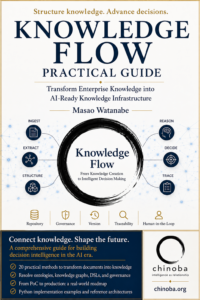
We believe this challenge can be addressed through a concept we call Knowledge Flow.
What Is Knowledge Flow?
Knowledge Flow is not simply another enterprise search system.
Its purpose is to continuously transform organizational knowledge into a structure that AI can reason with.
Every enterprise already possesses a vast amount of information, including:
- Word documents
- PDFs
- Excel spreadsheets
- PowerPoint presentations
- Wikis
- Emails
- Chat conversations
- Source code
- Design documents
- Operational manuals
Humans can understand these documents because they possess context and experience.
For AI, however, they are often nothing more than collections of text.
Knowledge Flow continuously analyzes these resources and transforms them into:
- Ontologies
- Knowledge Graphs
- Domain-Specific Languages (DSLs)
- Constraints
- Decision Patterns
Its objective is to automatically build an AI-ready knowledge infrastructure directly from enterprise documents.
Automatically Generating Ontologies
Every organization has its own domain-specific vocabulary.
For example, a manufacturing company may use concepts such as:
- Product Number
- Lot
- Production Process
- Defect
- Inspection
- Yield
A financial institution may use:
- Credit
- Guarantee
- Contract
- Customer Profile
- Risk
A healthcare organization may define:
- Patient
- Prescription
- Diagnosis
- Contraindication
These are not merely isolated words.
They represent interconnected concepts.
For example:
Product
├── Component
├── Process
├── Quality
└── Inspection
This network of relationships forms an ontology.
Modern LLMs can analyze enterprise documents and automatically identify:
- Concepts
- Hierarchical relationships
- Attributes
- Semantic associations
Knowledge Flow continuously performs this analysis, allowing enterprise ontologies to evolve automatically as organizational knowledge changes.
Automatically Generating DSLs
Organizations also possess countless decision rules.
For example:
Contracts exceeding $100,000 require director approval.
Or:
Stop the machine if the temperature exceeds 80°C.
Or:
Reorder inventory when stock falls below 100 units.
These are all expressions of organizational decision logic.
Knowledge Flow automatically converts such natural-language rules into executable Domain-Specific Languages (DSLs).
For example:
IF Contract.Amount > 100000

THEN Approval = Director
Or:
IF Temperature > 80

STOP Machine
Or:
IF Stock < 100

Purchase()
Enterprise documents are no longer passive documentation.
They become executable organizational knowledge.
Ontologies and DSLs Evolve Together
An ontology defines what exists.
A DSL defines how decisions should be made.
These two are deeply interconnected.
For example:
Customer

↓

Order

↓

Invoice
defines the business concepts.
Those concepts enable rules such as:
IF Customer.Status == Gold

Discount = 10%
Conversely, newly generated DSL rules often reveal previously unnoticed concepts.
Knowledge Flow continuously reinforces this cycle of mutual evolution.
Humans and AI Build Knowledge Together
Knowledge Flow is not an autonomous knowledge generation system.
Instead, it establishes a collaborative learning cycle between humans and AI.
Document

↓

LLM

↓

Ontology

↓

DSL

↓

Human Review

↓

Knowledge Base

↓

LLM
Human experts validate and refine the generated knowledge.
The improved knowledge base then becomes the foundation for future AI reasoning.
This is far more than Retrieval-Augmented Generation (RAG).
It is a continuously evolving organizational knowledge ecosystem.
Connecting to the Decision Trace Model
The DSLs generated by Knowledge Flow naturally integrate with the Decision Trace Model.
For example:
Need

↓

Goal

↓

Constraint

↓

Policy

↓

Decision

↓

Trace
Constraints and Policies are supplied directly from the Knowledge Flow.
Knowledge Flow therefore becomes the knowledge provider that supports traceable organizational decision making.
Integration with the Runtime OS
Knowledge Flow is not a static knowledge management platform.
When integrated with the Runtime OS, AI agents can reference:
- Ontologies
- DSLs
- Organizational Policies
- Constraints
- Historical Decision Traces
during runtime reasoning.
This transforms AI from a simple answer-generation system into a trusted decision-support platform grounded in organizational knowledge.
How LLMs Have Changed Knowledge Engineering
Historically, building ontologies and DSLs required enormous effort.
Knowledge engineers interviewed domain experts, manually designed conceptual models, and painstakingly encoded business rules.
These projects were expensive to maintain, and many became obsolete shortly after deployment.
Large Language Models have fundamentally changed this landscape.
Today, enterprise documents can be continuously analyzed to:
- discover new concepts,
- expand ontologies,
- generate DSLs,
- identify organizational knowledge,
- and keep knowledge structures synchronized with reality.
Human review and governance remain essential.
However, AI can now automate the most labor-intensive aspects of knowledge engineering, enabling enterprise knowledge infrastructures to evolve continuously.
The Future of Knowledge Flow
We believe the future of enterprise AI is not built upon document search alone.
Organizations need a system that continuously:
- structures organizational knowledge,
- formalizes decision rules,
- and enables humans and AI to improve knowledge together.
Knowledge Flow provides this foundation.
It automatically transforms enterprise documents into ontologies and DSLs, supplies knowledge to the Decision Trace Model, and supports trustworthy decision making within the Runtime OS.
For us, Knowledge Flow represents the knowledge infrastructure of the AI era.
The value of AI will not be determined solely by increasingly powerful foundation models.
Its true value lies in how well it understands organizational knowledge and transforms that knowledge into trustworthy decisions.
Knowledge Flow views knowledge not as static documents, but as a living flow that humans and AI continuously cultivate together.

Chinoba
Intelligence as Relationship
Research Platform
founded by
Masao Watanabe
AI Systems Architecture
Decision Trace
Human–AI Coordination
Algorithmic Governance
Related Research
This topic is part of the Chinoba Knowledge Base.

コメント