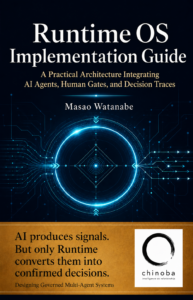
🎥 The YouTube version is also available:
How to Safely Connect AI Agents to Business Operations | Chinoba Decision Runtime Edge

When introducing generative AI and AI agents into business operations, the first requirement is not to run a larger number of agents.
What is needed is an execution foundation that makes clear who decides on an agent’s proposal, who authorizes execution, and how that process can be explained and audited.
One answer to this challenge is the Chinoba Decision Runtime Edge (CDR Edge).
CDR Edge is a lightweight Decision OS / Runtime OS for operating multi-agent systems safely. AI and agents are not made sovereign. AI emits signals, and only the Runtime finalizes decisions.
AI produces signals. Only the Runtime produces decisions.
Agents execute only approved, traceable decisions.
Separating AI Output from Decisions
Even if an AI says, “We should send a proposal to this customer,” that is not yet a decision. It becomes an executable decision only after questions such as the following have been addressed: Is the evidence sufficient? Does the actor have authorization to handle the customer’s information? Are the pricing conditions satisfied? Is human review required before sending?
Likewise, even if multiple agents conduct research and planning and reach agreement on a conclusion, that agreement alone does not create authority to operate an external system.
CDR Edge acts as a small Decision Kernel that connects Signals, Context, Policy, Permission, Risk, and Human Gates, and determines whether to Act, Ask, or Stop.
Positioning of CDR Edge
- Product name: Chinoba Decision Runtime Edge
- Abbreviation: CDR Edge
- Core: Decision Kernel
- Positioning: A lightweight Runtime for governed multi-agent execution
- Execution principle: Agents execute only decisions that are approved and traceable
The name “AgentOS” can make the agent itself appear to be the center of the system. In CDR Edge, the center is not the agent, but decisions, boundaries, accountability, and traceability. This also clarifies the division of responsibilities among the Enterprise Gateway and the Decision Trace Ledger.
Overall Architecture
flowchart TD
    IC["Interaction Core v2<br/>Message · Evidence · Event"] --> SI["Signal Ingress"]
    AG["Specialized Agents<br/>Research · Plan · Review"] --> SI
    SI --> DK["CDR Edge<br/>Decision Kernel"]
    DK --> BE["Policy & Boundary Engine"]
    BE --> HG["Human Gate<br/>when required"]
    HG --> CP["Command Permit Service"]
    BE --> CP
    CP --> AO["Multi-Agent Orchestrator<br/>execution only"]
    AO --> GW["Enterprise Gateway"]
    GW --> EX["Business Systems / Devices"]
    DK --> TJ["Local Trace Journal"]
    GW --> TJ
    TJ --> LS["Decision Trace Ledger"]
The important point is that the Multi-Agent Orchestrator does not make decisions. The Orchestrator expands decisions finalized by the Runtime into execution by the appropriate agents or workflows. When an agent replans or discovers an exception, it returns that information to the Runtime as a new Signal.
Internal Modules
| Module | Responsibility | Meaning in a Lightweight OS |
|---|---|---|
| Signal Ingress | Receives Signals, Evidence, and Proposals from interaction-core-v2 and individual agents |
Interrupt / input layer |
| Decision Kernel | Evaluates state, rules, objectives, and risk to finalize a Decision | OS kernel |
| Policy & Boundary Engine | Verifies authority, monetary limits, data boundaries, prohibited operations, and environmental constraints | Access Control / Safety Kernel |
| Human Gate Manager | Manages approvals, returns for revision, expiration, overrides, and emergency stops | Synchronization point with humans |
| Agent Scheduler | Assigns work to agents based on finalized Decisions | Task scheduler |
| Command Permit Service | Issues signed permits limited by target, authority, expiration, and number of uses | Capability token |
| Gateway Adapter | Connects to SaaS, business systems, equipment, and databases through the Enterprise Gateway | Device driver / I/O |
| Local Trace Journal | Stores Decision Traces in a local append-only journal | Write-ahead log |
| Ledger Sync | Finalizes and synchronizes Evidence, Decisions, and Execution Traces with the Ledger | Audit / Trust Plane |
| Runtime Supervisor | Handles watchdog functions, restart, isolation, rollback, and fail-closed behavior | Process supervisor |
Execution Flow
CDR Edge is not a mechanism that receives direct execution requests from agents and calls external APIs. It separates accountability through the following sequence:
Interaction Core v2
  → Signal
  → Policy / Context / Risk Evaluation
  → Decision
  → Boundary Check
  → Human Gate (only when required)
  → Command Permit
  → Multi-Agent Orchestrator
  → Enterprise Gateway
  → Execution Result
  → Runtime Evaluation
  → Local Journal + Decision Trace Ledger
A Command Permit is not merely an access token. It is a short-lived execution authorization that limits what can be performed, on which target, how many times, and until when. For example, a permit may authorize “prepare this estimate,” while “send it to the customer,” “finalize the price,” and “execute payment” are separated into distinct Decisions and Permits.
This prevents authority from expanding without limit, even as agents become more capable.
Division of Responsibilities with interaction-core-v2
interaction-core-v2 is positioned before CDR Edge as the Input / Interaction Layer. It transforms human conversations, documents, sensors, business events, and analytical results from other agents into structured Signals that the Runtime can handle.
| Component | Responsibility |
|---|---|
interaction-core-v2 |
Converts conversations, documents, sensors, events, and evidence into Structured Signals |
| CDR Edge | Converts Signals into Decisions and governs Boundaries, Human Gates, and Permits |
| Multi-Agent Orchestrator | Expands approved Decisions into execution plans |
| Enterprise Gateway | Performs secure I/O with external systems |
| Decision Trace Ledger | Finalizes and shares tamper-evident traces |
| View / Studio | Provides monitoring, explanation, and simulation; it does not make execution decisions |
This separation allows input understanding, decision-making, execution, and explanation to evolve independently. Avoiding the concentration of all responsibility in a single agent or a single large application is a prerequisite for long-term evolution and auditability.
Design as a Lightweight, Embedded Runtime
CDR Edge does not require Kubernetes or large-scale cloud infrastructure from the outset. It supports three profiles so that it can also run on field terminals, store servers, factory equipment, and departmental systems.
| Profile | Intended Use | Configuration |
|---|---|---|
| Embedded | Devices, stores, factories, field terminals | Single binary, local Policy, lightweight Journal, asynchronous Ledger synchronization |
| Edge Gateway | Site servers, departmental systems | Multiple agents, local Gateway, Human Gate integration |
| Enterprise | Enterprise-wide business AI | Central Policy, Ledger, audit, Federated Identity, management of multiple Runtimes |
As a first implementation step, it is suitable to build the Core as a single Rust process and make external connections replaceable through adapters. State and the Journal can begin with SQLite; external databases, cloud Ledgers, and central Policy distribution can be added when needed.
During network outages, only pre-delegated, low-risk operations should continue. Operations involving unknown authority, high risk, or unverifiable expiration status must not be executed. This is not about sacrificing availability; it is fail-closed design for making autonomy across boundaries safe.
Initial Repository Structure
chinoba-decision-runtime-edge/
  crates/
    runtime-kernel/          # decision state machine
    signal-ingress/          # interaction-core-v2 adapter
    policy-boundary/         # policy and risk evaluation
    human-gate/              # approval / override
    command-permit/          # signed execution permits
    agent-scheduler/         # execution assignment
    gateway-adapters/        # Enterprise Gateway adapters
    trace-journal/           # local append-only journal
    ledger-sync/             # remote ledger commitment
    supervisor/              # watchdog / rollback / isolation
  profiles/
    embedded/
    edge-gateway/
    enterprise/
  contracts/
    signal/
    decision/
    permit/
    trace/
What should be fixed first is not the implementation language, but the data contracts. At a minimum, Signal, Decision, Command Permit, and Trace Event must share common fields for ID, issuer, target, Policy Version, expiration, and references to Evidence.
Connection to Chinoba’s Seven Layers
CDR Edge turns each Chinoba layer into a practical execution foundation.
| Chinoba Layer | Realization in CDR Edge |
|---|---|
| Data | Events, documents, sensors, and external API inputs |
| Knowledge | References to Rules, Ontologies, Evidence, and Context |
| State | The current state of the field, business operation, and agents |
| Decision | Act / Ask / Stop determined by the Decision Kernel |
| Trust | Boundaries, Policies, Human Gates, Permits, and Traces |
| Operational | Execution through the Agent Scheduler and Enterprise Gateway |
| Learning | Analyzes outcomes on the Ledger and returns improvement Signals to the Runtime |
The Learning Layer does not make Decisions in place of the Runtime. Learning returns Signals that improve Policies, models, rules, and the quality of proposals. Decision sovereignty always remains with the Runtime.
Conclusion
CDR Edge is not a mechanism for allowing AI agents to operate with greater freedom. It is a Runtime for reconciling freedom and accountability when AI and agents become involved in real business operations and physical equipment.
AI can make proposals. Agents can investigate, plan, and execute. But the Runtime must determine what is authorized, where the process stops, and who assumes responsibility.
Chinoba Decision Runtime Edge is a small but essential Decision OS for bringing that principle into the field.

Chinoba
Intelligence as Relationship
Research Platform
founded by
Masao Watanabe
AI Systems Architecture
Decision Trace
Human–AI Coordination
Algorithmic Governance
Related Research
This topic is part of the Chinoba Knowledge Base.

コメント