🎥 The YouTube version is also available
The Relationship Economy: How AI Is Transforming Value, Trust, and Business

Introduction
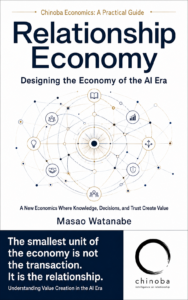
In the Relationship Economy, value is created not through a one-time transaction, but through the continuing relationships formed among people, businesses, regions, and AI.
Yet the Relationship Economy is not merely an abstract theory.
Many regions already possess assets that can serve as its foundation:
- Touchpoints with members
- Merchant networks
- Regional brands
- Purchase and behavioral histories
- Partnerships with local governments, tourism, sports, and transportation
- Trust built with the region over many years
EZOCA, Hokkaido’s regional shared point service, offers an interesting case for thinking about the Relationship Economy.
EZOCA has developed as a system for issuing points.
But its true value does not lie in the points themselves.
It lies in the relationships EZOCA has built across Hokkaido—among people, stores, businesses, and communities.
The opportunity is to evolve EZOCA from a point service into a Regional Intelligence Platform: a platform that understands relationships across Hokkaido and turns them into value.
This vision shows how the Relationship Economy can be put into practice.
Points Are Not Value in Themselves
Point services have long been used as an effective way to encourage customers to return to a store.
Customers purchase goods.
They receive points.
They return to use those points.
This mechanism can certainly help sustain transactions.
Today, however, many companies offer points:
- Retailers
- Credit card companies
- E-commerce platforms
- QR-code payment providers
- Airlines
- Railway operators
It is no longer unusual for consumers to manage and use multiple point programs.
As a result, the simple fact that “you earn points” is no longer enough to create meaningful differentiation.
The important question is not what percentage of points to award.
It is what kind of relationship can be formed between users and their region through points.
In the EZOCA vision, points are not the final goal. They are the starting point for evolving into a broader regional platform.
EZOCA’s True Asset Is Relationships
EZOCA already has a substantial foundation:
- More than 1.4 million members
- A network of approximately 600 participating stores
- Brand recognition across Hokkaido
- A track record of collaboration with local businesses
- Ongoing touchpoints with regional residents
Viewed merely as membership and store counts, these figures may appear to describe the scale of a point business.
From the perspective of the Relationship Economy, however, their meaning changes.
The 1.4 million members are not simply a collection of IDs.
They are people who live, shop, travel, sightsee, attend events, and participate in sports across different parts of Hokkaido.
The 600 participating stores are not simply places where points can be redeemed.
They are touchpoints that support the daily lives of residents, welcome visitors, and sustain local employment and economic activity.
In other words, EZOCA’s real asset is:
the relationships that connect people and stores, people and communities, and businesses with one another.
Understanding, nurturing, and turning these relationships into value for the entire region is at the heart of the Relationship Economy for EZOCA.
From Transaction Data to Understanding Everyday Life
Traditional point systems primarily handle information such as:
- Who made a purchase
- Which store they used
- How much they spent
- How many points were awarded
- When they redeemed points
This is important transaction data.
But it is not enough to understand a person’s life.
Consider a family living in Sapporo.
On weekdays, they buy daily necessities at nearby stores.
On weekends, they watch sports.
During summer holidays, they travel within Hokkaido.
They also participate in local events.
In a conventional system, these activities are managed as separate histories.
For the user, however, all of them are part of a single experience: life in Hokkaido.
If EZOCA can understand these activities as relationships, it can create new possibilities:
- Store use before and after sports events
- Participation in family-oriented local events
- Recommendations that combine tourist destinations with local stores
- Service guidance along travel routes
- New patterns of circulation within the region
The key is to shift the perspective from:
“What did this person buy?”
to:
“How does this person live within the region?”
Representing Regional Relationships Through a Community Graph
To implement the Relationship Economy, relationships must be treated as data.
A Community Graph provides the foundation for doing so.
For example, it can represent the following entities as nodes:
- Residents
- Tourists
- Families
- Participating stores
- Shopping streets
- Local governments
- Sports teams
- Regional events
- Tourist destinations
- Transportation operators
- Healthcare and educational institutions
- AI agents
It can then connect them through relationships such as:
- Lives in
- Used
- Participated in
- Supports
- Operates
- Traveled through
- Stayed at
- Purchased from
- Was recommended by
- Collaborates with
For example, which stores did sports spectators visit after a game?
Which areas did tourists travel through?
Did participation in a local event lead to visits to nearby shopping streets?
A Community Graph makes the flows within a region—previously difficult to see—more understandable.
This makes it possible to evaluate not only point redemption rates, but also:
- Regional circulation rates
- Customer referrals among participating stores
- Length of stay
- Event participation rates
- Tourism spending
- Local consumption
- Ongoing engagement with the region
In the Relationship Economy, value is measured not only by the amount of individual transactions, but also by the value created through relationships across the region.
Understanding the Present Through State Understanding
While a Community Graph represents the structure of relationships across a region, State Understanding identifies the current state of users and the region.
Imagine that a sports event is held on a Saturday.
AI can integrate context such as:
- Event date and time
- Weather
- Expected attendance
- A user’s current location
- Companions
- Transportation congestion
- Crowd levels at nearby stores
- Past usage patterns
- Other local events
- Routes home
It can also infer the user’s goals and intent.
The goal may be to enjoy a sports event with the family.
The intent may be to spend time comfortably before and after the game while also enjoying a meal or shopping.
If the system understands this state, AI does not need to distribute the same coupon to everyone. Instead, it can recommend:
- Family-friendly restaurants to visit before the game
- Travel routes that avoid congestion
- Nearby stores with available capacity
- Events for children
- Services available after the game
- Shopping options along the route home
AI is not simply looking for products with the highest probability of purchase.
It is understanding the user’s current situation within Hokkaido.
Decision AI Determines Value for the Region as a Whole
Traditional marketing AI selects products or coupons that a user is likely to purchase.
In the Relationship Economy, however, optimizing only for individual sales can produce undesirable outcomes for the region as a whole.
For example, directing many users to the same popular store may increase that store’s sales.
But it can also result in:
- Increased congestion
- Fewer visitors flowing to nearby stores
- A poorer user experience
- Lower circulation across the wider region
Decision AI considers not only the benefit to an individual user, but also:
- Customer referrals to participating stores
- Congestion reduction
- Regional circulation
- Tourism experiences
- Participation in local events
- Impact on residents
- Long-term trust
The question therefore shifts from:
“What should we sell to this person?”
to:
“What action will create the greatest value for both the user and the region in this situation?”
In the EZOCA vision, Next Best Action is understood as multidimensional value: not only user satisfaction, but also store visits, regional circulation for local governments, tourism spending, EZOCA’s customer lifetime value, and new sources of revenue.
Operational AI Turns Recommendations into Action
Recommendations alone do not move the regional economy.
They must connect to real services.
Operational AI executes the actions selected by Decision AI.
For example, it can:
- Deliver electronic coupons
- Reserve a store or service
- Register users for events
- Connect users with tourism services
- Adjust transportation guidance
- Redeem points
- Process payments
- Notify responsible staff
What matters to users is being able to use these services as one coherent experience, without having to navigate multiple disconnected systems.
Sports events, dining, shopping, transportation, and tourism should not remain isolated services. They should be connected around a single purpose.
The EZOCA vision similarly points toward linking reservations, coupons, payments, events, MaaS, and tourism through Operational AI to deliver an integrated experience.
Points Become One Form of Incentive
Points do not become unnecessary in the Relationship Economy.
Their role changes.
Traditionally, points have been rewards designed to encourage purchases.
In the Relationship Economy, points can be used as incentives for actions that support desirable outcomes for the region as a whole.
For example, points can be awarded for:
- Visiting less crowded stores
- Participating in local events
- Using public transportation
- Dispersing visits across tourist destinations
- Joining health-related activities
- Participating in local volunteer work
- Supporting small local businesses
In this model, points are not merely discounts.
They are a mechanism for connecting regional goals with individual actions.
The essential point is not to design an economic sphere around points. It is to design around regional relationships and value creation, and then use points as one means of enabling that vision.
From One Company’s Profit to Value Across the Region
In conventional point businesses, ROI is often evaluated through indicators such as:
- Point redemption rates
- Store visit rates
- Average purchase value
- Repeat purchase rates
- Member sales
These metrics remain important.
But in a Regional Intelligence Platform, the scope of evaluation expands to the region as a whole:
- Local consumption
- Tourism spending
- Regional circulation rates
- Length of stay
- Event participation rates
- Participating-store sales
- User lifetime value
- Return visit rates
- Number of partner organizations
- Number of API integrations
The vision document also frames local consumption, tourism spending, circulation rates, length of stay, and event participation as measures of regional ROI—not merely the sales of a single company.
This is a defining characteristic of the Relationship Economy.
Value is not monopolized by one company. It is distributed among multiple participants.
Users receive more convenient and rewarding experiences.
Participating stores gain visitors and sales.
Local governments gain regional revitalization and tourism promotion.
Sports teams strengthen relationships with fans.
Transportation operators benefit from greater travel demand and circulation.
EZOCA gains new revenue opportunities as a platform.
A single relationship foundation can create value for many different stakeholders.
New Revenue Models Beyond Points
As EZOCA evolves into a Relationship Economy platform, its revenue sources can extend beyond the point business itself.
Potential examples include:
- AI service fees
- Regional data analytics services
- Decision-support services for participating stores
- Regional DX support for local governments
- Tourism platforms
- Sports and event collaboration services
- API usage fees
- Joint ventures with partner companies
- Regional marketplaces
The vision document also identifies expansion into revenue sources beyond points, including AI services, regional data analysis, joint ventures, regional DX support, and platforms for tourism and local governments.
This is not simply an extension of the point business.
It is a transition toward a business portfolio built on relationships with the region.
EZOCA Does Not Need to Provide Everything
To realize a Regional Intelligence Platform, EZOCA does not need to develop and operate every service itself.
What matters is creating an environment in which diverse regional stakeholders can participate:
- Participating stores
- Local governments
- Tourism operators
- Sports teams
- Transportation operators
- Healthcare institutions
- Educational institutions
- Universities
- Regional companies
- Financial and energy companies
Each participant’s services and knowledge can be connected through APIs and the Community Graph.
EZOCA does not need to become a company that owns every service.
It can become an orchestrator that connects the participants of the region.
The vision also emphasizes the importance of developing EZOCA as an open platform in which companies, local governments, universities, sports organizations, tourism providers, and transportation operators can participate.
In the Relationship Economy, competitive advantage does not necessarily come from enclosing everything within one company.
It can emerge from a relationship structure in which diverse participants can join and create value together.
Trust Infrastructure Is Essential
Once regional data and services are connected, trust becomes central.
If EZOCA comes to understand residents’ purchases, travel, event participation, and tourism activities, it can provide more useful support.
At the same time, this creates risks of excessive surveillance and inappropriate data use.
The following mechanisms are therefore essential:
- User consent
- Clear disclosure of purposes of use
- Data minimization
- Access controls
- Separation of inference from fact
- User correction rights
- Records of decision rationales
- Human Gates
- Data-use rules among participating organizations
- Decision Trace
For example, if AI directs a tourist to a particular store, it must be possible to explain:
Why was this store selected?
Which data was used?
Whose interests were considered?
Did an advertising contract influence the decision?
What other options were available?
The Relationship Economy must not only be an economy that uses relationships. It must also be an economy that protects them.
Start Small and Evolve Step by Step
A Regional Intelligence Platform does not need to be completed all at once.
The EZOCA vision presents a phased roadmap that builds on existing assets.
Phase 1: Enhancement of the Point Platform
Use existing point, member, and participating-store data to improve user understanding and promotion.
Phase 2: Community Platform
Introduce Community Graph and State Understanding to connect relationships among stores, events, sports, tourism, and other regional activities.
Phase 3: Operational AI
Connect Decision AI’s choices to execution across reservations, coupons, payments, event registration, transportation, and tourism.
Phase 4: Regional Intelligence Platform
Expand participation to include local governments, healthcare, education, finance, energy, and regional companies.
The key is not to replace everything at once, but to evolve gradually by using existing member foundations, participating stores, applications, and regional trust.
This is an implementation principle shared by other Relationship Economy initiatives as well.
New economic ecosystems are not created from nothing.
They are created by discovering existing relationships, reconnecting them, and gradually expanding the circulation of value.
Three Lessons from EZOCA
The EZOCA case reveals three important lessons for the Relationship Economy.
First, redefine the true assets of an existing business.
The assets of a point business are not point-issuance functions. They are members, participating stores, brand recognition, usage histories, and trust with the region.
Second, place relationships—not products or transactions—at the center of the data model.
Connect people, stores, events, tourism, sports, and local governments through a Community Graph.
Third, connect AI decisions to real actions in the region.
Combine State Understanding, Decision AI, and Operational AI into one continuous flow from understanding to execution.
When these three elements come together, a point service can evolve into a regional Relationship Economy.
Conclusion
The future suggested by EZOCA is not about raising point reward rates.
It begins with points, but goes further:
Connecting people and stores.
Connecting residents and communities.
Connecting tourists and regional resources.
Connecting sports and shopping streets.
Connecting local governments and businesses.
And enabling AI to understand these relationships and support appropriate decisions and actions.
This is what a Regional Intelligence Platform can become.
EZOCA has the potential to evolve from a point company into a regional infrastructure company.
The essence of that evolution is not simply expanding its business domains.
It is transforming relationships that already exist across Hokkaido into value for the entire region.
The vision positions EZOCA 2.0 not as a more sophisticated point service, but as Hokkaido’s Regional Intelligence Platform—one that integrates Community Intelligence, Community Graph, Decision AI, and Operational AI.
This is not a story limited to Hokkaido.
Regional point programs.
Sports clubs.
Railway companies.
Shopping streets.
Tourism platforms.
Local-government services.
Any organization that already has ongoing touchpoints with people and communities may have the potential to become a core player in the Relationship Economy.
The important question is not what an organization sells.
It is:
What relationships does it hold, and what circulation of value can it create from those relationships?
Next, I will generalize the EZOCA case and introduce what a Regional Intelligence Platform is, and how it can support regional economic ecosystems.

Chinoba
Intelligence as Relationship
Research Platform
founded by
Masao Watanabe
AI Systems Architecture
Decision Trace
Human–AI Coordination
Algorithmic Governance
Related Research
This topic is part of the Chinoba Knowledge Base.

コメント