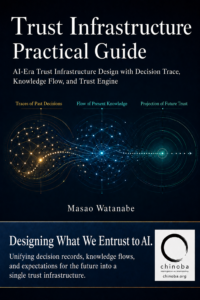
🎥 The YouTube version is also available:
Trust Infrastructure: Building the Foundation for Human–AI Collaboration

Introduction
Generative AI and AI agents are evolving from entities that merely follow human instructions into entities that make judgments, take action, and coordinate with other AIs and people.
In such a society, AI performance alone is not enough.
Between people and AI.
Between AI agents.
Between organizations.
We need an infrastructure that enables each party to trust the others and confidently entrust them with responsibilities.
We call this foundation Trust Infrastructure.
Before discussing it, however, we must first consider what trust is.
Trust Is an Expectation About the Future
In our view, trust is not simply a matter of believing in another party.
Trust is commonly understood as something built through past performance and experience.
“That person has kept promises in the past.”
“That AI has repeatedly given correct answers.”
“This organization has operated safely for many years.”
Such track records are important elements in forming trust.
But the moment when we truly need trust is not in the past.
We need trust at the moment we are about to entrust someone with a role.
Whether assigning work to a person, delegating a task to an AI agent, or collaborating with another organization, we are asking the same question internally:
“Will this party behave as expected, in this situation, right now?”
Trust is this expectation about the future.
Of course, that expectation is not determined by past experience alone.
The environment changes.
Objectives change.
Constraints change.
A decision that was correct yesterday may not be optimal today.
Trust, therefore, is not merely an evaluation of the past. It is a prediction of another party’s future behavior under present conditions.
How, then, does that expectation arise?
What Is Needed to Compute an Expectation?
When we decide to trust someone, we do not look only at their track record.
We also consider:
- the situation in which they were placed;
- the objectives they were pursuing;
- the constraints under which they operated;
- why they made a particular decision; and
- what resulted from that decision.
In other words, what we use to predict the future is not the outcome alone, but the process through which a decision was made.
If we can understand the situation a party faced, what it was trying to achieve, the constraints it considered, the evidence on which it based its judgment, and the action it ultimately selected, we can apply that decision-making mechanism to the present situation and infer:
“Will this party behave as expected in this situation as well?”
Trust Infrastructure seeks to reproduce, on computers, this inference that people make implicitly.
To do so, it requires three capabilities:
- understanding past decisions;
- understanding the current situation; and
- predicting future behavior.
Let us now look at the architecture that realizes these three capabilities.
How to Implement Trust Infrastructure
As we have seen, trust is the prediction that a party will behave as expected under current conditions.
How can this expectation be computed?
At minimum, three capabilities are required:
- Understanding past decisions
- Accurately understanding the current situation
- Predicting future behavior
The Trust Infrastructure we propose realizes each capability through a distinct architecture.
Step 1: Decision Trace Model — Understanding Past Decisions
The starting point of trust is not understanding what was done, but understanding why a decision was made.
For this purpose, ordinary execution logs are not enough.
Each decision must be recorded as a complete decision process consisting of:
- Situation
- Goal
- Constraint
- Context
- Alternatives
- Decision
- Action
- Result
- Feedback
This is the Decision Trace Model.
The Decision Trace Model enables us to treat past decisions not merely as history, but as reusable knowledge.
Step 2: Knowledge Flow — Understanding the Current Situation
Even if past decisions are understood, that alone is insufficient.
The same decision can lead to a different conclusion when the surrounding situation is different.
We therefore need knowledge that enables an accurate understanding of the current situation.
Yet organizational knowledge is distributed across many sources, including:
- design documents;
- standards and procedures;
- contracts;
- operating manuals;
- quality rules;
- meeting minutes;
- Slack; and
- GitHub.
Knowledge Flow transforms these sources through the following progression:
Document
↓
Knowledge
↓
Ontology
↓
Knowledge Graph
↓
Executable Knowledge
It thereby creates a knowledge foundation through which AI can understand and reason about the current situation.
In other words, Knowledge Flow is the knowledge foundation that supports trust.
Step 3: Trust Engine — Predicting Future Behavior
The ultimate purpose of Trust Infrastructure is neither to record the past nor merely to manage current knowledge.
What it must truly achieve is the ability to keep answering this question:
“Will this party behave as expected, in this situation, right now?”
That responsibility belongs to the Trust Engine, the core of Trust Infrastructure.
The Trust Engine integrates the Decision Trace Model and Knowledge Flow to infer expected behavior in the current situation.
First, it analyzes the history of past decisions retrieved from the Decision Trace Model, referring to similar decisions and their outcomes that are relevant to the present situation.
Next, it uses the latest knowledge, rules, policies, organizational state, and external conditions provided by Knowledge Flow to understand the current context.
It then considers:
- Goal
- Constraint
- Policy
- Role
- Context
and infers:
“What decision should be expected in this situation?”
“What action is most likely to follow from that decision?”
The Trust Engine does more than predict. It continuously observes actual execution results and evaluates the difference between expected and actual behavior.
When behavior matches expectations, trust is strengthened.
When a significant gap occurs, the engine analyzes its cause, asking whether:
- knowledge was insufficient;
- the goal had changed;
- constraints had changed;
- a new policy had been introduced; or
- the external environment had changed.
It then feeds the result back into the Decision Trace Model and Knowledge Flow as needed.
Through this cycle, trust becomes not a fixed score but a dynamic relationship that is continuously updated as experience accumulates and conditions change.
The Trust Engine is therefore the core module that realizes a complete reasoning cycle: learning from the past, understanding the present, predicting the future, and learning again from the result.
Components of the Trust Engine
How, specifically, does the Trust Engine compute expectation?
The Trust Engine is not a single algorithm. It consists of multiple functional modules for referring to past decisions, understanding the current situation, predicting future behavior, and learning from outcomes.
For example, it includes the following functions:
- Context Analyzer
Analyzes the current situation, environment, organizational state, and available knowledge to construct the current context. - Decision Trace Retriever
Searches the Decision Trace Model for similar past decisions and retrieves decision histories applicable to the current situation. - Knowledge Integrator
Integrates the knowledge, rules, policies, ontologies, and Knowledge Graph supplied by Knowledge Flow, preparing the knowledge required for reasoning. - Expectation Reasoner
Infers the expected decision and expected action while considering Goal, Constraint, Policy, and Role. - Execution Monitor
Continuously monitors actual execution results and detects deviations from expected behavior. - Trust Evaluator
Evaluates the gap between expectation and actual results, then updates the state of trust. - Learning & Feedback Manager
Creates new Decision Traces and feeds them back into Knowledge Flow, continually improving the accuracy of future reasoning.
These modules do not operate independently. Together, they form a single reasoning loop.
The Trust Engine is thus not merely a “trust-score calculator.” It is a reasoning engine designed to continuously implement, in computing systems, the cognitive process that people perform implicitly: understanding, predicting, evaluating, and learning.
The Overall Trust Infrastructure
As we have seen, Trust Infrastructure is not a single algorithm.
To realize trust as an expectation about the future, three architectures operate in coordination.
First, the Decision Trace Model records past decisions and manages them in a form that makes it possible to understand why those decisions were made.
Next, Knowledge Flow integrates knowledge distributed across the enterprise or organization and provides the knowledge needed to understand the current situation.
At the center, the Trust Engine integrates both to answer the question:
“Will this party behave as expected, in this situation, right now?”
The Trust Engine infers expected behavior from past decisions and current knowledge, then continuously evaluates outcomes and updates trust.
Trust Infrastructure therefore consists of three architectures:
- Decision Trace Model — understanding past decisions
- Knowledge Flow — understanding the current situation
- Trust Engine — predicting future behavior
By working together, these three architectures realize a continuous reasoning process that:
- learns from the past;
- understands the present; and
- predicts the future.
Trust is not an ambiguous concept that must depend solely on human intuition and experience.
It is a reasoning process that forms expectations by connecting past, present, and future—and continuously updates those expectations.
Trust Infrastructure is the architecture for realizing that reasoning process in computing systems.
Conclusion
Trust has long been regarded as something built through human experience and intuition.
But in an era in which autonomous AI collaborates with people, other AI agents, organizations, and society, that is no longer sufficient.
Trust must be explainable.
It must be shareable.
And it must be updatable as conditions change.
Only when these three requirements are met can trust serve as social infrastructure.
In this article, we proposed Trust Infrastructure as a system composed of three architectures:
- understanding decisions through the Decision Trace Model;
- integrating knowledge through Knowledge Flow; and
- reasoning about expectations through the Trust Engine.
The purpose of Trust Infrastructure is not to control AI.
Its aim is to enable people and AI, AI agents and one another, organizations, and society to understand each other’s intentions, decisions, and actions—and to keep answering the question:
“Will this party behave as expected, in this situation, right now?”
Trust Infrastructure is the new social foundation that supports such a world.

Chinoba
Intelligence as Relationship
Research Platform
founded by
Masao Watanabe
AI Systems Architecture
Decision Trace
Human–AI Coordination
Algorithmic Governance
Related Research
This topic is part of the Chinoba Knowledge Base.

コメント