🎥 The YouTube version is also available:
From Optimization to Exploration: Creativity, Autonomy, and Decision Trace in the Age of AI
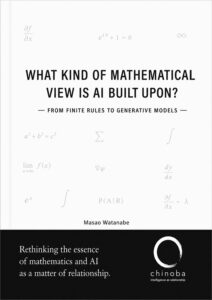
Books: What Kind of Mathematical Worldview Is AI Built Upon?: From Finite Rules to Generative Models

When people discuss operating multiple AI agents, the conversation tends to begin with questions such as: “How many agents should we have?” or “Which model should handle which task?”
But the real challenge is not merely making each individual agent more capable. It is designing how local judgments connect to the system’s overall purpose, constraints, and accountability.
In thinking about this challenge, Indra’s Net, a metaphor from Buddhist thought, and fractals, familiar from mathematics and the natural sciences, offer powerful insights. They may appear to be unrelated concepts, yet both embody the view that parts and wholes cannot be separated. That view is becoming increasingly important in the design of multi-agent systems.
Indra’s Net: Every Jewel Reflects Every Other Jewel
Indra’s Net is described as an immense net that covers the palace of Indra. At every intersection sits a jewel, and each jewel reflects all the others. To look into one jewel is to see every other jewel reflected within it—and within those reflections, countless further jewels.
The metaphor tells us that a whole is not simply an aggregation of many separate things.
An individual entity may appear independent, yet it exists through its relationships with others. A change in one place alters not only its immediate surroundings, but also how the entire net appears. Conversely, the state of the whole is expressed through the behavior of each jewel.
In the language of Huayan thought, this is “one is many; many are one.” The one cannot be separated from the many, and the many do not exist apart from the one.
This does not mean that everything is identical. Each jewel occupies a different position and reflects differently. The point is that difference and interdependence coexist.
Fractals: A Similar Order Appears in Every Part
A fractal is a structure in which similar shapes or rules recur as one zooms in or out. Trees, coastlines, clouds, blood vessels, and broccoli all exhibit patterns of self-similarity, if not perfectly, then at least in an approximate sense.
What matters about fractals is not only their visual fascination. It is that the same generative principles support a large structure across different scales.
The branching of a trunk, a large branch, and a small branch differs in scale, yet each emerges through similar principles. The whole does not need to be commanded centrally down to every detail. Local rules can accumulate into an ordered overall form.
There is an important caveat here as well. A fractal does not mean that every part is a copy of the whole. Each part takes its own form in response to local conditions, while remaining connected to a shared generative rule.
If Indra’s Net expresses mutual reflection, fractals express a generative principle that persists across scales.
Multi-Agent Systems Need More Than Division of Labor
In a multi-agent system, we can separate agents that research, plan, execute, verify, and escalate cases to people.
Such division of labor is necessary. But separating roles alone does not make a system like Indra’s Net or a fractal. It can just as easily produce a collection of components that struggle to work together.
When an execution agent calls an external API, for example, that operation needs at least the following broader context:
- What is the purpose of the operation?
- Which evidence and rules support it?
- Who authorized it, and under what conditions?
- What is the permitted scope of execution?
- Who will verify the outcome, and where will it be recorded?
If this context disappears at the level of a local agent, risky actions and decisions that cannot be explained can occur—even when the system’s stated overall purpose is sound.
This is where the perspective of Indra’s Net becomes useful. No agent needs unlimited knowledge of the entire system. But it must be able to refer to the purpose, evidence, constraints, and accountability to which its own judgment is connected. Each agent’s judgment needs a reflection of the whole.
Knowing the Whole Is Not the Same as Holding All Authority
It is important not to mistake Indra’s Net for a design in which every agent receives access to all information.
In a multi-agent system, the opposite should usually be true. Roles and permissions should be limited. A research agent does not need authority to transfer money, and an execution agent may not need unrestricted access to every customer record.
What is needed is not universal data sharing, but providing the context necessary for a judgment as verifiable references.
For example, an agent may receive not the underlying customer data itself, but references to authorized data, the applicable version of a policy, a hash of the target operation, an execution budget, and the expiry time of an approval.
This allows local agents to act autonomously without being able to silently substitute a different purpose or condition. The connection to the whole is preserved while authority remains minimal.
Fractal Governance: Applying the Same Principles at Different Levels of Detail
From a fractal perspective, the governance of organizations and agents requires principles that recur across scales.
Enterprise-wide AI governance, a departmental workflow, and an individual agent’s tool call operate at different levels of detail. Yet the following questions remain common to all of them:
- What is the purpose?
- What evidence and rules support it?
- Who has authority, and within what limits?
- Under what conditions is the matter handed back to a person?
- How are outcomes recorded, verified, and learned from?
Writing these five points only in an enterprise policy will not make them operational. Conversely, keeping them only inside individual tool calls will not connect them to organizational accountability.
Enterprise principles must flow into departmental operating rules; operating rules must flow into an agent’s execution conditions; and those conditions must be recorded in the Decision Trace for each individual case. From the details, it must also be possible to return to the higher-level principle.
This is not about copying identical rules mechanically. At the policy level, the rule may be: “External communications to customers require approval.” At the execution level, it becomes: “Fix the recipient, content, attachment, and policy version, then revalidate them after approval.” The principle is shared, but its expression and precision change with the level of detail.
The Connections of Indra’s Net and the Boundaries of Fractals
To operate multi-agent systems responsibly, we need to place two designs together.
What Indra’s Net teaches is connection: the ability to trace how an agent’s proposal, judgment, and execution relate to other agents, people, data, rules, and outcomes.
What fractals teach is principles that remain intact across boundaries. Whether at the level of an organization, team, workflow, agent, or tool call, the basic structure of evidence, authority, approval, recording, and verification should not disappear.
If we strengthen connections alone, everything can become too interdependent and accountability can become unclear. If we strengthen boundaries alone, local optimization and silos proliferate, and the overall purpose is lost.
What we need, therefore, is not to connect everything indiscriminately, but to connect things through evidence and accountability.
Five Building Blocks for Implementation
To ensure that these ideas do not remain conceptual, a multi-agent implementation needs at least the following components.
1. Operational Ontology
Represent business concepts, relationships, and preconditions in a form that agents can consult before acting. This is not merely about standardizing words such as “customer,” “contract,” “approval,” and “exception.” It means defining what actions are possible under which conditions.
2. Authorized Data
Use not data that an AI merely considers plausible, but data accompanied by source evidence, scope of application, approver, version, and usage constraints. Each agent should be able to point to the basis for its judgment.
3. Capability Boundaries
Limit, for each agent, the tools it can call, the targets it can affect, the number of actions it can take, the time and monetary budget it can use, and the network destinations it can reach. Autonomy becomes safer not through broad permissions, but through a clearly defined scope of authority.
4. Approval Binding
Bind the object a person reviewed to the object that will actually be executed, for example through hashes. If the content, recipient, policy, or execution conditions change after approval, return the case for reapproval.
5. Decision Trace
Preserve the proposal, the evidence consulted, the rules applied, the approval, the execution, the outcome, and the evaluation as one continuous record. This is more than a log. It is the structure that reconnects a local action to the purpose and outcome of the whole.
Autonomy Does Not Mean Acting in Isolation
Increasing the autonomy of AI agents does not mean separating them from people and allowing them to act however they wish.
Meaningful autonomy in business means understanding one’s permitted scope, consulting the necessary evidence, respecting boundaries that must not be crossed, returning cases to people when exceptions arise, and feeding outcomes back into subsequent decisions.
Indra’s Net dissolves the image of intelligence as something isolated. An individual agent’s judgment does not exist independently of data, rules, people, other agents, and past outcomes.
Fractals show that even without managing every detail from a single center, order can emerge from complexity when shared principles are embedded throughout the system.
The future of multi-agent systems does not lie in simply arranging large numbers of AI agents side by side. It lies in enabling every agent to fulfill its local role while reflecting the overall purpose, evidence, constraints, and accountability of the system.
One is many; many are one.
This phrase may become a principle for a new kind of execution architecture in an AI-powered society—one that is neither centralized control nor ungoverned decentralization.

Chinoba
Intelligence as Relationship
Research Platform
founded by
Masao Watanabe
AI Systems Architecture
Decision Trace
Human–AI Coordination
Algorithmic Governance
Related Research
This topic is part of the Chinoba Knowledge Base.

コメント