🎥 The YouTube version is also available:
Beyond Central AI: Designing Distributed Intelligence for Better Decisions
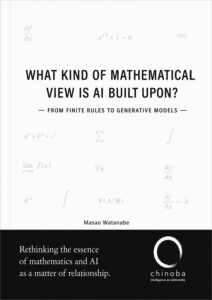
Books: What Kind of Mathematical Worldview Is AI Built Upon?: From Finite Rules to Generative Models

When autumn cloud patterns spread across the sky, they can make us stop and look up. Small formations appear not only in one part of the sky, but repeat at similar intervals far into the distance. No one has placed them one by one. And yet, there is an unmistakable order to them.
This scene brings to mind Rayleigh–Bénard convection. In a thin layer of fluid heated from below, warmer fluid rises while cooler fluid sinks. Once certain conditions are exceeded, what had been scattered motion can appear as a regular circulation of cells. Only simple physical rules operate locally, yet a pattern emerges across the whole system.
Of course, autumn cloud patterns should not be treated as identical to Bénard cells in a laboratory. The atmosphere adds wind, humidity, terrain, and temperature structures at different altitudes. Still, the repeating patterns visible in clouds involve convective structures of ascent and descent, cooling and condensation. That is why autumn clouds offer a useful entry point for thinking about how order can emerge in complex systems through local interaction.
What Bénard Convection Suggests
One important lesson from Bénard convection is that order does not necessarily arise from a central command center.
Part of a fluid warms, becomes less dense, and rises. Through its relationship with the surrounding fluid, a flow develops, while cooler fluid sinks elsewhere. Repeated over time, this creates cells with ascending and descending regions. No element understands that it should create a hexagonal pattern as a whole. Yet when boundary conditions and local interactions align, a stable pattern can emerge across the system.
The essential point is that this order is not static. The cells are circulating. The pattern is sustained through continuous ascent and descent, exchange and complementarity. When conditions change, the cells change in size and form; when instability increases further, the system can move into turbulence.
AI solutions often have a similar character. Business operations are not completed by running a fixed procedure once. Demand, inventory, customers, constraints, human judgment, and exceptions continue to change. What is needed is not an AI at the center that decides everything, but a way to connect local information and authority appropriately so that the whole system can maintain order while learning.
Seeing AI Not as a “Big Brain,” but as a Field Where Decisions Circulate
In conventional AI adoption, expectations often gather around one powerful model or a central dashboard: an AI that calculates the optimal answer and tells the whole organization what to do. This approach can work well when conditions are relatively stable and the objective function is clear.
But real operations contain signals that are visible only locally. In retail, there is customer behavior in front of a shelf. In manufacturing, there may be a subtle vibration in a machine. In a commercial negotiation, there is the tone of a conversation with a customer. In cybersecurity, there is the impact scope specific to an individual device. A design that aggregates all of this at the center before making a decision can become slow and lose context.
Instead, it is useful to design AI as a field in which decisions circulate.
Local AI systems and people contribute observable facts, hypotheses, constraints, and proposals. These move only to the adjacent decision-makers who need them. Decisions with broader consequences rise to higher levels of approval or coordination. The results of execution return to the local level as evidence for the next decision. When this circulation works, optimization of the whole is not the distribution of a single “correct answer.” It is the ongoing practice of balancing local adaptation with overall coherence.
Ideas for Applying This to AI Solutions
1. Retail: Capture the “Circulation of Demand” Emerging Store by Store
Do not treat assortment, replenishment, markdowns, and promotions as separate optimization problems. A store-level AI can make small proposals using weather, time of day, shelf position, inventory, waste, and promotional response. The store manager can add changes in events or customer mix that are visible only on site. Headquarters can identify patterns that may be reusable across stores.
The important point is not for headquarters to send the same answer to every store. It is to circulate, together with its evidence, the conditions under which a locally effective action can transfer to another store. This includes not only success cases but also counterevidence: “This did not work in this store, at this time, under these constraints.” That is how a retail decision loop can balance exploration with exploitation.
2. Manufacturing: Treat Equipment, Processes, and Quality as Cells
In a factory, equipment conditions, material lots, process settings, quality inspections, and maintenance plans influence one another. It is risky for a central monitoring AI to turn an anomaly-like signal from a single machine immediately into an order to stop everything.
Instead, an equipment agent can organize local evidence; a process agent can estimate the effect on work in progress and delivery; and a quality agent can compare the signal with historical defect patterns. Up to a certain threshold, the system can monitor or perform additional measurement. Only after crossing an important boundary should it move toward a shutdown decision that includes human approval. What matters here is not prediction accuracy alone, but clarity about which evidence, under which authority, permits execution to what extent.
3. Commercial Deals and Contracts: View Interdepartmental Friction as a “Heat Source”
Sales wants to protect the opportunity to win the business. Finance wants to protect margin and collection. Legal wants to reduce contractual risk. This is not simply conflict. It is a situation in which decision-makers with different boundary conditions are looking at the same transaction.
In a system such as an AI Deal Desk, AI does not merely decide whether a discount is acceptable. It structures proposed terms, required evidence, unanswered questions, and approval paths. A sales proposal can move to the business owner, finance, and legal at the appropriate level of detail, while each response returns as part of the decision record. The result is that interdepartmental friction becomes not something to eliminate, but a flow of judgment that can shape better terms.
4. Security: Let Speed and Caution Circulate Separately
When a device shows signs of ransomware, speed matters. At the same time, mistakenly stopping a critical system can have a major business impact. Here too, a design that uses one score to decide whether automation may execute is insufficient.
Device-level observation AI, asset criticality management, policy evaluation, an execution gate, and human approval can be designed as cells with different roles. If evidence is strong and the impact scope is limited, the system may initiate a short-lived automatic isolation. If the asset is critical, it can require human approval. If evidence is insufficient, it can move to monitoring and additional verification. This design keeps the decision flow moving while allowing execution only at safe boundaries. It resembles convection that maintains order within a dynamic environment.
Design Principles for “Circulating AI”
To translate this metaphor into implementation, at least five principles are needed.
- Locality: Each AI should have a clear view of the facts and constraints observable near its operational context.
- Boundaries: Separate who may reference, propose, approve, and execute what.
- Exchange: Enable evidence, hypotheses, unanswered questions, and outcomes to move to the people or systems that need them.
- Reversibility: Keep exploration small, time-bounded, and limited in impact so that it can be undone.
- Decision Trace: Make it possible to understand later why a decision was made, by whom, and within what scope.
Without these five elements, connecting many AI systems merely increases the volume of conversation. With evidence, authority, time, and execution outcomes recorded, local experiments can accumulate as organizational knowledge.
What Autumn Clouds Teach Us About the Beauty of AI
Autumn cloud patterns are not a completed still image. They appear as patterns to us amid constant changes in water vapor, temperature, wind, updrafts, and downdrafts. Perhaps they feel beautiful because order and change coexist.
Business AI is the same. Rather than trying to confine everything in one model and predict the future perfectly, it is often stronger—especially in changing environments—to build a system in which local intelligence acts with evidence, connects when necessary, and continues to be corrected by people as well.
AI is not only prediction. It is also a technology for designing the flow through which decisions emerge, are tested, delegated, executed, and returned as learning.
When looking up at autumn clouds, we might see them not merely as a sign of the weather, but as one form of order that is not centrally commanded. That perspective may lead us to design the next AI solution a little differently.
A Note on the Scientific Framing
Bénard convection concerns convective patterns in a fluid layer heated from below; under idealized conditions, regular cells can be observed. Atmospheric clouds involve many additional factors. This article therefore uses autumn clouds and Bénard convection not as scientifically identical phenomena, but as a metaphor for the idea that patterns can emerge through local interaction.
Reference: NOAA Physical Sciences Laboratory, Rayleigh-Benard Cells
https://psl.noaa.gov/outreach/education/science/convection/RBCells.html

Chinoba
Intelligence as Relationship
Research Platform
founded by
Masao Watanabe
AI Systems Architecture
Decision Trace
Human–AI Coordination
Algorithmic Governance
Related Research
This topic is part of the Chinoba Knowledge Base.

コメント