
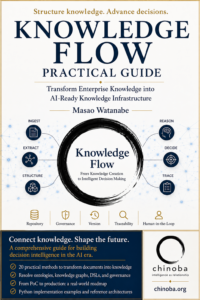
🎥 The YouTube version is also available
Beyond Model Governance: Building Trustworthy AI Through Knowledge Flow


Introduction
The use of generative AI in enterprises is expanding rapidly.
Searching internal documents.
Answering inquiries.
Reviewing contracts.
Creating sales proposals.
Analyzing equipment anomalies.
Supporting management decisions.
AI is beginning to enter a wide range of business operations.
At the same time, many organizations are encountering similar problems:
“AI responses sound natural, but we do not know whether they comply with internal rules.”
“We cannot verify which documents the AI used as evidence.”
“The AI makes decisions based on outdated documents.”
“Different departments receive inconsistent answers.”
“We do not know how much decision-making authority should be delegated to AI.”
These problems cannot be solved through improvements in AI model performance alone.
No matter how capable an AI model becomes, it cannot make decisions appropriate for an organization if the necessary Knowledge does not reach it.
Future AI governance must manage not only the model itself, but also:
- which Knowledge was used;
- where it came from;
- how it was structured;
- which AI received it;
- when it was delivered; and
- under what authority it was accessed.
The foundation for this is Knowledge Flow.
What Is Knowledge Flow?
Enterprises possess enormous amounts of Knowledge:
- policies and manuals;
- contracts;
- design documents;
- meeting minutes;
- customer information;
- manufacturing records;
- past inquiries;
- incident histories;
- laws and industry standards;
- employee experience; and
- the reasoning behind past decisions.
However, the mere existence of this information within an organization does not make it usable by AI.
It is distributed across document management systems, email, chat platforms, databases, file servers, and SaaS applications. Its formats and meanings also differ.
Knowledge Flow is the end-to-end process of collecting this information, transforming it into an understandable form, and delivering it to the decisions where it is needed.
Its basic structure can be represented as follows:
Documents / Data
↓
Ingestion
↓
Extraction
↓
Ontology
↓
Knowledge Graph
↓
Policy / DSL
↓
Knowledge Repository
↓
AI Agent
↓
Decision
↓
Decision Trace
Knowledge Flow is not merely document search or RAG.
It is a mechanism that transforms enterprise information into Knowledge that AI can use for decision-making, while governing both how that Knowledge is used and what decisions result from it.
AI Decisions Are Determined by the Knowledge Delivered to the AI
When an AI response causes a problem, the AI model itself is often the first thing to be questioned.
In enterprise operations, however, the condition of the Knowledge supplied to the model is frequently the real cause.
For example, if a contract review AI receives outdated contractual standards, it may generate a logically consistent answer based on those obsolete standards.
If an AI analyzing manufacturing equipment anomalies does not receive the latest maintenance history, it may classify normal equipment as abnormal or overlook a serious warning sign.
If a sales support AI does not know the history of the organization’s relationship with a customer, it may generate a proposal that does not match the customer’s interests.
In all these cases, the AI model itself may be operating correctly.
The problem is that the Knowledge required for the decision did not flow correctly.
AI governance must therefore monitor more than the final output. It must govern:
- what the AI knew;
- what it did not know;
- which Knowledge it prioritized;
- whether that Knowledge was current;
- whether the AI was authorized to use it; and
- whether it recognized contradictions between different sources.
To govern AI decisions, organizations must govern the flow of Knowledge reaching the AI.
How Knowledge Flow Governance Differs from Traditional Data Governance
Data governance primarily manages factors such as data quality, ownership, access rights, storage locations, and retention periods.
All these factors remain important within Knowledge Flow.
For AI governance, however, they are not sufficient.
AI combines multiple pieces of information, interprets their meaning, performs reasoning, and generates new decisions.
Suppose an organization has the following three documents:
- company-wide contract guidelines;
- exception rules for a specific department; and
- an individual agreement with a particular customer.
Even if each document is properly managed, the AI cannot make the correct decision unless it understands the relationships among them.
Which rule takes precedence?
Under what conditions does the exception apply?
Is the individual agreement still valid?
Who is the final approver?
The organization must govern these meanings and relationships.
Knowledge Flow Governance controls not only the data itself, but also:
- the meanings extracted from the data;
- the relationships among concepts and entities;
- applicable rules;
- conditions of applicability; and
- how the Knowledge is used in decision-making.
Seven Elements of AI Governance Based on Knowledge Flow
1. Knowledge Source Management
The first requirement is to manage the sources of Knowledge.
For every piece of Knowledge used by AI, the organization should clarify:
- who created it;
- who is responsible for managing it;
- when it was created or updated;
- whether it remains valid;
- which business processes may use it;
- how sensitive it is; and
- whether it takes precedence over other information.
Knowledge whose source is unclear should not be used for important decisions.
Knowledge Flow associates every piece of information with its provenance and accountable owner.
2. Ingestion Governance
Ingestion is the stage at which information from across the enterprise is brought into the Knowledge Flow.
This stage involves more than simply collecting files. It must govern:
- what information is ingested;
- how frequently it is updated;
- who may access it;
- whether it contains personal data;
- whether it contains confidential information;
- how long it is retained; and
- under what conditions it is deleted.
Giving all available information to AI is not the objective.
Only the information required by the AI should be ingested, under appropriate authority and for a defined purpose.
Collecting information without a clear purpose does not create governance. It merely accumulates new risks.
3. Extraction Validation
When Knowledge is extracted from documents, an LLM may misinterpret the content.
For example, it may:
- extract an obligation as a recommendation;
- omit an exception condition;
- misidentify an old date as the current expiration date;
- confuse the person responsible with the person authorized to approve; or
- generate a relationship that is not stated in the source document.
The extraction result must therefore retain a reference to the original source.
Knowledge used for important decisions may also require human review or validation by multiple models.
Extracted Knowledge must not automatically be registered as fact without verification.
4. Semantic Alignment Through Ontology
Different departments often use different terminology.
“Customer,” “member,” and “user.”
“Case,” “project,” and “sales opportunity.”
“Approval,” “confirmation,” and “authorization.”
Different terms may refer to the same thing, while the same term may be used with different meanings.
An Ontology defines the concepts and relationships used within the enterprise.
It enables AI to understand:
- which terms represent the same concept;
- which concepts are distinct;
- which concepts are broader or narrower;
- who holds which role; and
- which rules apply in a particular state.
An Ontology gives AI an organization-specific worldview.
In AI governance, changes to the Ontology must also be governed. If the definition of a concept changes, AI decisions may change with it.
5. Relationship Management Through a Knowledge Graph
Enterprise decisions rarely depend on a single document.
They are formed through relationships among multiple elements, such as customers, contracts, products, employees, policies, past decisions, and risks.
A Knowledge Graph represents these relationships.
For example:
Customer
↓ has a contract for
Product
↓ governed by
Maintenance Terms
↓ exception approved by
Responsible Manager
By following these relationships, AI can understand context that cannot be obtained through textual similarity alone.
However, an incorrect relationship in the graph may cause the entire reasoning process to fail.
A Knowledge Graph must therefore manage:
- the evidence supporting each relationship;
- creation time;
- validity period;
- confidence level;
- approval status;
- source references; and
- update history.
6. Executable Rules Through Policy and DSL
If enterprise rules exist only as natural-language documents, AI may not apply them consistently.
Important rules should therefore be structured as Policy or expressed in a domain-specific language, or DSL.
Examples include:
- Payments of one million yen or more require approval from a department head.
- Personal information must not be transmitted to an external AI service.
- Changes to contractual terms require legal review.
- Equipment may be stopped automatically when required for safety.
- High-risk cases must be sent to a Human Gate.
Representing rules in a DSL makes it possible to validate, test, and consistently apply them at runtime.
Combining natural-language Knowledge with executable Policy allows organizations to achieve both flexible understanding and reliable control.
7. Recording Knowledge Use Through Decision Trace
Knowledge Flow Governance must do more than organize Knowledge. It must also record how that Knowledge was used.
A Decision Trace records information such as:
- the purpose of the decision;
- the Context at the time of the decision;
- the Knowledge referenced;
- the Policies applied;
- the alternatives considered;
- the reasoning generated by the AI;
- human approval or modification;
- the action executed;
- the result of that action; and
- subsequent evaluation.
This makes it possible to trace why an AI made a particular decision when a problem occurs.
It also allows organizations to identify problems within the Knowledge itself. If the same Knowledge repeatedly contributes to incorrect decisions, that Knowledge can be reviewed and corrected.
Decision Trace is not only a mechanism for accountability. It is also a feedback mechanism for improving Knowledge Flow.
RAG Alone Does Not Constitute AI Governance
Many enterprises currently use RAG to provide internal documents to AI.
RAG is an important technology. However, merely retrieving documents and passing them to an LLM does not provide sufficient AI governance.
The retrieved documents may not be current.
Multiple documents may contradict one another.
The priority among documents may be unclear.
An applicable exception may be defined in a different document.
Furthermore, a retrieved passage may not apply to the current user or business situation.
A governed Knowledge Flow evaluates more than document similarity. It considers:
- validity;
- authority;
- scope of applicability;
- relationship to the current Context;
- consistency with Policy;
- conflicts among information sources;
- the user’s access rights; and
- the potential effect on the decision.
If RAG is a mechanism for finding relevant text, Knowledge Flow is a mechanism for delivering trustworthy Knowledge to a decision.
Knowledge Also Requires Trust
Not all Knowledge should be treated equally.
An officially approved policy does not have the same reliability as an individual employee’s note.
Data updated yesterday must be treated differently from a document created five years ago.
Information verified by multiple experts must also be distinguished from information that was merely extracted automatically by AI.
Each piece of Knowledge should therefore be evaluated for Trust.
Possible evaluation criteria include:
- reliability of the information source;
- authority of the creator;
- approval status;
- last update time;
- consistency with other information;
- extraction accuracy;
- contribution to past decisions;
- clarity of its scope of applicability; and
- traceability to supporting evidence.
AI should prioritize Knowledge with a high level of Trust.
If only low-trust Knowledge is available, the system should lower the confidence of its answer, request additional information, or send the decision to a Human Gate.
This approach assigns Trust not only to the AI, but also to the Knowledge the AI uses.
Knowledge Freshness Changes the Level of AI Autonomy
Enterprise Knowledge changes over time.
Laws are amended.
Internal policies are updated.
Contracts expire.
Responsible personnel change.
Product specifications are revised.
Customer circumstances evolve.
When Knowledge becomes outdated, an AI decision that was previously correct may no longer be appropriate.
Knowledge Flow must therefore monitor Knowledge freshness.
If critical Knowledge has expired, the system may automatically reduce the AI’s level of autonomy.
For example, if the latest contract review standards cannot be confirmed, the AI should not automatically approve a contract. It should only provide a recommendation.
If equipment maintenance records have not been updated, the AI may refrain from automatically stopping the equipment and instead alert the responsible employee.
Linking the state of Knowledge to the AI’s execution authority improves safety.
Runtime Governance Through Knowledge Flow
Reviewing an AI system before deployment is not sufficient governance.
Knowledge and Context must also be evaluated at the moment the AI makes a decision.
A runtime process could operate as follows.
1. Confirm the Purpose
Determine what the AI is attempting to accomplish.
2. Collect the Context
Obtain relevant information about the user, business process, current state, time, location, authority, and risk.
3. Retrieve the Knowledge
Retrieve the Knowledge required for the decision from the Knowledge Graph or Knowledge Repository.
4. Evaluate Knowledge Trust
Assess the source, freshness, approval status, and presence of contradictions.
5. Apply Policy
Identify the rules, constraints, and Boundaries that apply to the current Context.
6. Evaluate Decision Readiness
Determine whether essential Knowledge is missing and whether the AI is authorized and sufficiently informed to make the decision independently.
7. Execute or Escalate to a Human Gate
If trustworthy conditions are satisfied, execute the action. If uncertainty or risk is high, return the decision to a human.
8. Record the Decision Trace
Record the Knowledge used, reasoning, action, and result.
Through this mechanism, AI governance evolves from a static checklist into Runtime Governance that operates continuously during actual decision-making.
Manufacturing Example
Suppose an anomaly is detected in a manufacturing system.
A conventional AI system might determine whether the equipment is abnormal based on patterns in sensor data.
An AI supported by Knowledge Flow would also examine:
- equipment design information;
- the current product and production conditions;
- past failure history;
- recent maintenance records;
- previous responses to similar anomalies;
- safety standards;
- conditions requiring production shutdown; and
- the authority of the person responsible for the site.
If the AI proposes automatically stopping the equipment, the Policy Engine checks the safety rules applicable to that equipment and anomaly level.
If the anomaly presents a serious safety risk, the system stops the equipment automatically.
If the impact is limited, it requests confirmation from the responsible employee.
If maintenance records are incomplete, it suspends autonomous decision-making.
After the decision, the Knowledge consulted and the reason for the shutdown are recorded in the Decision Trace.
With this structure, the AI decision becomes more than pattern recognition. It becomes a decision grounded in enterprise Knowledge and safety Policy.
Contract Review Example
For contract review AI, Knowledge Flow integrates information such as:
- standard contractual terms;
- legal department review criteria;
- similar contracts from the past;
- existing agreements with the customer;
- individually approved exceptions;
- current laws and regulations;
- contract value;
- risk classification; and
- approval authority.
If the contract falls within standard terms, the risk is low, and the latest review criteria have been confirmed, the AI can automatically prepare a review result.
If the contract deviates from standard terms, it is sent to a legal specialist.
Even if a similar exception exists in a past case, the AI should not automatically apply it to the current contract. It must first verify whether the conditions for that exception are satisfied.
The Decision Trace records which clauses the AI identified as problematic and which policies or previous cases it referenced.
This makes it possible to improve review efficiency while maintaining accountability.
The Relationship Between Knowledge Flow and the Trust Engine
Knowledge Flow and the Trust Engine complement one another.
Knowledge Flow delivers the Knowledge required for AI decision-making.
The Trust Engine evaluates the expected future outcome based on the combination of Knowledge, AI, Context, and action.
For example, the Trust Engine lowers its Trust evaluation when:
- required Knowledge is missing;
- information is outdated;
- multiple rules conflict;
- information sources are unreliable; or
- the same Knowledge has previously contributed to an incorrect decision.
When Trust decreases, the system limits AI autonomy and requires human approval.
Conversely, when trustworthy Knowledge is available, Policy is clear, and past decision performance has been stable, the system can authorize autonomous execution within a limited Boundary.
The relationship can be expressed as follows:
Knowledge Flow
↓
Contextual Understanding
↓
Trust Evaluation
↓
Autonomy Control
↓
Decision and Action
↓
Decision Trace
↓
Knowledge Flow Improvement
Knowledge Flow supports Trust.
Trust determines the appropriate level of AI autonomy.
Decision Trace improves Knowledge Flow.
This cycle creates dynamic AI governance.
The Future of AI Governance
AI governance has traditionally focused on the AI model.
Which model is being used?
Are there problems with the training data?
Does the model exhibit bias?
Has it passed safety evaluations?
These questions will remain important.
However, the decisions made by AI in real enterprise environments are not determined by the model alone.
They are also shaped by:
- organization-specific Knowledge;
- the current Context;
- applicable Policy;
- relationships with other AI systems; and
- human approval.
Future AI governance must therefore be designed as:
Model Governance
+
Data Governance
+
Knowledge Governance
+
Decision Governance
+
Runtime Governance
Knowledge Flow runs through the center of all these governance domains.
Conclusion
Governing AI does not mean merely monitoring its outputs.
It means governing:
- what the AI knew;
- how it interpreted that Knowledge;
- which rules it applied; and
- why it made a particular decision.
To achieve this, organizations need a Knowledge Flow that transforms enterprise information into Knowledge that AI can use safely and delivers that Knowledge to the appropriate decision.
Knowledge Flow creates a continuous cycle that:
- clarifies the provenance of Knowledge;
- structures meaning and relationships;
- evaluates freshness and reliability;
- applies Policy and Boundaries;
- delivers only the necessary Knowledge to AI;
- records the reasoning behind decisions as Decision Traces; and
- improves Knowledge based on real-world outcomes.
The central question for future AI governance will not simply be:
“Which AI model are you using?”
A more important question will be:
“Which Knowledge reached the AI, through what pathway, and under what governance controls?”
Models are not the only factor that changes AI decisions.
The Knowledge flowing into AI changes them as well.
That is why the essence of AI governance is not to stop AI, but to design a trustworthy Knowledge Flow.


Chinoba
Intelligence as Relationship
Research Platform
founded by
Masao Watanabe
AI Systems Architecture
Decision Trace
Human–AI Coordination
Algorithmic Governance
Related Research
This topic is part of the Chinoba Knowledge Base.


コメント