
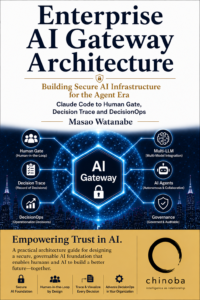
The following books are recommended references for Enterprise AI Gateway design and implementation.

When introducing generative AI into enterprise systems, many organizations begin with a chatbot that searches internal documents and answers questions.
However, once they move toward real-world operations, several challenges quickly emerge:
- Who is allowed to search and reference which documents?
- Can the evidence used in an answer be verified afterward?
- Can document search, business APIs, and workflows be connected securely?
- Can the organization maintain governance as models, tools, and data sources increase?
- Can it balance quality and cost without relying exclusively on high-end models?
A promising approach is an Enterprise AI Gateway + RAG architecture centered on Amazon Bedrock. It can then be extended to GraphRAG when an organization needs to handle relationships, dependencies, impact analysis, and causality that are difficult to address through document similarity search alone.
What Is Amazon Bedrock?
Amazon Bedrock is a fully managed AWS service for using multiple foundation models through a unified interface.
Rather than building and operating separate model-serving environments, applications can use APIs to access LLMs, embedding models, reranking models, Guardrails, Knowledge Bases, and other capabilities.
Its model ecosystem includes Anthropic Claude, Amazon Nova, Amazon Titan, Cohere, Meta Llama, Mistral AI, and others.
The important point is that Amazon Bedrock is not simply an API for invoking LLMs. For enterprise use, it should be viewed as an AI application platform that encompasses RAG, access control, auditing, guardrails, evaluation, and agent integration.
Why an Enterprise AI Gateway Is Needed
When AI is incorporated into business operations, an LLM alone is not sufficient.
For example, an AI assistant in a manufacturing or engineering organization may need to:
- Search design standards, work procedures, quality regulations, and maintenance records
- Retrieve product configurations, parts, projects, and change histories through business APIs
- Investigate defect reports, inspection records, and customer requirements across multiple sources
- Draft technical responses, change requests, and reports
- Ensure that important changes and external responses are executed only after human approval
If every AI application connects directly to each business system, authentication, authorization, auditing, API specifications, and endpoint management become fragmented. Governance becomes increasingly difficult as the number of AI applications and connected systems grows.
This is where a Gateway should be placed between AI and enterprise resources.
flowchart TD
    U["User"] --> A["AI Application / Agent"]
    A --> G["Enterprise AI Gateway"]
    G --> K["RAG / GraphRAG"]
    G --> B["Bedrock Models"]
    G --> T["Business APIs / Lambda / SaaS"]
    K --> S["S3 / Documents and Data"]
The Gateway becomes the boundary that centrally controls what AI can search, which tools it can execute, and under whose authority it acts.
Amazon Bedrock AgentCore Gateway
Amazon Bedrock AgentCore Gateway is a fully managed AI Gateway that consolidates access to agents, tools, other agents, and LLMs behind a single secure endpoint.
Existing REST APIs, OpenAPI specifications, and Lambda functions can be exposed to agents as MCP-compatible tools through the Model Context Protocol.
Its key responsibilities include:
- Exposing APIs and Lambda functions as AI tools
- Standardizing tool discovery and invocation through MCP
- Authenticating users and agents that access the Gateway
- Safely handling credentials from the Gateway to each business tool
- Centralizing logs, audits, and observability for tool usage
- Helping agents select contextually appropriate tools from a large number of available tools
A Gateway is not a mechanism for allowing AI to execute anything without restriction. It is a mechanism for exposing only approved capabilities under business authorization, human approval, and traceability controls.
The Basic RAG Architecture
RAG, or Retrieval-Augmented Generation, is an approach in which an AI system first retrieves relevant enterprise knowledge and then generates an answer based on that retrieved evidence.
A typical process is as follows:
- Store documents in Amazon S3 or another repository.
- Split documents into meaningful chunks.
- Convert each chunk into an embedding vector.
- Retrieve candidate chunks through vector search and metadata filters.
- Rerank the candidates when necessary.
- Provide the retrieved evidence and the user question to an LLM.
- Return an answer together with citations to the source material.
Amazon Bedrock Knowledge Bases makes it possible to build managed ingestion, indexing, retrieval, answer generation, and citation capabilities. In addition to S3, it can use sources such as SharePoint, Confluence, Google Drive, and OneDrive.
In RAG, Knowledge Boundaries Matter More Than the Model
Model selection often receives the most attention in RAG projects. However, accuracy and safety are more strongly affected by the following design decisions:
- How documents are chunked
- Whether original text, headings, versions, authors, and effective dates are retained
- Whether classifications such as public, internal-only, confidential, and prohibited-for-AI-use are defined
- Whether search results are filtered according to user permissions
- Whether every answer includes citations
- Whether the system can respond with “I do not know” when evidence is insufficient
For example, when design standards, quality regulations, work procedures, and technical reports are registered in a RAG system, each chunk should carry metadata such as the following:
{
  "document_id": "design-standard-2026-10",
  "title": "Equipment Design Standard",
  "section": "Temperature Monitoring for Rotating Machinery",
  "version": "3.2",
  "effective_from": "2026-10-01",
  "classification": "internal",
  "ai_use": "allowed",
  "allowed_roles": ["engineering", "quality"],
  "product_family": "rotating_equipment",
  "source_url": "s3://example/standards/design-standard-v3.2.pdf"
}
With this design, RAG becomes more than similarity search. It becomes knowledge access governed by both authorization and evidence.
Using Bedrock Knowledge Bases Through a Gateway
Amazon Bedrock Knowledge Bases can be exposed as a target through AgentCore Gateway. MCP-compatible agents can then invoke the Knowledge Base as a standard tool.
In addition to Retrieve, which returns direct search results, AgenticRetrieveStream can perform multi-step retrieval and return evidence-grounded answers.
| Layer | Primary responsibility |
|---|---|
| AI application | Conversation, user interface, user experience |
| Gateway | Authentication, tool exposure, connectivity, auditing |
| Knowledge Base | Document retrieval, access control, search, citations |
| LLM | Question understanding and evidence-grounded answer generation |
| Human approval | Important actions, exception handling, final accountability |
Selecting Models for RAG: Claude Haiku, Sonnet, Embeddings, and Reranking
RAG does not require the highest-performing model for every interaction. Separating workloads and selecting models by task is essential for balancing cost and quality.
Use Claude Haiku as the Default for Routine Answers
For high-volume internal questions, procedure guidance, specification checks, and simple summaries, Claude Haiku is a strong first choice.
Haiku is well suited to low-latency, cost-efficient, high-volume workloads such as classification, summarization, information extraction, and routine RAG responses.
The following tasks can often be handled sufficiently by Haiku:
- Guiding users to relevant sections of design standards or work procedures
- Providing citation-backed answers about quality regulations
- Classifying inquiries and defect reports
- Extracting fields from inspection records
- Summarizing meeting minutes and work reports
- Drafting technical responses and reports
Reserve Claude Sonnet for Complex Comparison and Decision Support
Claude Sonnet-class models are better suited to situations that require integrating multiple pieces of evidence and carefully handling conditions and exceptions.
- Comparing design standards, customer specifications, and contract requirements
- Preparing investigation reports from lengthy technical documents and failure histories
- Organizing the impact of a change request on quality, safety, and maintenance
- Planning an agent’s use of multiple tools
- Preparing decision materials for managers and technical leaders
Routine FAQs, procedures, and specification checks
  → Haiku + RAG

Comparison of multiple regulations, long-document analysis, and impact assessment
  → Sonnet + RAG

Design changes, procurement, external communications, and configuration changes
  → LLM provides recommendations only
  → Execute only after Gateway authorization and human approval
Bedrock pricing varies according to the model, input and output token volume, region, and inference method. Output tokens can become especially expensive, so applications should avoid generating unnecessarily long responses. Pricing should be estimated using the official pricing page and AWS Pricing Calculator during implementation.
Start with Titan Text Embeddings V2 for Embeddings
For enterprise-document RAG that includes Japanese, Amazon Titan Text Embeddings V2 is a practical starting point.
Titan Text Embeddings V2 is available in the Tokyo Region and supports 256, 512, and 1024 dimensions. A sensible approach is to begin with approximately 512 dimensions and then adjust based on retrieval quality, storage requirements, and cost.
For environments centered on multilingual documents, where retrieval quality across languages is particularly important, Cohere Embed Multilingual is also worth evaluating.
Improve Retrieval with Reranking
When improving RAG quality, adding reranking is often more effective than immediately switching to a more expensive generation model.
Reranking reorders the top retrieved candidates according to their relevance to the question, narrowing the evidence passed to the LLM. In the Tokyo Region, Amazon Rerank 1.0 and Cohere Rerank 3.5 are available.
Extending RAG to GraphRAG
Conventional RAG is effective at finding text that is similar to a question. However, it can struggle with questions such as:
- What is the relationship between an equipment anomaly and past design changes or maintenance records?
- What is the impact scope across customer requirements, design specifications, part configurations, and inspection records?
- Which processes, parts, change histories, and response records are associated with a quality issue?
- Which evidence and approvals led to a particular decision and action?
GraphRAG is effective in these cases.
GraphRAG stores not only the semantic similarity of document chunks, but also entities and relationships extracted from documents as a graph.
flowchart LR
    Q["Question"] --> V["Vector Search"]
    Q --> G["Graph Traversal"]
    V --> C["Evidence Chunks"]
    G --> R["Entities and Relationships"]
    C --> L["Evidence-Grounded LLM Answer"]
    R --> L
For example, GraphRAG can represent relationships such as:
Equipment A ──has component──> Bearing B
Bearing B ──experienced failure──> Overheating
Design Change C ──affects──> Bearing B
Maintenance Record D ──confirmed──> Overheating
Approval E ──approved──> Design Change C
This allows a system answering the question, “Tell me about bearing overheating,” to retrieve not only documents containing the word “overheating,” but also related equipment, components, design changes, maintenance history, and approval history.
Amazon Bedrock Knowledge Bases supports GraphRAG with Amazon Neptune Analytics. During document ingestion, the system can chunk documents, generate embeddings, extract entities and relationships, and store them as a graph.
When to Introduce GraphRAG
GraphRAG is not required for every RAG application from the outset.
For a simple FAQ or search over a single procedure manual, conventional RAG is often sufficient. GraphRAG provides greater value when the target domain involves causality, configuration, dependencies, impact scope, or approval history across multiple documents and systems.
| Question | Recommended approach |
|---|---|
| Find the relevant section of a work procedure or regulation | RAG |
| Confirm the latest version of a design standard | RAG + metadata filtering |
| Find similar defect or failure records | RAG + reranking |
| Analyze the impact of a design change on equipment, parts, and maintenance | GraphRAG |
| Trace the evidence, approval, and execution history behind a decision | GraphRAG + audit logs |
| Analyze knowledge and operational dependencies across departments | GraphRAG |
Recommended Initial Architecture
| Area | Initial recommendation |
|---|---|
| Document storage | Amazon S3 |
| Document retrieval | Amazon Bedrock Knowledge Bases |
| Embeddings | Titan Text Embeddings V2 |
| Reranking | Managed reranking or Amazon Rerank 1.0 |
| Routine answers | Claude Haiku |
| Complex analysis | Conditional escalation to Claude Sonnet |
| AI integration boundary | Amazon Bedrock AgentCore Gateway |
| Authentication and authorization | IAM, OAuth, Cognito, and related controls |
| Auditing | CloudWatch, CloudTrail, and application audit logs |
| GraphRAG | Amazon Neptune Analytics |
| Operational actions | Human approval, idempotency keys, execution receipts |
Implementation Principles
- Separate retrieval from execution
RAG and GraphRAG should provide evidence. Business actions should be executed through a separate path only after authorization checks and approval. - Evaluate evidence, not only answers
Do not evaluate only whether an answer sounds plausible. Evaluate whether the correct sources, relationships, and versions were retrieved. - Enforce document and relationship boundaries through metadata
Apply classification, confidentiality, authorization, and AI-use permissions as filters during retrieval and graph traversal. - Use a cost-efficient model by default, and escalate only when needed
Use Haiku as the standard model, escalating only complex comparison, reasoning, and planning tasks to Sonnet. - Introduce GraphRAG where relationships create value
Start by validating value with conventional RAG, then extend GraphRAG to impact analysis, configuration management, and decision traceability. - Record receipts for important actions
Keep a record of who searched which evidence, when they searched it, which model produced which proposal, who approved it, and what was ultimately executed.
Conclusion
The essence of enterprise AI with Amazon Bedrock is not simply invoking an LLM.
What matters is connecting organizational knowledge, business tools, human approval, authorization, and auditing within secure boundaries.
A practical first step is to combine S3, Bedrock Knowledge Bases, Titan Embeddings, Claude Haiku, and AgentCore Gateway to implement RAG. Then, extend the areas where understanding relationships and impact scope matters into GraphRAG using Neptune Analytics.
The objective is to evolve from an AI system that merely answers questions into an evidence-grounded knowledge and decision-making infrastructure—one that protects permissions and connects AI safely to human judgment.


Chinoba
Intelligence as Relationship
Research Platform
founded by
Masao Watanabe
AI Systems Architecture
Decision Trace
Human–AI Coordination
Algorithmic Governance
Related Research
This topic is part of the Chinoba Knowledge Base.


コメント