🎥 The YouTube version is also available:
Can Mathematics Create Randomness? From Probability to Decision in Generative AI
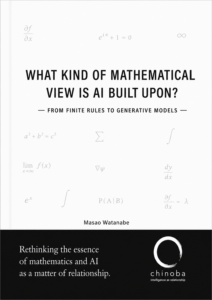
Books: What Kind of Mathematical Worldview Is AI Built Upon?: From Finite Rules to Generative Models

Thinking about probability leads to one fundamental question.
Does creating something random through mathematics mean creating something non-deterministic from a deterministic world?
Ordinarily, mathematical formulas are deterministic.
For example, given the function
\[ y = f(x) \]
the same input x always produces the same output y
\[ x \rightarrow f(x) \rightarrow y \]
There is no ambiguity in this.
However, the situation changes when we deal with probability.
When we roll a die, we do not know in advance which number from 1 to 6 will appear.
When we ask an AI to generate text, different sentences may be produced from the same prompt.
So where does this “unknowability” come from?
Adding a Random Element to a Deterministic Function
A probabilistic system can be represented, in simplified form, as follows:
\[ y = f(x, \omega) \]
Here, x is the ordinary input, and \( \omega \) is a random element.
In other words, the structure is not
\[ x \rightarrow y \]
but rather
\[ (x, \omega) \rightarrow y \]
The important point is that once \( \omega \) is fixed, the function f itself can be completely deterministic.
For example, consider a uniform random variable:
\[ U \sim \mathrm{Uniform}(0,1) \]
Now define:
\[ X = \begin{cases} 1 & U < 0.7 \\ 0 & U \ge 0.7 \end{cases} \]
Then:
\[ P(X = 1) = 0.7 \]
This allows us to create a random variable that “takes the value 1 with a probability of 70%.”
But this raises a deeper question.
Where does U come from?
Is Computer Randomness Truly Random?
We use random numbers in computers every day.
However, in many cases, they are not random numbers in the strict sense.
They are pseudorandom numbers.
In simplified form, the next value may be generated through a calculation such as:
\[ u_{n+1} = g(u_n) \]
Once the initial value—the seed—is determined, the subsequent sequence is also determined.
That is:
\[ \text{Seed} \rightarrow \text{Deterministic Algorithm} \rightarrow \text{Pseudo-Random Sequence} \]
If the same seed is given, the same sequence of random numbers can be reproduced.
This is extremely useful in scientific computing and AI experiments.
Philosophically, however, it is strange.
We call it “random,” yet in reality everything has already been determined.
In other words, genuine non-determinism has not emerged from deterministic computation alone.
Does Mathematics Create Randomness?
At this point, we need to slightly change the way we view probability.
Mathematical probability theory does not necessarily generate randomness itself.
In probability theory, a probability space is generally represented as:
is the set of all possible worlds or outcomes.
\[ (\Omega, \mathcal{F}, P) \]
\( \Omega \) \( \mathcal{F} \) is the set of events that can be observed within those worlds.
And P assigns probabilities to those events.
Viewed from another perspective, this structure can be understood as introducing into mathematics a set of possibilities concerning:
“Which world will be realized?”
Once a particular \( \omega \in \Omega \) is selected,
\[ y = f(x, \omega) \]
is determined.
Thus, the structure becomes:
\[ \text{Deterministic Rule} + \text{Random Choice} \rightarrow \text{Stochastic System} \]
What is truly mysterious here is not the formula itself.
It is Choice.
Where Does “Choice” Come From?
When we pursue this question fully, it goes beyond probability theory.
If we assume that the world itself is completely deterministic, we might represent the entire universe as a vast state
\[ S_{t+1}=F(S_t) \]
If the present state were known perfectly, the next state would also be determined.
In that case, the result of a die roll, a human decision, a computer-generated random number, and even the text produced by an AI would ultimately all be part of this vast state transition.
What we call “randomness” may simply mean that
we are unable to observe all of its causes.
On the other hand, if we assume that irreducible non-determinism exists in the world itself, the structure changes.
Rather than:
\[ S_{t+1}=F(S_t) \]
we have:
\[ S_t \rightarrow P(S_{t+1}\mid S_t) \]
The current state does not uniquely determine the next state.
Instead, it determines a probability distribution over possible next states.
And from among them, one reality is realized.
This distinction is profound.
AI Has the Same Structure
This question is also highly relevant to today’s generative AI.
In greatly simplified form, an LLM calculates:
\[ P(\text{next token}\mid\text{context}) \]
Suppose the text is:
AI will change the …
The model does not determine only one next word. Instead, it produces a probability distribution such as:
\[ \begin{aligned} P(\text{world}) &= 0.30 \\ P(\text{way}) &= 0.20 \\ P(\text{future}) &= 0.15 \\ P(\text{industry}) &= 0.10 \\ &\vdots \end{aligned} \]
Up to this point, if the model parameters, input, and computational conditions are fixed, the process can basically be understood as deterministic computation.
The interesting part comes next:
\[ \text{Probability Distribution} \rightarrow \text{Sampling} \rightarrow \text{Actual Token} \]
One token is selected from the probability distribution.
That selected token becomes part of the next context, and a new probability distribution is calculated.
\[ \text{Context} \rightarrow P \rightarrow \text{Choice} \rightarrow \text{New Context} \rightarrow P \rightarrow \text{Choice} \rightarrow \cdots \]
Generative AI creates text through the repetition of this process.
Probability and Decision Are Not the Same
This reveals a very important distinction.
Probability and Decision are not the same thing.
A probability distribution represents:
“What may happen,” and
“How likely each possibility is.”
But this alone does not determine
“What should actually be done.”
For example, even if an AI evaluates:
\[ P(A) = 0.7,\quad P(B) = 0.2,\quad P(C) = 0.1 \]
it does not necessarily follow that
“Therefore, it is permissible to execute A.”
Especially in enterprises, healthcare, finance, public systems, and Physical AI, the most probable option may differ from the option that should be authorized for execution.
There is an important boundary here:
\[ \text{Probability} \neq \text{Decision} \]
An AI calculating probabilities and an AI having Decision Authority over the real world are fundamentally different matters.
AI Creates Possibilities; Decision Selects Reality
From this perspective, the role of AI systems can be organized more clearly.
AI presents possibilities through:
\[ \text{Context} \rightarrow \text{Probability Distribution} \]
In other words, it generates Signals.
But in the real world, a separate process is required afterward:
\[ \text{Signal} \rightarrow \text{Evaluation} \rightarrow \text{Decision} \rightarrow \text{Execution} \]
Here, Decision differs from mere probabilistic sampling.
It is an act that incorporates Policy, Authority, Boundary, Human Judgment, Responsibility, and other considerations in order to
determine which of several possibilities will be executed as reality.
Rule, Possibility, and Choice
If we simplify the discussion so far, an interesting structure emerges:
\[ \boxed{ \text{Rule} + \text{Possibilities} + \text{Choice} \rightarrow \text{Realized Event} } \]
Rule defines what is possible.
Possibilities are the multiple futures that exist within those rules.
Probability assigns weight to each future.
And Choice makes one of them real.
What began as a discussion of probability thus becomes a question of Decision.
What Is More Mysterious Than Randomness Is That Something Becomes Decided
We usually ask:
“Why does randomness exist in the world?”
But perhaps we can reverse the question.
When multiple possibilities exist,
why does one of them become reality?
Mathematics can describe possibilities.
Probability can assign weights to them.
AI can calculate vast spaces of possibility.
But ultimately, a boundary must be crossed:
\[ \text{Possibility} \rightarrow \text{Actuality} \]
In pseudorandom systems, this transition is performed by deterministic algorithms.
In the physical world, its interpretation depends on one’s worldview.
And in human societies and AI systems, it appears as Decision.
Therefore, thinking about probability is not merely about asking, “What is randomness?”
Beyond that lies a more fundamental question:
How do possibilities become reality?
In an era in which AI acts within society, this is no longer merely a philosophical question.
AI generates Probability.
Agents propose Action.
But then:
Who confirms Choice as Decision?
Who authorizes that Decision, who takes responsibility for it, and how is it recorded?
A question that begins with probability ultimately leads to the issues of Decision, Authority, and Responsibility in the age of AI.

Chinoba
Intelligence as Relationship
Research Platform
founded by
Masao Watanabe
AI Systems Architecture
Decision Trace
Human–AI Coordination
Algorithmic Governance
Related Research
This topic is part of the Chinoba Knowledge Base.

コメント