🎥 The YouTube version is also available:
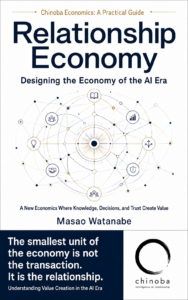
Chinoba Economics | Reframing the AI Economy from Transactions to Relationships

Introduction
So far, we have introduced a range of concepts that make up the Relationship Economy.
Knowledge Flow.
State Understanding.
Community Graph.
Decision Trace.
Trust Infrastructure.
Runtime Society.
Operational AI.
Public AI.
And the Regional Intelligence Platform, with EZOCA as an example.
At first glance, these may appear to be separate technologies or research themes.
Yet they are all rooted in one common question:
How is value created in the AI era?
In the conventional economy, “transactions”—providing products or services and receiving money in return—have been positioned at the center of value creation.
But as AI begins to take on roles within society and organizations, transactions alone can no longer fully explain how value is created.
Corporate knowledge flows.
The states of people and organizations are understood.
AI supports decisions.
Multiple AIs and humans coordinate.
The reasons behind decisions are recorded.
Trust is formed.
Ongoing relationships emerge.
And new value circulates through those relationships.
We call this new economic design for the AI era Chinoba Economics.
The Economy Was Centered on Transactions
In conventional economic activity, the transaction was the key unit.
A company sells a product.
A customer signs up for a service.
Payment is made.
The company earns profit.
Marketing, sales, distribution, and payment systems have largely been designed to increase the number of transactions.
This structure can be simplified as follows:
Product
↓
Transaction
↓
Revenue
↓
Profit
Companies have grown by selling more products and generating more transactions.
Even as digitalization advanced, this basic structure did not fundamentally change.
E-commerce sites sell products online.
Point programs encourage repeat purchases.
CRM systems manage customer touchpoints.
Advertising AI predicts the likelihood of purchase.
Technology evolved, but the ultimate goal remained the same: generate the next transaction.
However, in the AI era, a transaction-centered design alone is no longer sufficient.
What Changes in the AI Era?
Generative AI is not merely a tool for writing text.
It reads corporate documents.
It understands the situation of each user.
It compares multiple options.
It supports decision-making.
And it begins to operate business systems.
As AI agents become more widespread, AI will no longer simply receive one instruction at a time from humans.
It will understand goals.
Gather the knowledge it needs.
Ask other AIs to perform tasks.
Evaluate results.
Return decisions to humans when necessary.
And carry out real actions.
AI is beginning to shift from a tool that supports economic activity to an actor that participates in economic activity.
This change also alters what companies need to design.
It is no longer enough to design products.
It is no longer enough to design transactions.
Organizations must design the relationships formed among people, organizations, AI, knowledge, decisions, and trust.
What Is the Relationship Economy?
The Relationship Economy is an economy in which value is created not through one-time transactions, but through ongoing relationships.
Consider the relationship between a user and a company.
Rather than having a person make a single purchase, the company understands that person’s goals and circumstances and continues to provide the support they need.
The same applies to relationships between companies.
They do not merely place orders and make deliveries. They share knowledge, solve problems together, and create new services collaboratively.
New relationships also emerge between people and AI.
An AI may support the same person every day, gradually understanding that person’s work, goals, constraints, and previous decisions.
Relationships also emerge among AIs.
A sales AI, contract AI, pricing AI, and risk AI may each have distinct responsibilities while working together.
In the Relationship Economy, the basic structure of the economy can be understood as follows:
Knowledge
↓
Understanding
↓
Decision
↓
Action
↓
Trust
↓
Relationship
↓
Value
↓
Economy
Money is not the starting point of value creation.
Economic value emerges from the circulation of knowledge, decisions, actions, trust, and relationships.
The Core Idea of Chinoba Economics
Chinoba Economics views the economy as a flow of value.
Conventional economics has mainly focused on Money Flow and Product Flow.
Chinoba Economics places importance on the multiple flows that occur before money appears.
Knowledge Flow
Context Flow
Decision Flow
Trust Flow
Relationship Flow
Value Flow
Money Flow
Before revenue is generated, many activities take place.
An organization acquires knowledge about a customer.
It understands the customer’s current state.
It compares multiple proposals.
It makes a decision suited to that customer.
It executes the decision safely.
It builds trust in the result.
It creates an ongoing relationship.
Revenue and profit then emerge as outcomes.
In other words, Money Flow is what appears at the end.
For companies and regions to grow sustainably, they must design the flows that come before it: Knowledge, Decision, Trust, and Relationship.
Knowledge Flow: Knowledge Is a New Form of Capital
For AI to create value in companies and regions, it must be able to understand the knowledge used there.
Organizations hold vast amounts of information.
Operational manuals.
Contracts.
Design documents.
Meeting minutes.
Emails.
Chats.
ERP systems.
CRM systems.
Databases.
Source code.
Past decisions.
Yet much of this knowledge is scattered across departments and systems.
Even if knowledge exists, it does not create value if it cannot reach the right person or AI at the right time.
Knowledge Flow is a mechanism for transforming information scattered throughout companies and regions into knowledge that AI can understand and use for decision-making.
Its basic flow is as follows:
Documents and Data
↓
Ingestion
↓
Knowledge Extraction
↓
Ontology
↓
Knowledge Graph
↓
Decision Knowledge
↓
Operational Use
The purpose of Knowledge Flow is not simply to store documents.
It is to transform knowledge into an asset that can flow.
Organizations in which knowledge circulates and can be used by both people and AI can make faster and more consistent decisions.
State Understanding: AI Understands the Present
Having knowledge alone is not enough to make appropriate decisions.
Even the same person needs different support depending on their situation.
The appropriate action differs when the same customer:
- makes an inquiry for the first time;
- is approaching contract renewal;
- is experiencing a problem; or
- is seeking a new proposal.
State Understanding is a mechanism for understanding what state a person, organization, region, or system is in right now.
The elements that make up a state include:
Context
Goal
Intent
Role
Constraint
Risk
Relationship
Capability
History
Conventional AI has often focused on attributes and past history.
State Understanding integrates current circumstances, goals, intentions, and constraints.
This enables AI to understand not merely:
What did this person buy in the past?
but rather:
What does this person need now?
Community Graph: Relationships Become Assets
People, companies, and AI do not create value in isolation.
People belong to organizations.
Companies collaborate with customers and business partners.
Residents live within communities.
AI receives work from people and from other AIs.
Value emerges from these relationships.
A Community Graph represents people, AI, organizations, knowledge, events, services, and other entities as nodes, then connects them through relationships.
For example, it can manage nodes such as:
People
AI Agent
Organization
Community
Event
Knowledge
Decision
Service
These are connected through relationships such as:
BELONGS_TO
USES
PARTICIPATES_IN
COLLABORATES_WITH
REFERENCES
APPROVED
DELEGATED_TO
TRUSTS
This enables AI to understand not only individual data points, but also:
Who is connected to whom.
Which organizations should collaborate.
Who holds important knowledge.
Which AI can be entrusted with a decision.
Relationships may be difficult to see in accounting statements, but they strongly influence the future value of a company or region.
In Chinoba Economics, we regard these relationships as Relationship Capital.
Decision Trace: Decisions Become Assets
Companies and societies make many decisions every day.
Approving a contract.
Setting a discount.
Stopping a piece of equipment.
Selecting a patient’s treatment plan.
Determining eligibility for public assistance.
Yet in many cases, only the final result is recorded, while the reasoning behind the decision is not sufficiently preserved.
Decision Trace is a mechanism for recording the reasons and process behind a decision.
For example, it records information such as:
Goal
Context
Intent
Evidence
Candidate Actions
Constraint
Policy
Risk
Decision
Actor
Result
Feedback
This makes it possible to trace:
What was decided.
Why a particular option was selected.
What knowledge was used.
What risks were considered.
Who approved the decision.
What the outcome was.
Decision history is not merely a log.
It is knowledge that can be used to improve the next decision.
In Chinoba Economics, accumulated decisions are regarded as Decision Capital.
Trust Infrastructure: Do Not Leave Trust to Chance
In the Relationship Economy, ongoing relationships create value.
But relationships cannot be sustained without trust.
If people do not know what evidence an AI used to make a decision, they cannot trust it.
If they do not know what data was used, they cannot trust it.
If they do not know who granted authority, they cannot trust it.
If responsibility is unclear when something goes wrong, they cannot trust it.
Under such conditions, people and organizations cannot entrust AI with important work.
Trust Infrastructure is the foundation that enables people, AI, and organizations to collaborate safely.
Its core components include:
Identity
Role
Policy
Boundary
Human Gate
Decision Trace
Audit
Escalation
A Boundary defines the range within which AI is allowed to act.
A Human Gate returns decisions to people in situations where AI must not decide alone.
Decision Trace records the reason for each decision.
The purpose of Trust Infrastructure is not to eliminate AI autonomy.
It is to allow AI to act autonomously within approved boundaries while enabling humans to intervene in important decisions.
By balancing autonomy and governance, trust can be created as a system.
Runtime Society: A Society in Which AIs Work Together
As AI agents become widespread, work will not be completed by a single AI alone. Multiple AIs will divide responsibilities.
Sales AI.
Contract AI.
Pricing AI.
Inventory AI.
Quality AI.
Risk AI.
Public AI.
Each will have specialized knowledge and roles while coordinating with other AIs and humans.
Runtime Society is an environment in which people, AI, and organizations coordinate in real time.
What is required is not merely conversation among AIs.
It requires:
Role
Goal
Context
Policy
Boundary
Coordination
Conflict Resolution
Escalation
Human Gate
Decision Trace
There will be situations in which AIs disagree.
A sales AI may want to propose a discount.
A pricing AI may want to protect margin.
An inventory AI may want to change the delivery date.
A risk AI may want to place the transaction on hold.
In a Runtime Society, such conflicts are coordinated based on shared goals and policies. When they cannot be resolved, they are escalated to humans.
This is not simply a system that connects AIs.
It is a dynamic social model with roles, responsibilities, authority, and trust.
Operational AI: Turning Decisions into Actions
Even if generative AI produces excellent answers, its value remains limited if actual work does not change.
Operational AI connects AI decisions to real actions.
For example, it can:
Register a task in a CRM system.
Notify a customer.
Create a quotation.
Submit an approval request.
Reserve a store or service.
Deliver a coupon.
Stop equipment.
Escalate an issue to an expert.
Update a business system.
The core cycle of Operational AI is as follows:
Understand
↓
Decide
↓
Validate
↓
Execute
↓
Observe
↓
Learn
Through this cycle, AI evolves from an entity that answers questions to an entity that moves business operations forward.
However, Policy, Boundary, Risk, and Human Gate must be checked before execution.
After execution, a Decision Trace must be preserved, and the results must be returned to the next Knowledge Flow.
Chinoba Platform: An Implementation Foundation for the Relationship Economy
Chinoba Platform is the foundation for putting Chinoba Economics into operation in real companies and regions.
Its overall structure is as follows:
Enterprise Data / Community Data
↓
Knowledge Flow
↓
Knowledge Graph / Community Graph
↓
State Understanding
↓
Decision AI
↓
Trust Infrastructure
↓
Operational AI
↓
Action
↓
Decision Trace
↓
Learning
Chinoba Platform does not replace existing systems such as CRM, ERP, and databases.
Existing systems manage transactions and records.
Chinoba Platform is responsible for:
Integrating knowledge.
Understanding states.
Recognizing relationships.
Supporting decisions.
Executing safely.
Learning from decisions and outcomes.
If existing systems are Systems of Record, Chinoba Platform is a:
System of Understanding, Decision and Action.
The Regional Relationship Economy Through EZOCA
In the EZOCA case, we considered the possibility of using a regional point program as an entry point for building a Relationship Economy across Hokkaido.
EZOCA’s true assets are not limited to its point issuance function.
Its assets include:
Members.
Partner stores.
Regional brands.
Usage history.
Partnerships with local companies.
Trust built over time throughout Hokkaido.
A Community Graph can connect residents, tourists, stores, local governments, sports, events, transportation, and more.
State Understanding can identify the current state of users and the region.
Decision AI can determine the Next Best Action that creates value for the region as a whole, rather than simply recommending an individual product.
Operational AI can connect decisions to execution across coupons, reservations, payments, events, transportation, and tourism.
As a result, a point service can evolve into a Regional Intelligence Platform.
Points are not the center of the economic sphere.
They become one incentive for encouraging actions that are desirable for the region.
The Public Relationship Economy Through Public AI
Government, healthcare, and education can also be understood through the lens of the Relationship Economy.
For residents, government services, healthcare, education, and welfare are not separate services.
They are connected within a single life.
Public AI understands a resident’s state and connects that person to the systems, healthcare, education, and welfare support they need.
Knowledge Flow structures laws, systems, medical knowledge, and educational knowledge.
Community Graph represents relationships among residents, government, healthcare, education, and local communities.
State Understanding captures the current state of life, health, and learning.
Trust Infrastructure protects consent, authority, privacy, and appeals.
Runtime Society coordinates public-service AI, healthcare AI, education AI, and human specialists.
The purpose of Public AI is not to increase the number of procedures processed.
It is to ensure that the people who need support are connected to it—and that the relationship continues.
Economic Spheres Addressed by Chinoba Economics
Chinoba Economics is not a theory limited to a particular industry.
The same structure can be applied across many types of economic spheres.
Regional Economic Spheres
Connecting residents, stores, local governments, tourism, sports, and transportation.
Corporate Economic Spheres
Connecting employees, departments, customers, business partners, knowledge, and AI.
Manufacturing Economic Spheres
Connecting factories, equipment, workers, parts, quality, energy, and AI.
Healthcare Economic Spheres
Connecting patients, physicians, hospitals, pharmacies, care providers, families, local governments, and AI.
Education Economic Spheres
Connecting learners, teachers, families, learning materials, communities, companies, and AI.
Sports Economic Spheres
Connecting fans, teams, venues, sponsors, regions, stores, and events.
The Creator Economy
Connecting articles, books, videos, lectures, research, communities, and projects.
The fields differ, but the underlying structure is the same.
Knowledge flows.
States are understood.
Relationships are connected.
Decisions are made.
Actions are executed safely.
Trust is formed.
Value circulates.
The Four Forms of Capital in Chinoba Economics
Traditional economics has emphasized land, labor, equipment, and financial capital.
Chinoba Economics identifies four new forms of capital for the AI era.
Knowledge Capital
The knowledge held by an organization or region.
What matters is not the volume of documents, but whether the knowledge is in a state that AI can understand and use for decision-making.
Relationship Capital
The relationships formed among people, AI, organizations, and regions.
This includes continued use, collaboration, reputation, communities, and trust.
Decision Capital
Past decisions, the reasons behind them, their outcomes, and the learning they generate.
What matters is whether decisions can be recorded and reused in future decision-making.
Trust Capital
A state in which people and organizations can collaborate with confidence and delegate roles to AI.
It is built through explainability, consistency, accountability, boundaries, and human gates.
These four forms of capital are not independent.
Knowledge Capital supports decisions.
Decision Capital creates organizational learning.
Trust Capital enables collaboration.
Relationship Capital creates new value.
The Chinoba Economics Value-Circulation Model
The overall model of Chinoba Economics can be represented as the following cycle.
Knowledge
↓
Deliver the knowledge that is needed
State Understanding
↓
Understand the current situation, goals, and intentions
Relationship
↓
Understand the connections among people, AI, and organizations
Decision
↓
Select an action from multiple candidates
Trust
↓
Confirm Policy, Boundary, and Human Gate
Action
↓
Operational AI executes
Result
↓
Observe execution outcomes and changes in relationships
Decision Trace
↓
Record the reasons and outcomes of decisions
Learning
↓
Update knowledge, policy, and relationships
As this cycle repeats, companies, regions, and society continue to learn.
Value does not end with a single transaction.
The results of decisions and actions create new knowledge and relationships, leading to the next cycle of value creation.
What It Means to Design an Economic Sphere
When people speak of designing an economic sphere, they often imagine building payments, point programs, member IDs, or marketplaces.
But Chinoba Economics argues that this is not enough.
What must truly be designed is the structure of:
Who participates.
What knowledge is shared.
What relationships are formed.
What goals are shared.
Who decides what.
How far AI may be allowed to act.
What boundaries must be protected.
Who holds final responsibility.
How value is distributed.
How the system learns from results.
An economic sphere is not a mechanism for enclosing users within a service.
It is a collaborative structure in which diverse actors participate, bring their knowledge and capabilities together, and continuously create value.
The Purpose of AI Is Not Automation
In AI adoption, automation rates and cost reduction often become the primary objectives.
Efficiency certainly has value.
But the purpose of Chinoba Economics is not to replace all human work with AI.
AI is good at certain tasks.
Processing large volumes of information.
Comparing alternatives.
Applying consistent rules.
Detecting anomalies and relationships.
Executing repetitive processes.
Humans also have responsibilities that should remain human.
Defining values.
Judging ambiguous situations.
Taking responsibility.
Understanding another person’s emotions.
Considering social meaning.
Economic spheres in the AI era must combine the roles of people and AI appropriately.
The purpose of AI is not to exclude people.
It is to enable people, AI, and organizations to create value together that could not previously be realized.
Practical Principles of Chinoba Economics
Implementing Chinoba Economics does not require building a massive platform from the beginning.
It can start with one important decision.
The basic steps are as follows.
1. Define the Goal
Define the value you want to achieve, rather than starting with an AI feature.
2. Identify the Relationship
Clarify which relationship or relationships you want to improve.
3. Organize Knowledge
Identify the documents, data, and rules required for the decision.
4. Define the State
Determine what states need to be understood.
5. Structure the Decision
Organize the options, constraints, risks, and decision criteria.
6. Set Boundaries
Determine what AI can decide and what requires human confirmation.
7. Connect to Action
Connect decisions to existing business systems and services.
8. Preserve a Decision Trace
Record decision reasons, execution outcomes, and feedback.
9. Evaluate Relationship Value
Measure not only short-term revenue, but also trust, continuity, collaboration, and impact on regional value.
The practical approach is to implement one small cycle, verify the result, and then expand the scope gradually.
Conclusion
The economy of the twentieth century developed around physical goods.
The digital economy of the early twenty-first century expanded around information and platforms.
And in the AI era, the center of the economy is beginning to shift toward relationships.
Knowledge flows.
States are understood.
People and AI coordinate.
Decisions are recorded.
Trust is formed.
Relationships accumulate.
And new value emerges from them.
The Relationship Economy is not simply an idea that places greater importance on human relationships.
It is an economic model for actually designing and implementing the relationships among people, AI, organizations, knowledge, decision-making, and trust.
And the theory and implementation framework for doing so is Chinoba Economics.
Chinoba Economics is not a methodology for merely introducing AI.
It is a practical framework for considering:
How companies should be designed in the AI era.
How regions should be connected.
How public services should change.
How people and AI should collaborate.
How value should circulate.
Until now, economic spheres have been designed primarily around the question:
How should money circulate?
But in the AI-era economy, the more important questions are:
How should knowledge flow?
How should states be understood?
How should decisions be supported?
How should trust be formed?
How should relationships be cultivated?
The economy is not sustained by transactions alone.
Knowledge flows.
Decisions are made.
Trust accumulates.
Relationships grow.
And value circulates as a result.
This is the practical framework for designing that new circulation of value.
That is Chinoba Economics.

Chinoba
Intelligence as Relationship
Research Platform
founded by
Masao Watanabe
AI Systems Architecture
Decision Trace
Human–AI Coordination
Algorithmic Governance
Related Research
This topic is part of the Chinoba Knowledge Base.

コメント