
🎥 The YouTube version is also available:
The Relationship Economy: How AI Is Transforming Value, Trust, and Business

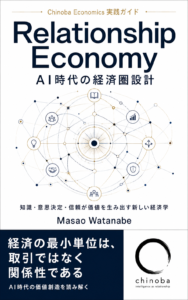
Books: Relationship Economy AI時代の経済圏設計 Chinoba Economics 実践ガイド: 知識・意思決定・信頼が価値を生み出す新しい経済学

Introduction
In previous articles, we introduced the key ideas that make up the Relationship Economy.
Knowledge Flow transforms information scattered across companies and communities into knowledge that AI can use.
State Understanding identifies the current condition of people and organizations.
Community Graph represents the relationships among people, AI, organizations, knowledge, and services.
Trust Infrastructure designs the boundaries, accountability, and human intervention required for AI decisions and actions.
Runtime Society provides an execution environment in which multiple AI Agents and humans coordinate through defined roles.
Yet these elements do not create value merely by existing independently.
Collecting knowledge alone is not enough.
Understanding a state alone is not enough.
Having AI make recommendations alone is not enough.
What matters is:
understanding knowledge, assessing the situation, connecting it to real action, and learning from the results.
We call the foundation for implementing this entire flow the Chinoba Platform.
The Chinoba Platform is not merely an AI foundation for introducing generative AI.
It is an operational platform for connecting people, AI, organizations, knowledge, decisions, and actions—and for making the Relationship Economy work in practice.
The Relationship Economy Does Not Work Through Concepts Alone
In the Relationship Economy, value is created not through one-time transactions, but through ongoing relationships.
However, simply declaring that a company or community values relationships changes nothing.
Suppose a company wants to prioritize long-term relationships with its customers.
At a minimum, it must be able to:
- Understand the customer’s past behavior
- Grasp the customer’s current situation
- Estimate the customer’s Goals and Intent
- Reference internal knowledge and rules
- Compare multiple options
- Check the Boundaries that must be respected
- Return the decision to a human when necessary
- Execute proposals or operational tasks
- Record the results and reflect them in future decisions
If these elements are fragmented, AI cannot function effectively.
In many organizations, data, documents, CRM systems, operational systems, and generative AI exist separately.
AI may be able to answer questions, but it cannot complete actual work.
The Chinoba Platform aims to eliminate this fragmentation and connect:
Knowledge to Action as one continuous flow.
What Is the Chinoba Platform?
The Chinoba Platform is an AI platform that integrates the knowledge, relationships, states, decisions, and operations present in companies and communities.
Its overall flow is as follows:
Enterprise Data / Community Data
↓
Knowledge Flow
↓
Knowledge Graph / Community Graph
↓
State Understanding
↓
Decision AI
↓
Trust Infrastructure
↓
Operational AI
↓
Action
↓
Decision Trace
↓
Learning
Generative AI plays an important role within this flow.
However, generative AI is only one part of the whole.
Generative AI alone cannot continuously manage:
- The latest operational state
- Organization-specific rules
- Authorities
- Risks
- Areas of responsibility
- Execution outcomes
The Chinoba Platform combines the reasoning capabilities of LLMs with enterprise knowledge, operational data, Policies, Graphs, Workflows, Agents, and Audit mechanisms.
This enables AI to evolve from an entity that merely generates answers into one that can make decisions and act safely within an organization.
Knowledge Flow — Transforming Information into Decision-Ready Knowledge
The starting point of the Chinoba Platform is Knowledge Flow.
Companies and communities contain a vast amount of information, including:
- PDFs
- Word documents
- Excel files
- PowerPoint presentations
- Slack
- Teams
- SharePoint
- Google Drive
- CRM
- ERP
- Databases
- Websites
- Source code
- Sensor data
- Event information
However, these sources cannot be used directly for AI decision-making.
Their formats differ, and their meanings and relationships have not been organized.
Knowledge Flow performs the following processes:
- Collect information
- Split and analyze documents
- Extract people, organizations, products, rules, decisions, and other entities
- Organize terminology and concepts as an Ontology
- Register relationships in a Knowledge Graph
- Attach sources, update dates, and access permissions
- Make the resulting knowledge available for AI at the time of decision-making
Consider an AI system for contract review.
Simply loading contract documents is not enough.
The AI needs to combine:
- The company’s contract policies
- Previous similar contracts
- The customer’s transaction history
- Applicable laws and regulations
- Conditions for exception approval
- The authority of the responsible person
- The current negotiation status
Knowledge Flow is the mechanism that delivers this knowledge when a decision must be made.
Knowledge Graph — Understanding Relationships in Knowledge
Document search alone makes it difficult to understand the whole picture of a company or community.
This is because what truly matters is not the document itself, but the relationships among the elements contained in it.
For example:
A customer uses a product, signs a contract, receives support from a representative, experiences an issue, and has been involved in previous decisions.
These are not separate pieces of information.
They form one connected relationship structure.
A Knowledge Graph represents entities such as:
- People
- Organizations
- Products
- Services
- Contracts
- Documents
- Rules
- Events
- Decisions
- AI Agents
These are connected through relationships such as:
BELONGS_TOUSESCREATEDAPPROVEDREFERENCESAFFECTSDECIDEDGOVERNED_BY
This enables AI to understand not only:
“Which document contains this information?”
but also:
“Who is related to this information, which operation does it affect, and which decisions does it influence?”
State Understanding — Understanding the Present
A Knowledge Graph represents the knowledge and relationships held by a company or community.
However, decision-making also requires an understanding of the present situation.
The appropriate response may differ depending on a customer’s current state.
For example, these customers require different actions:
- A customer making their first inquiry
- A customer approaching contract renewal
- A customer experiencing a service issue
- A customer considering cancellation
- A customer waiting for a new proposal
State Understanding integrates information such as:
- Context
- Goal
- Intent
- Role
- Constraint
- History
- Location
- Time
- Risk
- Relationship
It then structures questions such as:
- What is happening now?
- What should be achieved?
- Which issue should be prioritized?
If Knowledge Flow delivers accumulated knowledge from the past, State Understanding is the mechanism that constructs an understanding of the present.
Decision AI — Determining What Should Be Done
After understanding the state, the next requirement is decision-making.
Traditional Recommendation AI has focused primarily on:
“What should be recommended?”
Decision AI determines:
“What should be done now?”
In retail, for example, it may decide whether to:
- Send a coupon
- Recommend a product
- Invite the customer to an event
- Take no action
- Hand the case over to a human representative
In manufacturing, it may evaluate whether to:
- Continue operations
- Conduct an inspection
- Change production conditions
- Stop equipment
- Escalate the issue to a quality representative
Decision AI compares multiple candidates based on:
- Contribution to the Goal
- Expected Value
- Risk
- Cost
- Constraints
- Policy
- Trust
- Impact on the Relationship
It does not simply select the option with the greatest short-term profit.
In the Relationship Economy, Decision AI must consider long-term relationships, trust, and organizational principles.
Operational AI — Turning Decisions into Action
Even if AI makes excellent recommendations, no value is created unless they lead to actual action.
In many generative AI implementations, AI generates an answer and a human manually enters it into another system.
For example:
AI drafts an email.
A staff member copies it.
They open the CRM.
They check the customer information.
They send the email.
They record the result.
In this model, AI remains only partial support.
Operational AI connects AI decisions to business execution.
For example, it can:
- Register a task in a CRM
- Send a notification to a customer
- Create an approval request
- Check inventory
- Generate a quotation
- Start a Workflow
- Escalate to a responsible person
- Update a dashboard
- Record execution results
The basic Operational AI flow is as follows:
Understand
↓
Understand the current situation

Decide
↓
Select the best action

Validate
↓
Check Policy, Boundary, and Risk

Execute
↓
Operate business systems

Observe
↓
Confirm the outcome

Learn
↓
Reflect the decision and outcome in the next cycle
Through this cycle, AI evolves from answer generation into operational execution.
From Recommendation to Next Best Action
In the Relationship Economy, the focus shifts from simply recommending products to identifying the Next Best Action.
The Next Best Action is the most appropriate action to take next, given the current state.
Importantly, it is not necessarily a sales action.
Possible actions include:
- Introduce a product
- Prioritize problem resolution
- Recommend participation in an event
- Arrange a meeting with a representative
- Provide information only
- Avoid contacting the customer for now
- Hand the case over to a human
If a customer is currently dealing with a service issue, proposing a new product may be inappropriate.
Even if there is a short-term sales opportunity, prioritizing problem resolution first may build greater long-term trust.
The Next Best Action should therefore be designed not as:
an action that maximizes revenue,
but as:
an action that maximizes the long-term value of the relationship.
Embedding Trust Infrastructure into the Execution Path
As Operational AI begins to operate real systems, safety becomes critical.
AI may automatically:
- Send email
- Set discounts
- Change contract terms
- Stop equipment
- Access personal information
These operations require clear Boundaries.
For this reason, the Chinoba Platform performs validation through Trust Infrastructure before execution.
For example, it checks:
- Under whose authority the action will be performed
- Whether the Agent has the required authority
- Whether the intended purpose is appropriate
- Whether only necessary data is being used
- Whether the amount or risk is within permitted limits
- Whether a Human Gate is required
- Whether the action can be recorded
The flow is as follows:
Decision Proposal
↓
Policy Check
↓
Boundary Check
↓
Risk Evaluation
↓
Human Gate if Required
↓
Execution
↓
Decision Trace
Trust Infrastructure is not merely a mechanism for auditing AI after execution.
It must be embedded in the path from decision to execution.
Decision Trace — Recording Why an Action Was Taken
In Operational AI, it is necessary to record not only what was executed, but also why it was executed.
For example, if AI offers a customer a discount, the Decision Trace should record:
- The customer’s state
- The applied Goal
- The estimated Intent
- The Knowledge referenced
- The options considered
- The Policies applied
- The Boundaries checked
- The risk assessment
- Whether a Human Gate was used
- The execution outcome
This makes it possible to later determine:
- Why was a discount offered only to this customer?
- Which rules did the AI follow?
- Who approved the decision?
- Did the action actually have the intended effect?
The outcome can then be returned to Knowledge Flow to improve future decisions.
Implementation Layers of the Chinoba Platform
Conceptually, the Chinoba Platform can be structured into the following layers.
1. Data and Integration Layer
Connects enterprise and community data.
- Document Storage
- CRM
- ERP
- Database
- IoT
- APIs
- External Data
- Community Data
2. Knowledge Layer
Transforms data into knowledge AI can understand.
- Document Ingestion
- Knowledge Extraction
- Ontology
- Knowledge Graph
- Vector Search
- Graph RAG
- Knowledge Repository
3. Context and State Layer
Constructs the current state.
- Context
- Goal
- Intent
- Role
- Constraint
- Event
- State Model
4. Decision Layer
Evaluates alternatives and makes decisions.
- Candidate Generation
- Decision Rules
- Policy Engine
- Risk Evaluation
- Next Best Action
- Decision Trace Model
5. Trust Layer
Controls safe AI actions.
- Identity
- Access Control
- Boundary
- Human Gate
- Audit
- Approval
- Escalation
6. Operational Layer
Turns decisions into real actions.
- Agents
- Workflows
- API Execution
- Notifications
- System Updates
- Task Creation
- Monitoring
7. Learning Layer
Returns outcomes to future knowledge and decisions.
- Feedback
- Outcome Evaluation
- Relationship Change
- Policy Improvement
- Knowledge Update
- Trace Analysis
This architecture manages the entire flow from data to execution as one platform.
Example — Enterprise Sales Support
Consider introducing the Chinoba Platform into a sales operation.
A customer sends an inquiry about a new proposal.
First, Knowledge Flow collects:
- Past sales opportunities
- Information about the customer company
- Contracts
- Product materials
- Previous inquiries
- Cases involving similar customers
Next, State Understanding constructs the following state:
- The customer is approaching contract renewal
- A support issue occurred recently
- The customer is cautious about new investment
- The contact person needs material for explaining the proposal to management
Decision AI compares candidates such as:
- Propose a new product
- Prioritize resolution of the support issue
- Send ROI materials
- Arrange a meeting with a sales representative
After considering the impact on the Relationship, it selects the following Next Best Action:
First explain the status of the support issue, then send ROI materials, and propose a meeting.
Operational AI then performs the following steps:
- Retrieve the support status
- Generate a customer-facing explanation
- Attach ROI materials
- Request review by the sales representative
- Send the message after approval
- Record the activity in the CRM
Finally, it stores the reasoning and outcome in the Decision Trace.
This is one example of implementing the Relationship Economy in sales operations.
Example — A Regional Economic Ecosystem
The same structure can be applied to a regional economic ecosystem.
Consider the day of a large sports event.
Knowledge Flow integrates:
- Event information
- Store information
- Transportation information
- Weather
- Historical visitor behavior
- Local events
- Tourism information
State Understanding identifies conditions such as:
- Visitors are concentrated in the area
- Congestion is expected in specific zones
- Many visitors are families
- Food and beverage demand is likely to rise after the game
- Some stores have available capacity
Decision AI evaluates options such as:
- Avoid directing visitors toward congested areas
- Recommend less crowded stores
- Introduce family-oriented events
- Recommend stores along visitors’ routes home
Operational AI then delivers appropriate notifications to each user.
This can lead to:
- Reduced congestion
- More visitors directed to participating stores
- Greater movement within the region
- Better visitor experiences
- Expanded regional consumption
In this model, points are merely one form of incentive.
The true value lies in connecting relationships and actions across the entire region in an appropriate way.
Does the Chinoba Platform Replace Existing Systems?
The Chinoba Platform does not replace all existing CRM, ERP, and operational systems.
Each existing system has an important role.
CRM manages customer information.
ERP manages transactions and accounting.
Workflow systems manage procedures.
The Chinoba Platform sits above these systems and is responsible for:
- Integrating knowledge
- Understanding state
- Supporting decision-making
- Connecting multiple systems for execution
- Recording the reasons behind decisions
In other words, if existing systems are systems of record, the Chinoba Platform is a:
system of understanding, decision-making, and execution.
A Small-Scale Implementation Approach
Implementing the Relationship Economy does not require building a large platform from the beginning.
It can start with one operation, one decision, and one relationship.
For example:
- Select one target business process.
- Define an important Goal.
- Identify the necessary Knowledge.
- Define Context and State.
- Organize decision candidates.
- Set Boundaries and Human Gates.
- Execute one Action.
- Record a Decision Trace.
- Evaluate the result.
Potential first use cases include:
- Sales proposals
- Inquiry handling
- Contract review
- Quality-incident response
- Event-participation promotion
- Customer churn prevention
The important point is not to begin with AI functionality.
Do not begin with:
“Let us introduce a chatbot.”
Instead, begin with:
“Which state should we understand, which decision should we improve, and which relationship value should we increase?”
Its Relationship to the Relationship Economy
The purpose of the Chinoba Platform is not to maximize automation.
It is to create better relationships among people, AI, and organizations.
Knowledge Flow delivers the necessary knowledge.
State Understanding makes the current situation understandable.
Decision AI selects an appropriate action.
Trust Infrastructure protects safety and accountability.
Operational AI executes the decision.
Decision Trace enables learning from the outcome.
Through this cycle, the following process continues:
Knowledge
↓
Understanding
↓
Decision
↓
Action
↓
Trust
↓
Relationship
↓
Value
↓
Learning
This is the implementation model of the Relationship Economy.
Conclusion
The Relationship Economy is not merely an abstract philosophy.
It is an implementable approach to economic design.
It enables organizations and communities to flow their Knowledge, understand the relationships among People, AI, and Organizations, grasp the current State, make better Decisions, and execute Actions within safe Boundaries.
The reasons for decisions and their outcomes are accumulated as a Decision Trace and used to improve the next decision.
The Chinoba Platform is the foundation that makes this entire system possible.
Generative AI becomes an important reasoning engine within it.
But generative AI alone cannot realize the Relationship Economy.
Knowledge.
State.
Relationships.
Decision-making.
Trust.
Execution.
Learning.
These elements must be designed as one continuous flow.
The Chinoba Platform evolves AI from “a tool that answers” into a foundation that understands relationships and puts value into action.
We call this implementation framework Chinoba Economics.
In the next article, we will introduce the Regional Intelligence Platform—an application of the Relationship Economy to regional economies that goes beyond local points and connects people, stores, local governments, tourism, and sports.


Chinoba
Intelligence as Relationship
Research Platform
founded by
Masao Watanabe
AI Systems Architecture
Decision Trace
Human–AI Coordination
Algorithmic Governance
Related Research
This topic is part of the Chinoba Knowledge Base.


コメント