
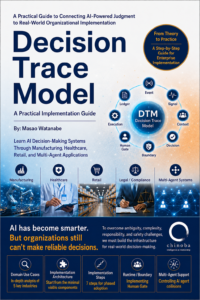
🎥 The YouTube version is also available:
Decision Trace Studio: Making Human, AI, Rule, and Tool Decisions Traceable


When generative AI begins to enter business operations, what organizations need is not merely a record of “what the AI answered.”
What truly matters is the ability to answer questions such as:
Who reviewed which evidence, under which rules, approved what, executed what, and what was the outcome?
As AI generates proposals, people approve them, and workflows or external tools carry them out, decision-making becomes distributed across multiple actors.
This is where the Decision Trace Studio becomes necessary.
Decision Trace Studio is a framework for recording a complete chain of decisions involving people, AI, rules, and tools over time—so that the chain can later be verified, explained, and improved.
A Decision Does Not End with a Single Answer
In conventional systems, logs often retain only the outcome of a process.
- Points were awarded.
- An email was sent.
- A record was updated.
- An item was approved.
- An API was executed.
But outcomes alone are not enough to assess the quality of a decision.
For example, if a benefit was granted to a particular user, what matters is not only the fact that it was granted.
Organizations also need to know:
- Who made the proposal?
- Which activity history or conditions did the AI rely on?
- Which campaign rules were applied?
- Who gave the final approval?
- Which tool or API was used for execution?
- Did any issue occur after execution?
- Should the rule or decision be reviewed later?
Only when these elements are preserved as a single unit can an organization explain why a particular result occurred.
What Is a Decision Trace?
A Decision Trace is a traceable record that connects the process leading to a decision with the outcome that follows.
Typically, the following sequence is handled as one Trace:
Proposal
  → Evidence Review
    → Rule Evaluation
      → Human Approval
        → Execution
          → Outcome
            → Retrospective Review
For example, in AI-assisted customer support, a Trace could contain the following:
| Stage | What to Record |
|---|---|
| Proposal | The response draft generated by AI, the reason for the proposal, and the target customer |
| Evidence Review | Referenced FAQs, contract terms, prior support cases, and retrieval timestamps |
| Rule Evaluation | Decisions relating to personal data, price changes, refunds, and other policy constraints |
| Human Approval | Approver, approval time, revisions made, and reasons for rejection or return |
| Execution | The actual message sent, the tool used, and the execution result |
| Outcome | Customer response, resolution status, errors, and scope of impact |
| Retrospective Review | Improvements to rules, prompts, and knowledge resources |
The crucial point is not simply to record the AI’s output. It is to preserve the entire path through which an AI proposal passes through people and institutional controls before reaching execution.
Designing So That Responsibility Is Not Shifted onto AI
In AI-enabled work, people often use the vague phrase, “the AI made the decision.”
In reality, however, the AI may only have generated a proposal. A human may have made the final decision. A predefined rule may have made the decision. Or the work may have been divided: the AI proposes, a person approves, and a tool executes automatically.
If this division remains unclear, responsibility becomes ambiguous when something goes wrong.
Decision Trace Studio makes the actor involved in each step explicit.
- Human: approval, rejection, revision, exception judgment
- AI Agent: summarization, candidate extraction, classification, proposals, explanations
- Rule Engine: threshold checks, authorization checks, prohibited-condition checks
- Tool / Workflow: email delivery, database updates, ticket creation, point awards
- System: authentication, audit logging, failure detection, retry control
This makes it possible to distinguish between “who decided what” and “who executed what.”
It is a design for using AI effectively while keeping ultimate governance responsibility with people and the organization.
Put Evidence at the Center of the Decision Trace
In a Decision Trace, evidence is the most important element.
Every AI proposal should be linked to the evidence it referenced.
- The relevant parts of source documents or repositories
- Document versions, Git commits, and API specification revisions
- Retrieval timestamps and expiration dates
- Search conditions and reasons for excluding candidates
- The user’s authority and permitted data scope
- Versions of the model, prompt, and tools used
This makes it possible to later verify why the AI made a particular proposal based on records, rather than speculation.
If the outcome was inappropriate, the cause can also be decomposed.
- Was the supporting information outdated?
- Did retrieval fail to find necessary materials?
- Were the rules insufficient?
- Was the AI’s interpretation inappropriate?
- Had the human approval process become a formality?
- Was there a problem with the controls of the execution tool?
This is not a log designed to punish AI. It is a learning foundation for improving the collaboration among people, AI, institutions, and tools.
Do Not Treat Every Decision the Same Way
When introducing Decision Trace, there is no need to impose a heavy approval workflow on every operation.
If people must wait for approval even for low-risk processes, operations will come to a halt. On the other hand, leaving high-risk processes entirely to AI can lead to incidents and loss of trust.
For this reason, the level of traceability and control should vary according to risk.
| Type of Decision | Example | Recommended Treatment |
|---|---|---|
| Low risk | Summaries, tagging, draft creation | Execute automatically and record the result |
| Medium risk | Customer inquiry replies, campaign candidate extraction | AI proposal plus human review |
| High risk | Permission changes, refunds, contract changes, individual evaluations | Evidence presentation, multiple approvals, and audit controls |
| Prohibited or exceptional areas | Legal violations, external transmission of confidential information | Stop immediately through rules and record the event |
What matters here is not the capability of the AI, but the scale of the impact that the decision may create.
Even with a highly capable model, evidence checks and human approval should not be omitted for high-risk actions. This principle makes AI adoption sustainable.
Use Traces for Retrospective Learning
The value of a Decision Trace is not limited to audit readiness.
Its greater value lies in enabling organizations to learn from their own decision-making patterns.
For example, by analyzing Traces over a certain period, an organization can identify:
- Which types of AI proposals are frequently returned for revision
- Which rules generate a high volume of exceptions
- Which teams are experiencing approval delays as bottlenecks
- Which evidence sources are outdated and making decisions unstable
- How extensively people revise AI proposals
- Which areas can be automated and which should retain human judgment
Through this analysis, organizations can improve not only prompts, but also business rules, document management, authorization design, and approval flows themselves.
In other words, Decision Trace Studio is not a mechanism for collecting AI activity logs. It is a studio for making organizational decision-making visible and improving it continuously.
Conclusion: In the AI Era, Record the Decision Path—Not Only the Result
As AI begins to make proposals within business processes, tools begin to act, and people begin to approve, conventional logs that preserve only outcomes become insufficient.
What is needed is a record that can explain:
Not merely what happened, but why it was permitted to happen.
Decision Trace Studio treats the journey from proposal and evidence review through human approval, execution, outcome, and retrospective review as one traceable unit.
This enables organizations to neither trust AI blindly nor fear it excessively.
They can review evidence, distribute responsibility, and learn from outcomes.
Once that cycle is designed, AI becomes more than an automation tool. It becomes a collaborative foundation through which organizations can accumulate better decisions over time.


Chinoba
Intelligence as Relationship
Research Platform
founded by
Masao Watanabe
AI Systems Architecture
Decision Trace
Human–AI Coordination
Algorithmic Governance
Related Research
This topic is part of the Chinoba Knowledge Base.


コメント