
Over the past few years, generative AI has rapidly become part of everyday business operations.
From document creation and research analysis to software development, design support, and customer service, organizations across industries are increasingly integrating AI into their workflows.
Today, however, we are entering a new phase.
AI is evolving from a tool that simply answers questions into an assistant that supports work—and further into autonomous AI agents capable of executing tasks on behalf of humans.
Claude Code, ChatGPT, Gemini, MCP, and Multi-Agent Systems are accelerating this transformation.
As a result, AI is no longer just an information retrieval tool. It is becoming an active participant in business processes and operational workflows.
At the same time, organizations are facing new challenges.
Deploying AI is relatively easy.
Operating AI safely, governing it effectively, and integrating it into enterprise environments is much harder.
Which AI models should be used?
Who manages access and permissions?
How should usage and costs be monitored?
How can sensitive information be protected?
How much authority should AI agents have when connected to business systems?
How should multiple AI agents be coordinated and governed?
And when something goes wrong, can the organization explain what happened and why?
In my previous book,

I explored one of the most important challenges in enterprise AI adoption:
How can AI decisions and actions be recorded, traced, and explained?
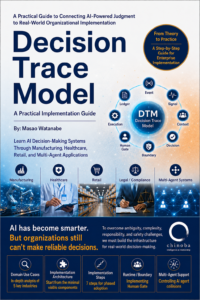
The book introduced the Decision Trace Model as a practical framework for achieving explainability, traceability, auditability, and human oversight in AI-driven systems.
This new book,

serves as a natural continuation of that journey.
While the previous book focused on how to record and explain AI-driven decisions, this book focuses on a broader question:
How can AI be operated safely and systematically within an enterprise?
At the center of this discussion is the concept of the Enterprise AI Gateway.
The Enterprise AI Gateway is an operational platform designed to manage the growing use of AI across an organization in a secure, governed, and scalable manner.
Positioned between users and AI models, it provides centralized capabilities such as:
- Authentication and authorization
- Model routing and selection
- Usage and cost management
- Logging and auditing
- Governance and policy enforcement
By introducing an Enterprise AI Gateway, organizations can consolidate fragmented AI usage, maintain security and compliance, and safely leverage multiple AI models and AI agents across the enterprise.
Furthermore, when combined with Human Gates, Decision Trace, and AI Governance mechanisms, the Enterprise AI Gateway evolves beyond a simple AI access layer into an Enterprise Runtime.
An Enterprise Runtime provides integrated management for:
- AI agent execution
- Approval workflows
- Escalation processes
- Audit trails
- Policy enforcement
- Human oversight
As organizations move toward environments where multiple AI agents collaborate to accomplish complex tasks, the Enterprise Runtime naturally evolves into a Multi-Agent Runtime, enabling humans and AI agents to work together within a unified operational framework.
At the implementation level, this book covers practical architectures and technologies including:
- Claude Code
- LiteLLM Gateway
- Tailscale Zero Trust
- Multi-LLM Architecture
- MCP Integration
Rather than focusing solely on concepts and architecture diagrams, the book takes a practical approach:
What is required to safely deploy and operate generative AI in an enterprise environment today?
Beyond implementation, the book also explores emerging concepts such as:
- Human-in-the-Loop Systems
- Runtime Architecture
- Multi-Agent Runtime
- AI Governance
- DecisionOps
- Multi-Agent Society
Through these topics, readers can follow a structured journey:
Generative AI Adoption
↓
Enterprise AI Gateway
↓
Enterprise Runtime
↓
Multi-Agent Runtime
↓
DecisionOps
↓
Multi-Agent Society
In the age of AI agents, enterprise systems are evolving beyond traditional information systems.
They are becoming platforms that support execution, governance, coordination, and organizational decision-making.
I refer to this evolution as Decision Infrastructure.
The next stage after AI adoption is AI operations.
And beyond AI operations lies a future where humans and AI agents collaborate to create value together.
I hope this book provides a practical guide for understanding and building that future.
Chinoba — Runtime Society and Coordination Systems:
chinoba.org


Chinoba
Intelligence as Relationship
Research Platform
founded by
Masao Watanabe
AI Systems Architecture
Decision Trace
Human–AI Coordination
Algorithmic Governance
Related Research
This topic is part of the Chinoba Knowledge Base.


コメント