
🎥 The YouTube version is also available:
From Search and Monitoring to Enterprise Decision Assets | Decision Trace Model Trust Infrastructure

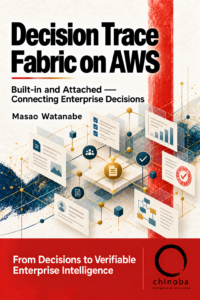
Books: Decision Trace Fabric on AWS: Built-in and Attached – Connecting Enterprise Decisions

When introducing AI into enterprise operations, many organizations begin with search, summarization, monitoring, and alerts.
They make policies and past cases searchable. They monitor equipment data and notify people of anomalies. AI answers questions and shows the documents it referenced. These are certainly important, and they are practical entry points for creating value in the field.
However, the essence of enterprise activity is not merely finding information or detecting anomalies.
What should be done after an anomaly is detected?
Which option should be chosen from several alternatives?
Who approves the decision, under what authority and responsibility?
What evidence supports the decision, what risks are accepted, and under what conditions should it be reconsidered?
This is where enterprise decision-making begins.
If a Semantic Digital Twin captures the state and changes of the physical world with meaning, and Knowledge Flow connects and circulates knowledge scattered throughout an organization, then the Decision Trace Model is the structure that records the decisions made using that knowledge and reality, and transforms them into reusable assets.
Trust Infrastructure, in turn, makes those decision records not only explainable afterward, but also verifiable: it allows us to establish that a decision was actually made, at a particular point in time, by an entity with the appropriate authority, based on the stated evidence.
This article examines how to design and collect Decision Traces for enterprises—traces that go beyond search histories and monitoring events.
A Decision Trace Is Not an “AI Explanation”
When people hear the term Decision Trace, they may imagine an explanation generated by AI or a list of sources displayed with an answer.
For example:
- Which documents did this answer reference?
- Which features supported this recommendation?
- Which threshold triggered this alert?
Such information is important. It is an Evidence Trace: a record of the evidence behind an output. But the Decision Trace required by an enterprise is broader.
A Decision Trace should provide the minimum structure needed to answer the following question:
Who—or what—made which decision, under what circumstances and authority, using which evidence and alternatives, what action was taken, and what was the result?
This includes not only AI, but also people, business systems, machines, rule engines, and multiple collaborating agents.
A Decision Trace is therefore not merely a log.
It is a causal structure that connects changes in reality, available knowledge, decisions, actions, outcomes, and learning.
Enterprise Decisions Already Exist in Distributed Form
In many organizations, the materials needed for critical decisions already exist. But they do not exist in a single system.
Consider equipment maintenance. Information relevant to a decision may be distributed across:
- Temperature, vibration, current, and operating-hour data in IoT devices or PLCs
- Production orders, process steps, and work records in MES
- Inspection results, defect details, and corrective-action records in quality systems
- Material lots, inventory, and procurement information in ERP
- Maintenance standards, work procedures, and change histories in document-management systems
- Field observations, hypotheses, and decision rationales in chat and meetings
- Approvals, rejections, and exception handling in workflow systems
- Equipment stoppages, isolation actions, purchase orders, and recovery records in execution systems
A monitoring system may detect the occurrence of an anomaly. But what an enterprise truly needs to know is different.
- Why was the impact on certain products, lots, or customers judged to be within a particular scope?
- Why was continued monitoring chosen instead of immediate shutdown?
- Which exception in which procedure was applied?
- Who ultimately approved isolation, shipment, or recovery?
- Was the decision appropriate in light of the outcome?
- What should be detected earlier next time, and which decisions should be automated or supported?
If this chain is not retained, the organization will depend each time on “the person who knew what was happening then.” Valuable decision assets remain trapped in the tacit knowledge of experienced employees, personal emails, and memories of meetings.
The Six Layers of a Decision Trace
To handle enterprise decisions, it is useful to distinguish at least six layers.
| Layer | What it records | Example |
|---|---|---|
| Reality Trace | States and changes in the real world | Rising vibration, lot arrival, delivery delay, customer behavior |
| Evidence Trace | Evidence used in a decision | Policies, inspection results, past cases, drawings, external information |
| Decision Trace | Selections, approvals, deferrals, rejections | Stop equipment, isolate a lot, approve a discount |
| Action Trace | Execution resulting from a decision | Equipment shutdown, shipment hold, purchase order, customer notification |
| Outcome Trace | Results that occur after execution | Defect rate, loss, recovery time, customer impact |
| Learning Trace | Review and knowledge updates | Threshold changes, procedure revisions, recurrence-prevention actions |
This distinction is not intended to make the data foundation more complicated.
Rather, it is necessary to avoid confusing “an observed fact,” “a decision made by a human or AI,” and “the result of that decision.”
For example, “vibration exceeded the prescribed level” is a Reality Trace.
“Stop the equipment and isolate lots processed during the previous 24 hours” is a Decision Trace.
“Send a stop command and place the lots on shipment hold” is an Action Trace.
“No defects were found in the isolated lots, and the equipment recovered in two hours” is an Outcome Trace.
Only by preserving these distinctions can an enterprise evaluate not merely the accuracy of an alert, but whether the decision and subsequent execution were appropriate.
What Should Be Recorded Is Not Every Action, but Every Decision Point
When introducing Decision Traces, the first thing to avoid is trying to collect all data, all conversations, and all operations.
Such an approach is unsustainable in terms of cost, privacy, field workload, and trust in the operating model.
The important task is to identify the decision points in a business process. A decision point is a place where multiple options exist and the choice changes responsibility, cost, risk, customer impact, or safety.
Typical examples include:
- Deciding whether to stop, continue, or conduct further checks when data falls outside a standard range
- Determining the scope of lot isolation following a quality anomaly
- Changing priorities when delivery delays occur
- Approving exceptions in credit, pricing, procurement, or hiring
- Accepting, rejecting, or deferring an AI recommendation
- Approving actions outside assigned authority or exceptions to internal policies
- Deciding on disclosure, reporting, and recovery after an incident
If these decision points are selected as the initial scope, Trace becomes not a mechanism for surveillance, but a record through which an organization can learn responsibly.
How Can an Enterprise Collect Decision Traces?
Collection does not need to be fully automated. In fact, three approaches should be combined according to the nature of the data.
1. Collect Automatically from Systems and the Physical World
Much of the Reality Trace and Action Trace can be obtained from existing systems.
- Equipment, sensors, cameras, RFID, and barcodes
- ERP, MES, WMS, CRM, and SCM
- Quality management, maintenance management, ticketing, and workflow systems
- Document management, identity and access management, and audit logs
- AI agent searches, reasoning, tool use, and execution results
However, it is not necessary to replicate all source data into a central platform. What matters is the ability to connect events relevant to a decision with meaningful context.
Rather than treating data merely as a time-series value such as “vibration: 12.4,” it should be treated as an event such as:
At SFN-Machine-01, while processing production order P-1028, an abnormal vibration pattern was detected 37 minutes after a fixture replacement.
This creates an event connected to the equipment, process, production order, time, and change history.
Here, the Semantic Digital Twin transforms physical-world data into a context that can support decisions.
2. Record Lightly at the Moment of Decision
An operating model that asks people to write lengthy rationales for every decision is likely to fail.
Instead, lightweight fields should be embedded where work already takes place: approval screens, exception-handling screens, AI recommendation interfaces, and maintenance tickets.
For example:
- Decision selected: stop / continue / isolate / conduct additional verification
- Primary rationale: safety, quality, customer impact, policy, cost, or delivery
- Evidence referenced: selected from candidates or linked directly
- Uncertainty: what remains unconfirmed
- Re-evaluation condition: what would trigger a review of the decision
- Approval: who holds final accountability
The key is not to eliminate free text entirely.
It is to make it possible to retain, even briefly, what only a person can provide: “Why was this treated as an exception?” or “What concern remains?”
3. Let AI Create a Draft Retrospectively, Then Have People Confirm It
Meetings, emails, chats, and reports contain a vast amount of context behind decisions. It is not realistic to structure all of it manually.
This is where AI can be used not as the decision-maker, but as an editor supporting the construction of a Trace.
AI can generate candidates for:
- The decision that appears to have been made
- Relevant people and their roles
- Evidence that was referenced
- Alternatives that were considered
- Actions that were executed
- Open issues
- Metrics that should be tracked to evaluate the outcome
However, content inferred by AI must not become an official record automatically.
In cases involving accountability, approval, exceptions, or external explanation, a Decision Trace should become official only after human confirmation. AI output is a “candidate,” “draft,” or “interpretation.” It is not a substitute for source records or formal approval.
What Data Structure Should Represent a Single Decision?
A single Decision Trace can be represented with the following structure.
| Field | Description |
|---|---|
| Decision ID | A unique identifier for the decision |
| Decision Question | What needed to be decided |
| Scope | Relevant equipment, lots, customers, contracts, sites, and so on |
| Decision Maker | Person, organization, agent, or rule engine |
| Authority | Authority, delegation, and approval conditions for making the decision |
| Context Snapshot | Real-world state and constraints at the time of decision |
| Evidence Set | Documents, data, cases, and external information used |
| Alternatives | Options considered and reasons for rejection |
| Decision | Selected option, confidence level, and conditions |
| Action Plan | Actions, owners, deadlines, and dependent parties |
| Policy Binding | Applicable policies, exceptions, and guardrails |
| Outcome | Execution results, impacts, and measures |
| Review | Post-decision evaluation, differences, learning, and revisions |
| Integrity Data | Timestamps, signatures, hashes, versions, and provenance |
With this structure, it becomes possible to answer more than simply “what happened?”
For example:
- What decisions were made in similar conditions in the past?
- How successful were those decisions?
- Which evidence was associated with better or worse outcomes?
- Whose experience, which policy, or which data influenced the decision?
- Which rules generate frequent exceptions?
- Under what conditions are AI recommendations not accepted by people?
This is where Knowledge Flow emerges.
Decision records become more than audit trails. They become reusable knowledge that flows into the next decision.
Trust Infrastructure Does Not Collect Everything; It Collects the Conditions of Trust
When considering Trust Infrastructure, people may first think of blockchain or tamper-resistant ledgers.
These may be valid technical options. But the essence of Trust Infrastructure is not a specific technology.
Its essence is to make the following questions answerable for a decision record:
- Where did this data come from?
- When was it acquired, and how was it transformed?
- Who or what made, approved, and executed the decision?
- Did that entity have the required authority at that time?
- Which policies and model versions were applicable at the time of decision?
- Has the record been changed afterward?
- If it was corrected, what was changed, why, and by whom?
For this reason, Trust Infrastructure collects not only the content of a decision, but also its conditions of trust.
| Condition of trust | Information to collect |
|---|---|
| Identity | IDs for people, organizations, agents, devices, and data sources |
| Authority | Roles, permissions, delegations, and approval paths |
| Provenance | Originals, acquisition routes, transformation history, and usage history |
| Integrity | Hashes, signatures, and tamper-detection information |
| Time | Timestamps for occurrence, acquisition, decision, approval, and execution |
| Policy | Applicable policies, thresholds, exception conditions, and model versions |
| Accountability | Approvers, objections, rejections, and responsibility boundaries |
| Disclosure | Who may view, use, or share information, and for what purpose |
For example, if AI recommends that a shipment should be placed on hold, Trust Infrastructure needs more than the recommendation text.
It needs to retain:
- Which model, prompt, and retrieval settings produced the recommendation
- Which documents and data were referenced
- Whether the relevant user was authorized to use that information
- Which policy was applied to formulate the recommendation
- Who reviewed the recommendation and made the final decision
- What action was taken and what result followed
This moves AI explainability beyond a plausible narrative toward a verifiable record of decision-making.
The Crucial Principle: Do Not Overwrite History
Enterprise decisions may later prove to have been wrong. For this reason, a Decision Trace is not a database that preserves only “the correct conclusion.”
The initial decision, additional evidence, changes in judgment, actions taken, and post-event evaluations all need to be retained in chronological order.
For example:
- An anomaly was detected.
- The initial decision was to continue monitoring.
- Additional inspection increased the likelihood of a lot-related issue.
- The relevant lots were isolated.
- Investigation found that fixture misalignment was the cause.
- Thresholds and inspection procedures were revised.
If this sequence is overwritten afterward with only “fixture misalignment was the cause,” the organization loses the reason monitoring was initially selected, what was known at each point, and whether the change in judgment was appropriate.
Trust does not arise from the absence of mistakes.
It arises from the ability to trace honestly how a decision was made under uncertainty and how it was corrected when new information became available.
Start with One High-Value Decision Chain
There is no need—and no reason—to make all enterprise decisions traceable at once.
The best initial target is an operation with the following characteristics:
- There is an event in the physical world or a business system
- Decision points are clear
- Multiple forms of evidence are required
- Exceptions and person-dependent judgment are common
- Outcomes can be measured after execution
- The process affects safety, quality, revenue, customers, or compliance
In manufacturing, a strong initial theme is the chain from equipment anomaly detection to impact assessment, lot isolation, recovery, and recurrence prevention.
In retail, the target might be discount decisions and outcome evaluation based on demand changes, inventory, gross margin, and competitive conditions.
In finance or review operations, it might be additional checks, evidence, approvals, conditional changes, and recovery outcomes for exceptional cases.
The key is not to treat AI answer accuracy as the only KPI.
Relevant measures include:
- Time from decision to execution
- Number of additional verification cycles
- Recurrence rate of exception decisions
- Rework, loss, incidents, or defects after decisions
- Return rate due to insufficient evidence
- Variability in decisions across similar cases
- Reuse rate of prior decision assets
- Reasons AI recommendations are accepted, revised, or rejected
From Search and Monitoring to Enterprise Decision Assets
Search is an entry point to knowledge. Monitoring is an entry point to changes in reality.
But what determines enterprise value is the decision that follows.
A Semantic Digital Twin captures reality as meaningful states.
Knowledge Flow connects distributed knowledge, experience, policies, and outcomes.
The Decision Trace Model records decisions, evidence, actions, and results, then makes them available to the next decision.
Trust Infrastructure makes the provenance, authority, integrity, and timing of those records verifiable.
When these four elements are connected, an enterprise is not merely introducing AI.
It is connecting the physical world and organizational knowledge, and transforming decision-making itself into a capability that can be learned from, verified, and continuously improved.
AI is not prediction. It is decision.
And trustworthy AI is not AI that merely explains its answer well.
It is AI whose decisions about the real world can later be verified through the evidence, authority, accountability, and outcomes on which they were based.


Chinoba
Intelligence as Relationship
Research Platform
founded by
Masao Watanabe
AI Systems Architecture
Decision Trace
Human–AI Coordination
Algorithmic Governance
Related Research
This topic is part of the Chinoba Knowledge Base.


コメント