🎥 The YouTube version is also available:
What Is AI Economics? Intelligence Field Economics for the Age of AI
The Relationship Economy: How AI Is Transforming Value, Trust, and Business
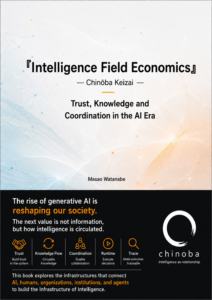
Books: Intelligence Field Economics: Trust, Knowledge and Coordination in the AI Era


The Internet was originally built as an infrastructure for distributing information.
The Web.
Search engines.
Social media.
Cloud platforms.
At their core, they were systems for delivering information.
Humans searched.
Humans read.
Humans decided.
Humans acted.
In other words, in traditional society,
the flow of information
and
the subject of decision-making
were fundamentally separated.
However, with the emergence of generative AI,
this structure is beginning to change dramatically.
AI no longer merely presents information.
It proposes.
Organizes.
Summarizes.
Reasons.
Compares.
Recommends.
Negotiates.
It assists judgment itself.
In other words, AI has begun distributing
intelligent processing
itself.
This is an extremely important shift.
In the past, value came from
“possessing information.”
But today,
information itself is rapidly becoming commoditized.
You can search for it.
Generative AI can create it instantly.
It can be translated.
Summarized.
Structured.
Information is no longer scarce.
Instead, the real challenge is shifting toward:
“How do we connect information, make judgments, and translate them into action?”
In other words, the center of value is moving from:
Information
toward:
Coordination
Decision
Trust
Meaning
Context
This is not merely a technological evolution.
It is a transformation of social structure itself.
During the Industrial Revolution,
machines expanded physical labor.
During the Information Revolution,
computers expanded information processing.
And in the AI Revolution,
“intelligent processing”
itself is beginning to distribute across society.
Here, intelligence does not simply mean IQ.
It includes:
Reasoning
Prediction
Relational understanding
Negotiation
Selection
Coordination
Meaning generation
In other words,
the capability to determine
“what should happen next.”
This transformation fundamentally changes the structure of value in society.
The value of companies.
The value of organizations.
The value of individuals.
The value of nations.
Increasingly, these will no longer be determined by
“how much information they possess,”
but by
“how effectively they can circulate intelligence.”
What matters here is that
AI alone is not what changes the world.
What truly changes is the interaction between:
AI and humans,
AI and organizations,
AI and institutions,
AI and society.
In other words,
intelligence is beginning to shift from being
an internal capability of isolated entities
to something that flows through relationships.
This differs significantly from the traditional view of AI.
For decades, AI pursued
“more intelligent standalone systems.”
Stronger reasoning.
Larger models.
Higher accuracy.
More human-like intelligence.
At the end of this trajectory stood the concept of:
AGI (Artificial General Intelligence).
Implicitly, this framework assumed that:
intelligence = the capability of a single entity.
But real society does not function through isolated entities alone.
Companies.
Nations.
Markets.
Communities.
Supply chains.
Legal systems.
All of these exist through
interactions among multiple actors.
In essence,
society itself is fundamentally
a system of relationships.
And what AI is truly entering today is not merely
knowledge generation.
Rather, it is entering society’s:
coordination mechanisms,
decision support systems,
trust formation processes,
meaning connections,
knowledge circulation,
behavioral guidance,
in other words,
the Coordination Layer of society itself.
Modern AI already acts as:
Recommendation algorithms
connecting people and information.
Agents
coordinating tasks and workflows.
LLMs
restructuring knowledge.
Workflow AI
controlling organizational processes.
Multi-agent systems
enabling coordination among multiple actors.
In other words,
AI has already begun entering
the flow of society itself.
At this stage, what becomes important is not simply model performance.
More critical questions are:
Who makes decisions?
Who bears responsibility?
Where are the boundaries drawn?
How is trust formed?
How does knowledge circulate?
How are decisions recorded?
In other words,
the AI era is also becoming
an era of intelligence governance.
This book approaches these transformations through the perspective of:
“Intelligence Field Economics.”
Within this framework,
intelligence does not exist solely inside AI models.
Rather,
across humans,
AI,
organizations,
institutions,
markets,
and infrastructures,
intelligence emerges distributively through interaction itself.
In this sense,
intelligence exists as
a field of relationships.
What becomes important here are:
Trust Networks
Knowledge Flows
Decision Flows
Coordination Structures
Agent Interactions
Decision Traces
The economy of the AI era is not merely an information economy.
It is becoming an economy centered on designing
the flow of intelligence itself.
This transformation can be explored across domains including:
AI,
multi-agent systems,
organizational intelligence,
Decision Trace Models,
knowledge circulation,
trust networks,
governance,
and social structures.
Ultimately, this opens the possibility of addressing the question:
“What kind of intelligence structure will human society evolve into in the AI era?”
AI is not merely a tool.
It is beginning to transform
the intelligence structure of society itself.
These ideas are brought together in the forthcoming book:
Intelligence Field Economics
— Trust, Knowledge and Coordination in the AI Era —
Published.
Chinoba — Runtime Society and Coordination Systems:
chinoba.org

Chinoba
Intelligence as Relationship
Research Platform
founded by
Masao Watanabe
AI Systems Architecture
Decision Trace
Human–AI Coordination
Algorithmic Governance
Related Research
This topic is part of the Chinoba Knowledge Base.

コメント