
🎥 The YouTube version is also available
The Relationship Economy: How AI Is Transforming Value, Trust, and Business


Introduction
In the previous article, I explained that in the age of AI, it is important not only to look at products or past purchase histories, but also to understand the current state of people and organizations.
We call this idea State Understanding.
However, understanding the state of an individual alone is not enough to fully grasp the movement of the economy and society.
This is because people do not act in isolation.
They live with their families,
belong to companies and organizations,
maintain relationships with customers and business partners,
participate in local communities,
and use a variety of services.
Furthermore, in the age of AI, new relationships are emerging—not only between people, but also between:
- People and AI
- AI and organizations
- AI and AI
- Organizations and communities
To understand economic value in the future, we need to understand not individuals and companies separately, but how they are connected.
We call the knowledge foundation that represents these relationships the Community Graph.
A Community Graph visualizes connections among people, AI, organizations, knowledge, and services, turning the relationships themselves into valuable assets.
Traditional Systems Have Managed “Entities”
Traditional information systems have managed people and organizations as separate pieces of data.
For example:
- Customer masters
- Employee masters
- Product masters
- Supplier masters
- Store masters
- Organization masters
- Contract information
- Purchase histories
Customer-management systems manage customer information. HR systems manage employee information. Sales-management systems manage products and revenue.
These systems can record:
What exists.
However, it is not easy for them to understand:
How those things are related.
For example, consider a customer with the following information:
- Works for a company
- Supports a local sports team
- Participates in multiple events
- Uses particular stores with their family
- Interacts with acquaintances in a community
- Regularly uses an AI assistant
In traditional databases, these records are stored in separate tables or systems.
As a result, it has been difficult to understand, as one coherent structure, how that person is connected within society and the economy.
Value Comes Not from “Points,” but from “Connections”
What matters to an organization is not only a customer’s attributes.
It is what that customer is connected to.
Even people of the same age, in the same region, and with the same occupation may behave differently if their relationships differ.
For example:
- Which communities they participate in
- Who influences them
- Which companies and services they trust
- Which events they attend continuously
- What roles they play in which organizations
- Which AI systems they use to support decision-making
Looking at customers and organizations only as isolated “points” does not reveal this value.
Only by understanding the “connections” among people, organizations, and AI can value become visible.
In other words, an important asset in the AI era is not only individual data.
It is the relationships among data.
What Is a Community Graph?
A Community Graph is a mechanism for representing the various actors that make up a community—and the relationships among them—as a graph structure.
For example, it may represent the following as nodes:
- People: residents, customers, employees, tourists, fans
- AI: AI assistants, specialist agents, business agents
- Organizations: companies, local governments, schools, hospitals, stores
- Communities: regions, teams, projects, fan clubs
- Events: meetings, sports events, tourism, campaigns
- Knowledge: documents, rules, expertise, past decisions
- Services: products, services, public services, digital functions
The relationships among them are represented as edges.
For example:
- Belongs to
- Uses
- Participated in
- Purchased
- Supports
- Manages
- Trusts
- Collaborates with
- Is influenced by
- Requested a decision from
- Referenced knowledge from
A Community Graph is not simply a directory of people and companies.
It represents:
Who is connected to what, and in what meaningful way.
People: Individuals Live Within Multiple Relationships
Every person has multiple roles.
The same person may be:
- A parent at home
- A manager within a company
- A resident in the local community
- A sports fan
- A customer at a store
- A participant in an online community
Traditional customer data treats a person as a “buyer.”
HR data treats that person as an “employee.”
Membership data treats the person as a “service user.”
In reality, however, they are all the same individual.
A Community Graph represents that individual as one node while also expressing their relationships with multiple organizations, roles, services, and communities.
This enables AI to understand not only:
What has this person purchased?
but also:
Within what relationships is this person acting?
Organizations Also Move Through Relationships
Organizations do not create value in isolation, either.
Companies operate through relationships with:
- Customers
- Employees
- Suppliers
- Shareholders
- Local communities
- Governments
- Partner companies
- AI services
Within an organization, departments such as the following also interact with one another:
- Sales
- Product development
- Manufacturing
- Quality assurance
- Legal
- Human resources
- Management
The problem is that, in many organizations, these relationships are not sufficiently visible.
For example, a customer request may move from sales to product planning, be translated into specifications by development, handed over to manufacturing, and verified by quality assurance.
Many people, departments, documents, and decisions are involved in this process.
Yet traditional systems tend to preserve each of them as separate records.
By connecting people, departments, projects, documents, and decisions through a Community Graph, organizations can make visible:
- Who was involved in which decision
- Which knowledge was referenced
- Where information stopped flowing
- Which departmental relationships are weak
- Who holds important knowledge
A Community Graph is therefore not an organization chart. It is a dynamic map of how an organization actually works.
AI: The Emergence of a New Relationship Actor
In the AI era, a new actor is added to the Community Graph:
AI.
Until now, AI has often been treated as a function embedded within a system.
However, as AI agents become more widespread, AI begins to take on independent roles.
For example:
- AI supporting sales representatives
- AI reviewing contracts
- AI monitoring manufacturing equipment
- AI handling customer inquiries
- AI guiding local events
- AI coordinating multiple AI agents
Each of these AI systems has different knowledge, roles, authorities, and areas of responsibility.
In a Community Graph, AI can be represented as a node in the same way as people and organizations.
The graph can then manage relationships such as:
- Who uses the AI
- Which organization the AI belongs to
- Which knowledge the AI may access
- Which decisions the AI is entrusted to make
- Which other AI systems it collaborates with
- Who holds final accountability
This makes human–AI collaboration explicit.
It becomes possible to design AI not merely as a tool, but as an actor with a defined role in society and organizations.
The Relationship Between People and AI Is Also Changing
The relationship between people and AI is no longer simply one of “user and tool.”
For example, if an AI supports the same user every day and comes to understand that person’s work, goals, decision criteria, past decisions, preferences, and constraints, a continuing relationship forms between the person and the AI.
However, this relationship is not the same as trust between people.
Trust in AI is built through:
- Accuracy
- Consistency
- Explainability
- Clear authority boundaries
- Privacy protection
- Human control
- Traceability of decision histories
In a Community Graph, the relationship between people and AI can have meanings such as:
- Uses
- Delegates to
- Supervises
- Approves
- Sets a trust level for
This allows organizations to manage not only what AI can do, but also:
In whose relationship, and to what extent, can AI be entrusted?
Relationships Have Histories
A relationship is not complete simply because a connection has been created.
It changes over time.
For example, the relationship between a customer and a company may develop as follows:
Awareness
↓
First use
↓
Continued use
↓
Trust
↓
Recommendation
Conversely, it may evolve in the opposite direction:
Disappointing experience
↓
Inquiry
↓
Delayed response
↓
Declining trust
↓
Churn
Relationships within organizations change in the same way.
People who repeatedly collaborate on projects accumulate trust and shared understanding.
On the other hand, if information sharing is inadequate, relationships weaken.
In a Community Graph, it is important to record not only whether a relationship exists, but also:
- When it began
- How strong it is
- Whether it has remained active recently
- Which events changed it
- Which decisions or actions it influenced
This makes it possible to treat relationships not as static data, but as evolving assets.
The Idea of Relationship Capital
Facilities are assets for a company.
Patents and brands are also assets.
Data and knowledge are important assets in the age of AI.
In the same way, the relationships held by companies and local communities can also be viewed as assets.
We call this Relationship Capital.
Relationship Capital includes, for example:
- Ongoing relationships with customers
- Collaborative relationships between companies
- Trust relationships with local communities
- Collaborative relationships among employees
- Participation in communities
- Human–AI collaboration relationships
- Relationships among AI agents
- Reputation and trust accumulated within an organization
These may not always be recognized directly as accounting assets, but they have a major impact on the future value of companies and communities.
Even when companies offer the same products, those with strong relationships with customers and local communities continue to be chosen.
Even when companies use the same AI technologies, those with stronger knowledge sharing and collaboration can achieve better outcomes.
In other words, differences in competitiveness arise not from technology alone, but from the relationships surrounding that technology.
Community Graph Makes Relationship Capital Visible
Relationship Capital is important, but difficult to see.
A Community Graph becomes a foundation for making this invisible capital visible.
For example, in a local economy, it can help analyze:
- Which events created new relationships
- How tourists became connected to stores and local areas
- How sports fans transitioned into local spending
- Which communities encouraged participation
- What value was created through collaboration between companies and local governments
Within companies, it can help identify:
- Who holds critical knowledge
- Which cross-departmental relationships produce results
- Which AI systems support which operations
- Where decision-making is being delayed
- Whether knowledge is concentrated in particular individuals
A Community Graph is not merely a social network diagram.
It is an economic foundation for visualizing the structures through which value is created.
An Implementation Image for Community Graphs
When implementing a Community Graph, it is not necessary to register every relationship from the beginning.
Start with the actors directly connected to value creation.
For example, within a company, the following can be defined as core nodes:
- People
- Organization
- Project
- Document
- Knowledge
- Decision
- AI Agent
Possible relationships include:
BELONGS_TOWORKS_ONCREATEDREFERENCESDECIDEDAPPROVEDUSESDELEGATED_TOCOLLABORATES_WITH
For example:
People
↓ WORKS_ON
Project
↓ REFERENCES
Knowledge
↓ SUPPORTS
Decision
↓ EXECUTED_BY
AI Agent
↓ GOVERNED_BY
Organization
This makes it possible to trace, for a single decision:
- Who was involved
- Which knowledge was used
- Which AI supported it
- Which organizational rules were applied
Knowledge Flow, State Understanding, and Community Graph
The three concepts introduced so far are not independent.
Knowledge Flow transforms information scattered across companies and communities into knowledge that AI can use.
State Understanding integrates that knowledge with current context, goals, and intent in order to understand the present state.
Community Graph represents the relationships among people, AI, organizations, knowledge, events, and other entities.
By combining these three, AI can answer questions such as:
- Who is involved?
- What is the current state?
- Which knowledge should be referenced?
- Who should collaborate?
- Which AI should be asked to help?
- What should be decided next?
In other words, the following cycle emerges:
Knowledge Flow
↓
State Understanding
↓
Community Graph
↓
Decision
↓
Action
↓
New Relationship
Actions create new relationships, and those relationships are used in the next decision.
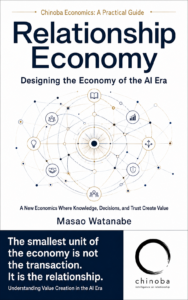
Its Relationship with the Relationship Economy
The Relationship Economy places greater importance on building ongoing relationships and creating value through them than on increasing one-time transactions.
A Community Graph is the foundation for understanding and nurturing those relationships.
For example, if AI recommends only the products with the highest profit margins, short-term sales may increase.
However, if it repeatedly makes recommendations that ignore the user’s goals and context, the relationship will weaken.
By contrast, if AI understands the user’s state and surrounding relationships, and provides support that is genuinely needed, trust accumulates.
As a result, value such as the following can emerge:
- Continued use
- Recommendations
- Community participation
- Collaboration between companies
- Contributions to local communities
- Co-creation of new services
This creates the following cycle:
Relationship
↓
Trust
↓
Collaboration
↓
Value Creation
↓
Stronger Relationship
This cycle is the fundamental structure of the Relationship Economy.
Considerations When Managing Relationships
Community Graphs hold significant potential.
At the same time, converting relationships and trust between people into data requires careful consideration.
In particular, the following uses may lead to serious problems:
- Inferring relationships that individuals do not know about
- Unilaterally evaluating human relationships
- Allowing AI to determine trustworthiness
- Excessively monitoring relationships
- Using data for purposes other than its original intent
- Treating old relationships as if they were still current
Therefore, implementation requires:
- Clear disclosure of the purpose of use
- Consent from the individuals concerned
- Distinguishing inference from fact
- Access controls
- Expiration periods for relationship data
- Records of decision rationale
- Mechanisms for objection and correction
- A Human Gate
To use relationships as assets, we must also design mechanisms that protect those relationships.
Conclusion
Value in the age of AI does not arise solely from individual people, companies, data, or AI systems.
It arises from how they are connected, how they collaborate, and how they build trust.
A Community Graph represents the relationships among People, AI, Organizations, Knowledge, Events, and Services, making previously invisible Relationship Capital visible.
AI that can understand relationships can do more than recommend products.
It can help determine:
- Which people should be connected
- Which organizations should collaborate
- Which AI should be delegated a role
- Which knowledge should be shared
Relationships do not emerge only by chance.
In the AI era, we need designs that understand, protect, and cultivate relationships themselves.
We call the system that transforms these relationships into value the Relationship Economy.
In the next article, I will introduce the Decision Trace Model—Decisions Become Assets: how AI that understands relationships and states can make decisions, and preserve their rationale as an asset for the organization.


Chinoba
Intelligence as Relationship
Research Platform
founded by
Masao Watanabe
AI Systems Architecture
Decision Trace
Human–AI Coordination
Algorithmic Governance
Related Research
This topic is part of the Chinoba Knowledge Base.


コメント