🎥 The YouTube version is also available:
Semantic Chunks: Turning Approved Rules into Reusable Knowledge Assets | Authorized Rule Ledger

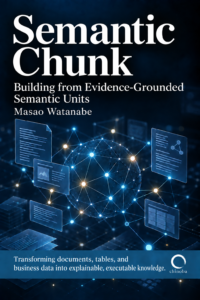
When introducing AI, search, and Knowledge Graphs into business operations, Semantic Chunking can be a powerful starting point. Rather than simply splitting documents into small pieces, it treats information as units that preserve coherent meaning, scope, conditions, and relationships. This improves search accuracy, the quality of RAG references, and the reusability of organizational knowledge.
However, if Semantic Chunks remain merely “units for retrieval,” an important question remains for business use:
Who verified this statement, against what evidence, and within what scope was it approved for use?
For example, when dealing with maintenance procedures, quality criteria, contractual exceptions, customer-response rules, or execution conditions for AI Agents, retrieving semantically similar text is not enough. Unless it is clear whether the information is current, which equipment or product it applies to, under what conditions exceptions are permitted, who approved it, and whether it has actually been implemented and verified, it is dangerous to use search results directly for decisions or execution.
This is why Semantic Chunks should be extended into an Authorized Rule Ledger that includes evidence, approval, and conditions of use. This design transforms a Chunk from a simple retrieval unit into Authorized Data that can be referenced, reused, and audited in business operations.
The Gap in Accountability That Semantic Chunks Alone Cannot Fill
A typical Semantic Chunk contains at least the following:
- An excerpt from the original text, or a reference to the original text
- An explanation, rule, or fact that forms one coherent unit of meaning
- Topics, targets, relationships, and keywords
- Links to neighboring Chunks or concepts in an ontology
This makes it possible to identify, for example, what should be checked when a particular piece of equipment becomes abnormal, or which provisions relate to a given contract condition, without reading an entire document.
However, a Chunk that appears plausible in search results is not necessarily a rule that may be used in the field. The former is a candidate. The latter requires clear accountability and boundaries of applicability.
Descriptions in outdated procedures, meeting minutes from an exploratory stage, quality criteria intended for a different product, or personal notes from an individual employee can all appear near the top of a search result. Even if an LLM produces a plausible summary, the risk does not disappear. In fact, the smoother the language becomes while the source and scope remain invisible, the easier it is for users to overlook an incorrect generalization.
What is needed is to connect Semantic Chunks, which handle semantic similarity, with the information required to authorize their use in business.
What Is an “Authorized Rule Ledger”?
An Authorized Rule Ledger manages rules, decision criteria, constraints, procedures, and exception conditions as Semantic Chunks. Each Chunk is given evidence, scope of applicability, approval status, usage constraints, and implementation and verification status.
The key point is not to fix a single answer in one place. It is to make clear which statement was confirmed by whom, when, and for what purpose it may be used—and to make changes traceable over time.
Each Chunk therefore serves two roles simultaneously:
- A semantic unit: a unit that search, summarization, Knowledge Graphs, and Agents can understand and reference.
- A governance unit: a unit used to determine the permissible scope of business use, responsible owner, version, and verification status.
When these two roles are connected, AI can do more than return similar text. It can present an evidence-backed rule that may be used under the current conditions.
Seven Pieces of Information Each Chunk Should Hold
As a minimum structure for an Authorized Rule Ledger, each Semantic Chunk should include the following information.
| Information | Content | Why it is needed |
|---|---|---|
| Original evidence | Relevant source passage, document ID, page or paragraph, acquisition date, quotation range | Enables people to return to the original source and verify the correctness of summaries and extraction |
| Scope of applicability | Organization, product, equipment, region, contract, process, period, preconditions | Prevents misapplication in a different context |
| Approver | Approving role, organization, identifier, and approval date | Clarifies who determined that the information may be used |
| Version | Chunk version, source-document version, effective date, expiration date, replacement target | Makes currency and change history traceable |
| Usage constraints | Reference only, proposal only, no automatic execution, Human Check required, confidentiality classification, and so on | Controls how far AI and users may rely on the information |
| Implementation status | Not implemented, in progress, implemented, retired, target system | Prevents confusion between documented policy and actual operation |
| Verification status | Not verified, reviewed, tested, audited, nonconformity detected | Prevents overlooking situations in which implementation exists but effectiveness is unconfirmed |
These should not be treated as fields that must all be completed perfectly at once. It is better to begin with high-priority business domains and leave unknown items explicitly marked as “unknown.” Preventing automatic use while key facts remain unknown is itself part of the ledger’s value.
Separate the States: Candidate, Reviewed, Authorized, and Expired
Extracted Chunks must not be treated as authorized from the beginning. Their lifecycle should be made explicit.
| Status | Meaning | Treatment in AI and search |
|---|---|---|
| Candidate | Extracted and registered candidate; evidence or scope has not yet been confirmed | Used only for discovery; never for decisions or execution |
| Reviewed | Original source and semantic unit have been confirmed, but business-use approval is incomplete | May be presented to people as review material |
| Authorized | Approver, scope, version, and usage constraints have been confirmed | May be used for business reference or proposals, subject to constraints |
| Implemented / Verified | Implementation and verification status have also been confirmed | May be used to evaluate execution conditions; automatic execution still requires separate authorization |
| Superseded / Expired | Replaced by a new version or no longer valid | Not used for current decisions in principle; retained as history |
With this lifecycle, outputs created by LLMs, classifiers, or rule-extraction systems remain candidates. Only information that has passed human confirmation becomes Authorized Data. AI confidence may be used to prioritize reviews, but it must never substitute for approval itself.
Connect Not Only the Rule, but Also Its Evidence and Implementation
What makes an Authorized Rule Ledger strong is that it does not store only the rule text. At minimum, it should connect the following relationships:
Original Evidence → Semantic Chunk → Approval → Usage Constraints
                         ↓                 ↓
                Implementation Target   Verification Records / Audit Results
For example, consider a Chunk stating: “When certain conditions are met, approval by the responsible person is mandatory.” This Chunk should be connected to the original policy text, the applicable transaction type, amount, and customer category, the approving authority, the effective version, and the limitation that the Agent may only make a proposal.
It should also link to the workflow that implements the rule, relevant test results, and audit logs.
This makes it possible to answer the following questions through one structure:
- Which original source supports this decision?
- May this rule be applied to this customer, amount, or region?
- Which version is currently effective?
- Who approved it?
- May the Agent execute automatically, or is a Human Check required?
- Does the implementation actually conform to this rule?
- After the rule changes, which implementations and verifications must be updated?
This is not merely an information-organizing approach for Knowledge Graphs. It is a mechanism for making the boundary between decision and execution traceable.
Treat Human Check as a Ledger-Update Process, Not a Final Approval Step
Human Check is not simply the act of placing a final stamp on AI output. It should be designed as the process of verifying the original source, scope, version, and usage conditions, and thereby creating Authorized Data.
To make this process efficient, reviewers should not be asked to read long documents. A review screen should bring together at least the following on one page:
- The text extracted as a Chunk
- The relevant source passage, including surrounding context
- Target, conditions, and related concepts inferred by AI or an extraction system
- Differences between the current and previous versions
- Recommended usage constraints
- Actions for approval, return for revision, scope correction, and expiration
The reviewer’s job is not to write the content from scratch. It is to decide quickly: “Is this the right semantic unit?” “May it be used within this scope?” and “Are these constraints sufficient?”
In this way, people do not make every decision in place of AI. Instead, they define the boundaries of judgment that the organization can safely reuse.
Connecting to AI Agents: From Evidence for Answers to Conditions for Actions
An Authorized Rule Ledger improves more than the quality of RAG answers. It can be used as a decision condition when an AI Agent performs actions such as sending external messages, registering information, requesting approval, or changing settings.
An Agent can follow this sequence:
- Identify the user request and target.
- Retrieve only Authorized Chunks that match the applicable scope.
- Check version, effective period, usage constraints, and implementation and verification status.
- Propose or execute only the actions permitted when the conditions are satisfied.
- Record the evidence Chunk, version, evaluation result, and Human Check as a Decision Trace.
For example, if the usage constraint is “proposal only; human approval required,” the Agent must not call an execution API. It should instead present an approval-ready summary and the original evidence.
If verification status is unconfirmed, automatic execution should not proceed even when the rule itself has been authorized. If the case falls outside the defined scope, the Agent should not fill the gap with a plausible similar Chunk. It should stop and state: “No applicable authorized rule was found.”
At this point, the Semantic Chunk becomes not merely a fragment of AI knowledge, but an input to a runtime that governs action.
Start with High-Importance Decisions
There is no need to convert all company documents into a ledger at once. In fact, expanding scope too early can overwhelm the approval process and create a knowledge base that is never updated.
A practical sequence is:
- Select one decision that has high impact if misapplied and is referenced repeatedly.
- Create Semantic Chunks that retain original evidence and scope of applicability.
- Define approver, version, and usage constraints first.
- Clearly distinguish Candidate from Authorized in search results.
- Add links to implementation, verification, and audit records.
- Improve Chunk granularity and review screens using usage logs and reasons for returned reviews.
Suitable initial targets include first-level quality-issue decisions, stop conditions during maintenance, customer-response escalation, permission assignment, and quotation or contract exception decisions. In all of these domains, the central issue is not merely knowing an answer. It is knowing under what conditions and under whose responsibility that answer may be used.
Conclusion: Manage Not Only Meaning, but Meaning That May Be Used
Semantic Chunking makes documents easier for AI to read and brings search and Knowledge Graphs closer to practical use. But what businesses truly need is not merely an increase in meaningful fragments. They need to manage the basis, scope, approver, and constraints under which those fragments may be used.
When each Chunk holds original evidence, scope of applicability, approver, version, usage constraints, and implementation and verification status, Semantic Chunks become an Authorized Rule Ledger.
This ledger is not simply a collection of metadata for improving search precision. It is a knowledge infrastructure that makes organizational judgment reusable, connects AI proposals and execution to boundaries that can stop them, and makes it possible to explain evidence and accountability afterward.
AI should not operate on information that merely sounds plausible. It should operate on information that can be traced back to the original source, whose conditions of use are understood, and that people have approved with accountability.

Chinoba
Intelligence as Relationship
Research Platform
founded by
Masao Watanabe
AI Systems Architecture
Decision Trace
Human–AI Coordination
Algorithmic Governance
Related Research
This topic is part of the Chinoba Knowledge Base.

コメント