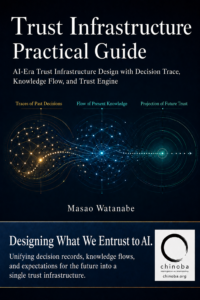
🎥 The YouTube version is also available:
Trust Infrastructure: Building the Foundation for Human–AI Collaboration

The rapid evolution of generative AI has enabled AI systems to write articles, translate languages, generate software, assist with design, and perform increasingly sophisticated analysis. AI has become deeply integrated into our work and everyday lives, and its presence continues to grow.
However, this transformation is about far more than improved performance.
We are now reaching a turning point where our relationship with AI itself is fundamentally changing.
AI Is No Longer Just a Tool
Traditionally, AI functioned as a tool used by humans.
Humans issued instructions, AI processed information, and then returned results. Decision-making remained entirely in human hands, while AI served only as an assistant.
Human
   ↓
   AI
   ↓
Result
This was a one-way relationship.
Today, however, the emergence of generative AI and AI agents is fundamentally changing this structure.
AI no longer interacts only with humans. It increasingly collaborates with other AI systems, supports organizational operations, participates in communities, and even operates within social institutions and governance frameworks.
In other words, AI is evolving from a tool used by people into an entity that exists within society and forms relationships with other participants.
The AI of the future will operate within multidirectional networks where humans, AI systems, organizations, communities, and social institutions continuously influence one another.
As Relationships Increase, Coordination Becomes More Difficult
When only two people collaborate, mutual familiarity is often sufficient.
However, as AI joins the interaction, AI agents collaborate with one another, organizations become involved, communities emerge, and coordination expands to society as a whole, relationships become exponentially more complex.
The scope of coordination evolves through several stages:
- Collaboration between individuals
- Human–AI collaboration
- Coordination among AI agents
- Collaboration with organizations and institutions
- Coordination across society as a whole
In such an environment, the critical question is no longer simply what each participant can do, but rather how much each participant can be trusted.
As relationships become increasingly complex, trust can no longer remain a personal feeling. It must become a foundational infrastructure supporting society itself.
Four Factors That Prevent Coordination
Why does coordination become so difficult?
We believe the challenges can be summarized into four fundamental factors.
1. Uncertainty of Expectations
We cannot predict how another party will behave next.
Without the ability to anticipate future actions, meaningful collaboration becomes difficult.
2. Lack of Transparency of Intent
We often do not understand why a particular decision was made.
When the purpose and reasoning behind a decision are invisible, it becomes difficult to accept or rely upon that decision.
3. Inconsistent Decision Criteria
Humans, AI systems, organizations, and institutions often operate under different values, rules, and evaluation standards.
When decision criteria are inconsistent, identical situations can produce entirely different outcomes, making coordination increasingly difficult.
4. Information Asymmetry
Sometimes only certain participants possess the information necessary for decision-making.
When access to information is uneven, participants cannot fully understand the situation or make well-informed decisions.
As long as these four problems remain unresolved, sustainable coordination among humans, AI, organizations, and society cannot be achieved.
What Is Trust?
Trust is commonly understood as confidence or belief in another party.
However, we do not view Trust as merely an emotional or psychological state.
We define Trust as:
The ability to rationally understand another party’s intentions, decisions, and actions, thereby creating an environment where collaboration can occur with confidence.
The important distinction is that Trust does not arise simply because we like someone.
Rather, Trust emerges because we can understand them.
Trust is therefore not an emotion.
It is an infrastructure that enables society to coordinate.
Four Mechanisms for Building Trust
How, then, can Trust be established?
We believe four essential mechanisms are required.
1. Reducing Uncertainty of Expectations
To predict future behavior, it is necessary to accumulate past decision histories.
This is where Decision Trace becomes essential.
By recording:
- the situation,
- the decision that was made,
- and the resulting outcome,
future behavior becomes increasingly predictable.
Decision history creates rational expectations.
2. Reducing the Lack of Transparency of Intent
Every decision has a purpose and a rationale.
Making goals, constraints, reasoning, and priorities visible—and sharing them with others—greatly improves mutual understanding.
True transparency goes beyond explainability.
It requires communicating why a decision was made.
3. Reducing Inconsistent Decision Criteria
Successful collaboration between humans and AI requires common rules and governance.
Boundaries, policies, and governance frameworks should be clearly defined so that everyone makes decisions according to shared criteria.
This enables consistent and predictable coordination.
4. Reducing Information Asymmetry
Information must reach the right people at the right time.
Knowledge Flow, which enables information to circulate appropriately throughout an organization or society, is therefore a critical component of Trust Infrastructure.
When information is effectively shared, decision quality improves, and coordination becomes significantly more effective.
The Concept of Trust Infrastructure
Trust is not simply another AI capability.
Nor is it merely an issue between human beings.
Trust is the social foundation that enables humans, AI systems, organizations, institutions, and communities to collaborate safely and effectively.
As AI becomes an active participant in society, Trust should be viewed as infrastructure—just like transportation networks, electricity, or the Internet.
This is what we call Trust Infrastructure.
A New Architecture for the AI Era
Generative AI is capable of producing sophisticated answers to increasingly complex questions.
But generating answers alone is not enough for sustained collaboration within society.
The more important questions become:
- How did the AI make its decision?
- Why did it make that decision?
- How can society determine whether that decision is trustworthy?
To address these questions, we are researching an integrated architecture that combines:
- Decision Trace Model
- Trust Infrastructure
- Knowledge Flow
- Governance & Boundary Systems
- Runtime Society
Rather than viewing AI simply as a powerful computational tool, we believe it should be understood as a participant that collaborates with others to create value within society.
This perspective represents the next stage in AI architecture.
Conclusion
AI is evolving from the era of tools into the era of participants in society.
In a world where humans, AI systems, organizations, communities, and social institutions are all interconnected, AI performance alone is no longer sufficient.
The real challenge is:
How can we build a society where diverse participants can collaborate with confidence?
Achieving this requires mechanisms that allow us to understand intentions, decisions, and behaviors, and to form rational expectations about future actions.
Trust is not merely an ethical principle or an abstract ideal.
It is the infrastructure that enables sustainable coordination among humans, AI, organizations, and society.
We believe that Trust Infrastructure will become one of the most important research themes for building the social foundation of the AI era.

Chinoba
Intelligence as Relationship
Research Platform
founded by
Masao Watanabe
AI Systems Architecture
Decision Trace
Human–AI Coordination
Algorithmic Governance
Related Research
This topic is part of the Chinoba Knowledge Base.

コメント