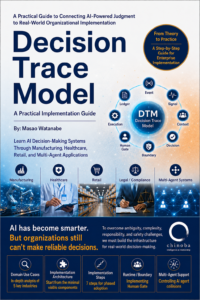
I am pleased to announce the publication of my new book,
Decision Trace Model: A Practical Guide to AI Decision Systems.

To celebrate the release, the Kindle edition will be available free of charge for 24 hours, from June 8, 2026, 5:00 PM JST to June 9, 2026, 5:00 PM JST.
If you are interested in AI adoption, multi-agent systems, or organizational AI transformation, I hope you will take this opportunity to download a copy.
AI Has Become Smarter. But Have Organizations Changed?
In recent years, AI technologies have advanced at an extraordinary pace.
Machine Learning.
Generative AI.
Agents.
RAG.
Multi-Agent Systems.
Organizations can now leverage sophisticated analysis, recommendations, and automation at a scale that was previously unimaginable.
Yet a significant gap remains between AI-generated recommendations and real-world organizational execution.
Questions such as:
- Who should review the recommendation?
- Which rules should govern its use?
- How should conflicting recommendations be resolved?
- How should recommendations be translated into action?
- Who is ultimately accountable?
continue to emerge in practical deployments.
As AI becomes more capable, the critical challenge is no longer simply what AI can propose.
The challenge is how those proposals can be integrated into organizational activities and operational processes.
From Proposal to Execution
The framework introduced in this book,
Decision Trace Model (DTM),
is designed to structure the path from AI-generated recommendations to real-world execution.
DTM provides a framework for achieving:
- Safety
- Explainability
- Auditability
- Continuous Improvement
through a structured architecture.
At its core, DTM consists of:
- Event
- Signal
- Context
- Decision
- Boundary
- Human Gate
- Execution
- Ledger
These components make it possible to understand how information is processed, how actions are selected, and why particular outcomes occur.
The goal is not merely to build smarter AI.
The goal is to create an environment where AI can be utilized safely, continuously, and effectively within organizational processes.
What Makes This Book Different?
This book is not simply an introduction to the concepts behind Decision Trace Model.
It is a practical implementation guide built around real-world case studies.
Through examples drawn from:
- Manufacturing
- Healthcare
- Retail
- Multi-Agent Environments
the book explores how organizations can integrate AI into daily operations while maintaining safety, accountability, and human oversight.
In addition, the book presents a step-by-step adoption roadmap for organizations asking:
“Where should we begin?”
The implementation journey includes:
- Introducing RAG
- Introducing Knowledge Graphs
- Introducing AI Suggestions
- Introducing Human Review
- Introducing Boundaries and Governance
- Recording Decision Traces
- Evolving Toward Multi-Agent Systems
Rather than focusing solely on theory, the book emphasizes practical adoption strategies that organizations can apply immediately.
Position Within the Broader Framework
This book is part of a broader body of work that includes:
- Decision Trace Model
- Trust Infrastructure
- Knowledge Infrastructure
- Runtime Society
Among these works, this volume serves as the most practical and implementation-oriented guide.
Its focus is not only on conceptual architecture but also on how organizations can introduce, operate, and evolve AI systems in the real world.
Who Should Read This Book?
This book is intended for:
- Enterprise Architects
- AI Architects
- Technology Leaders
- Transformation Leaders
- Governance Professionals
- Multi-Agent System Designers
- Anyone exploring the next stage of organizational AI adoption
If you are interested in building systems where AI and humans can collaborate effectively, I hope this book provides useful insights and practical guidance.
Thank you for reading.
Chinoba — Runtime Society and Coordination Systems


Chinoba
Intelligence as Relationship
Research Platform
founded by
Masao Watanabe
AI Systems Architecture
Decision Trace
Human–AI Coordination
Algorithmic Governance
Related Research
This topic is part of the Chinoba Knowledge Base.

コメント