Decision Trace Model: A Complete Guide — From Prediction to Decision Infrastructure
AI systems have become capable of generating many “answers.”
However, in real-world operations, critical problems still remain:
• It is unclear why a particular decision was made
• Decisions vary depending on the person
• Decisions cannot be reused
• Accountability is ambiguous
In other words:
AI can produce outputs, but it cannot make decisions.
This reveals a structural limitation.
What is important is this:
What AI produces is not a decision.
Risk scores
Predictions
Recommendations
These are all signals.
However, in reality, we need decisions:
Should it be approved?
Should it be rejected?
Should it be escalated to a human?
AI does not make decisions.
There is a fundamental gap between Signal and Decision.
This gap is the core limitation of modern AI systems.
1. What is the Decision Trace Model?
The Decision Trace Model is a framework that transforms AI
from a mere prediction tool into a decision-making system.
Traditional AI has primarily focused on:
- Prediction
- Classification
- Recommendation
However, in real-world operations, what is truly required is not just output.
It is decision.
The Decision Trace Model defines decision-making as the following structure:
Event → Signal → Decision → Boundary → Human → Log
With this structure, organizations can:
- Visualize decisions
- Make decisions explainable
- Reproduce decisions
- Continuously improve decision quality
In other words:
AI is no longer just a model — it becomes a “decision engine.”
This demo shows how decision-making is structured, executed, and recorded as a traceable system.
This system transforms raw changes into structured decisions through a clear and traceable flow:
Raw Change → Signal Extraction → Decision → Boundary → Human → Log
Instead of relying on implicit reasoning inside models, decision logic is externalized and made explicit.
Each step is:
• Traceable — you can see how the decision was made
• Explainable — the reasoning is structured and visible
• Executable — decisions directly trigger actions
• Governable — constraints and human checkpoints are embedded
This is not just an AI model.
It is a decision system.
2. Why is the Decision Trace Model Necessary?
Modern AI systems have fundamental limitations.
Decisions are not structured
Even with advanced models:
- Judgments remain in people’s heads
- Logic is buried in code or prompts
- Reasoning cannot be reused
- Outcomes cannot be properly explained
As a result:
- Inconsistency in decisions
- Lack of accountability
- Poor scalability
- Loss of knowledge
The fundamental problem
Traditional systems look like this:
Input → Model → Output
But real-world decision-making requires:
- Constraints (cost, risk, policy)
- Trade-offs
- Human judgment
- Context understanding
Prediction is not decision.
Paradigm Shift
The Decision Trace Model introduces a fundamental shift:
- Treat decisions as a first-class object
- Externalize logic
- Make processes traceable
This enables:
✔ Explainable decisions
✔ Scalable operations
✔ Knowledge accumulation
✔ Human-AI collaboration
3. Core Structure of Decision Trace
At the heart of the model is a simple yet powerful structure:
Event → Signal → Decision → Boundary → Human → Log
Event
A trigger from the real world
(e.g., order placed, anomaly detected, user action)
Signal
Processed information used for decision-making
(e.g., predictions, metrics, trends)
Decision
The actual judgment
(e.g., approve, reject, recommend, escalate)
Boundary
Constraints and rules
(e.g., budget limits, risk thresholds, policies)
Human
Human involvement when necessary
(e.g., approval, intervention, interpretation)
Log
A complete record of the decision
(e.g., why the decision was made)
This structure allows decisions to be treated as data.
4. Decision Trace Architecture
The Decision Trace Model typically consists of the following layers:
Ontology Layer
Defines meaning and context
Signal Layer (AI / ML / LLM)
Generates signals (does not make decisions)
Decision Layer (DSL / Rules)
Defines decision logic
Execution Layer (Behavior Tree / Orchestrator)
Controls flow and execution
Boundary Layer (Policy / Risk)
Applies constraints
Trace & Ledger Layer
Records all decisions
AI generates signals.
The system makes decisions.
Structure is fixed, but implementation can be incremental
One of the key characteristics of the Decision Trace Model is that:
the structure is consistent, but the implementation can be introduced incrementally
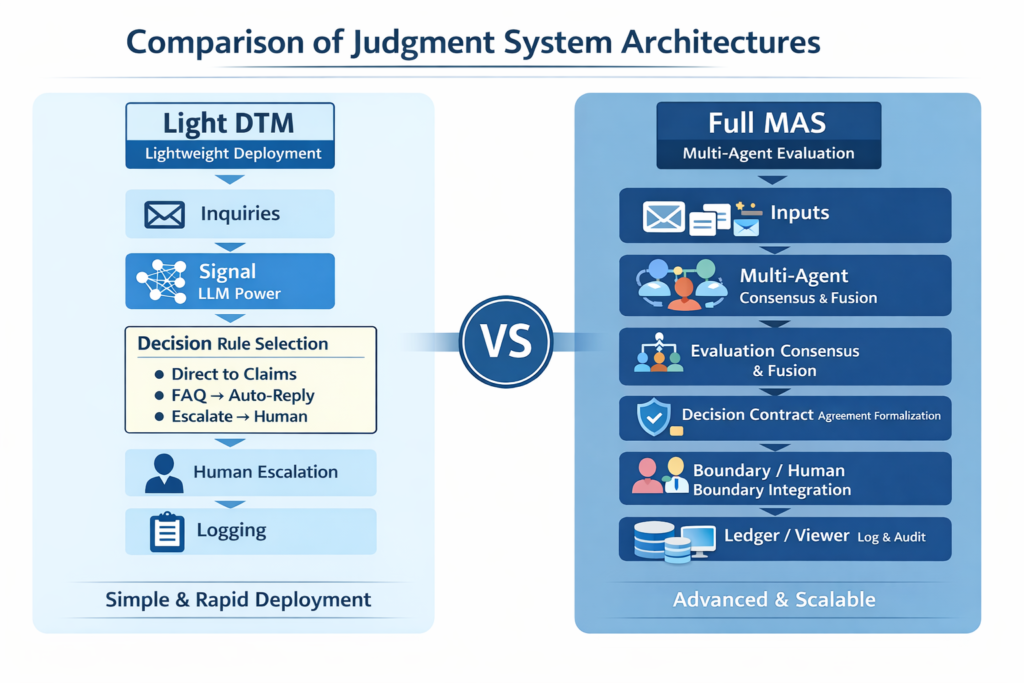
Not every use case requires a full setup with:
- Ontology
- Multi-Agent
- Behavior Tree
In fact, in many real-world scenarios, it is more practical to:
start with a minimal setup and expand as needed
Minimal Setup (Light Configuration Example)
For example, in a simple use case such as customer inquiry handling,
the following structure is sufficient:
Event (inquiry)
→ Signal (LLM classification)
→ Decision (rules)
→ Human (if needed)
→ Log (record)
- Route complaints to human agents
- Automatically respond to FAQ-type inquiries
- Hold or defer unclear cases
Even with this minimal configuration, the system can achieve:
- Clear decision criteria
- Guaranteed escalation paths
- Reproducible decision-making
- Continuous improvement through logs

See detail in Lightweight DTM for Building “Decision-Capable AI”
5. From Concept to System
Decision Trace Model is not just a concept.
Decision-making can already be:
- Defined as a structure
- Executed as a system
- Continuously improved
And today, the concrete implementations to achieve this are emerging.
Decision Trace Studio
Decision-making is not something you design once and finish.
It requires a continuous cycle:
- Design
- Execute
- Compare
- Improve
Decision Trace Studio is an environment for designing, validating, and improving decisions.
It enables you to:
- Design decision flows as nodes
- Simulate scenarios
- Compare before and after changes
- Generate improvement suggestions
In other words,
It turns decision-making into an operable system
While traditional AI handles outputs,
Decision Trace Studio handles
Decision itself
Light DTM Starter Kit
“It’s difficult to build all of this from the beginning.”
That is a natural concern.
To address this, we provide:
This is a minimal implementation of the Decision Trace Model that separates:
- Signal (AI outputs)
- Decision (simple rules)
With just this separation:
- The reason why outcomes differ becomes visible
- Variability in decisions is reduced
- Minimum reproducibility is achieved
In other words,
It is the first step toward moving AI from “output” to “decision”
For more details, see:
“Minimum Viable Decision AI — Light DTM Starter Kit”
Overview
- Decision Trace Model
→ Structure of decision-making (Concept) - Decision Trace Studio
→ Design, simulation, and improvement (System) - Light DTM Starter Kit
→ Entry point for adoption (Entry Point)
Together, these transform AI from a mere tool into:
Decision Infrastructure
6. Before / After
Traditional approach:
Input → Model → Output
(Decisions remain in people’s heads)
Decision Trace Model:
Event → Signal → Decision → Boundary → Human → Log
(Decisions are treated as structured objects)
What changes:
• Decisions are recorded
• Decisions become reproducible
• Decisions can be continuously improved
• Decisions become organizational assets
And this accumulated decision asset does not stop at being recorded.
By applying Decision Trace GNN Core,
stored decisions are learned as relational structures,
becoming reusable, optimizable,
and continuously evolving entities.
In other words,
decisions shift from something that is merely recorded
to something that is actively learned.
7. Differences from Traditional Approaches
vs XAI (Explainable AI)
- XAI: Explains model behavior
- Decision Trace: Explains decision processes
Not “why the model predicted,”
but “why the decision was made.”
vs LLM-based systems
- LLM: Generates outputs and suggestions
- Decision Trace: Defines decision structure
LLM = Signal generator
Decision Trace = Decision system
vs Rule-based systems
- Rules: Often static and fragmented
- Decision Trace:
- Signals
- Rules
- Execution
- Logs
Integrates the entire decision lifecycle
8. Use Cases
The Decision Trace Model can be applied across all domains:
Manufacturing
Quality decisions, anomaly handling, regulatory compliance
Retail / Marketing
Pricing optimization, promotions, personalization
Finance
Risk assessment, fraud detection, approvals
Healthcare
Diagnosis support, treatment decisions
Supply Chain
Inventory, demand, logistics decisions
Applicable anywhere decisions exist.
9. Implementation Overview
In a typical implementation, the Decision Trace Model is composed of the following elements:
- Decision DSL
Defines decision logic and conditional rules. - Behavior Tree
Controls execution order, branching, stopping conditions, and retries. - Multi-Agent
Distributes roles across different perspectives and functions, generating multiple decision candidates and evaluations. - Log / Ledger
Records the decision process in an append-only manner, ensuring reproducibility, auditability, and continuous improvement.
By integrating these components, decision-making is transformed from an abstract concept into an executable system.
Key Principle
Separate signal generation from decision-making
- AI models → generate signals
- Decision systems → make decisions
Start with Light, Expand to Full
The separation of Signal and Decision is a fundamental design principle of the Decision Trace Model.
The key point is that this can be introduced incrementally.
As a minimal setup (Light),
simply separating:
- Signal (AI predictions)
- Decision (simple rules)
is enough to transform AI from producing outputs
into enabling actual decision-making.
In a full implementation (Full), this is further extended by:
- Explicitly defining Decisions using a DSL
- Structuring priorities and conditional branches
- Incorporating Boundary constraints and Human involvement
This allows decision-making to handle more complex real-world scenarios.
In short:
- Light = separating Signal and Decision
- Full = deeply designing the Decision itself
→ Learn more:
A Minimal Architecture for Decision-Capable AI with Light DTM
Why the Same AI Produces Different Outcomes — The Invisible Design of “Decision Priorities”
10. Reference Implementation and Schemas
The Decision Trace Model is not only a conceptual framework,
but also a structure that can be directly implemented.
To support this, reference schemas and sample implementations are available on GitHub:
GitHub: https://github.com/masao-watanabe-ai/decision-trace-model
This repository provides concrete examples of how decision processes can be structured:
ontology.json— defines the semantic structure of decision elementsdecision-contract.dsl— describes decision logic as explicit contractsbehavior-tree.yaml— defines the execution flow of decisionstrace-example.json— example of a complete decision traceledger-example.json— example of how decisions are recorded in the ledger
In addition, reference schemas are provided to standardize the structure:
ontology.schema.jsondecision-contract.schema.jsonbehavior-tree.schema.jsondecision-trace.schema.jsondecision-ledger.schema.json
These schemas define how decision systems can be represented as structured, traceable objects.
As a result, the Decision Trace Model becomes:
- Designable — decision structures can be explicitly defined
- Implementable — systems can execute decisions based on these structures
- Verifiable — decision processes can be validated and audited
This moves the model beyond theory into a practical foundation for building decision systems.
11. Advanced Topics
To deepen your understanding:
Core Concepts & Overall Architecture
- Decision
- AI Factory Model — AI is not software, but a form of manufacturing
- Decision Trace Model — A system for turning human decision-making processes into assets
Understand first how to conceptualize AI and what should be treated as an asset
Decision Structure & Representation
- How should AI decisions be represented?
— The structural foundation of decision description in the Decision Trace Model — - What is DSL? — A design for making AI decisions explicitly writable
- Decision Trace Model and Ledger
— Why AI systems require immutable, non-erasable decision histories —
Understand how decisions are written and how they are preserved
Safety & Boundary Design
- Boundary Design
— Seven boundaries for safely stopping AI systems — - Designs without explicit boundaries will inevitably fail
— Implicit boundaries cause incidents; the cost of formalization is the cost of safety — - Yield and Boundary
— Why semiconductor manufacturing and AI system design are surprisingly similar —
Understand where to stop AI and why stopping conditions matter
Quality & Continuous Improvement
- AI Quality Engineering
— Why quality engineering becomes critical again in the age of AI —
Understand how to continuously improve AI systems
People & Organization
- How do we develop designers of decision systems?
— The conditions for people who can articulate decision structures, and how to turn experience, failure, and conflict logs into learning —
Understand who builds and evolves these systems
12. Final Thoughts
The true evolution of AI is not about improving model performance.
It is about structuring decisions.
The Decision Trace Model is an architecture designed to
put an end to black-box decision-making.
AI is no longer just a system that produces answers.
It becomes an infrastructure that executes decisions.