Introduction
In the past, I implemented AI using Light DTM (Decision Trace Model) in two very different domains:
- A manufacturing environment
- An IT customer support operation
Interestingly, the AI systems themselves were almost identical.
They consisted of:
- LLM-based classification models (GPT/BERT) for intent and category detection
- Anomaly detection models (e.g., AutoEncoders) for deviation detection
- Rule-based + statistical models for scoring risk and importance
These components produced outputs such as:
- Classification
- Anomaly detection
- Scoring
In other words, they were all responsible for generating Signals using machine learning models.
From a technical perspective, the AI itself was essentially the same across domains.
The Key Observation
However, during implementation, I realized something critical.
Even though we used the same AI,
the final decisions were completely different.
In manufacturing:
→ stop_machine
→ human_review
The core decision was:
👉 Should we stop the machine?
In IT customer support:
→ human
else:
→ auto_reply
The core decision was:
👉 Should this be handled by a human or automated?
The models could:
- Detect anomalies
- Classify inputs
- Generate scores
But what was ultimately required was something else:
- Should we stop?
- Should we escalate to a human?
- Should we proceed automatically?
The Real Problem
At that moment, it became clear:
The problem was not AI.
The problem was decision-making.
And more importantly:
What differed across domains was what to prioritize when making decisions.
The Core Insight: Decision Priorities
Let’s take a closer look.
Manufacturing
The highest priority is safety.
Even if cost increases
Even if efficiency decreases
👉 Safety must always come first
Therefore:
- If there is an anomaly → stop
- If uncertain → involve a human
Because:
A wrong decision can lead to accidents
IT / Customer Support
The key priorities are:
- Speed of response (SLA)
- Customer experience
If everything is escalated to humans:
- Response time slows
- Customer satisfaction drops
Therefore:
- Automate what can be automated
- Escalate only critical cases
Because:
Mistakes lead to complaints and churn
What This Means
Even with the same AI:
👉 The decision structure changes completely depending on the domain
And the reason is:
👉 Each domain has different decision priorities
This Is the Essence of Decision
AI can:
- Classify
- Predict
- Score
But it does not decide:
👉 What should be prioritized
Designing that part is what we call:
Decision Design
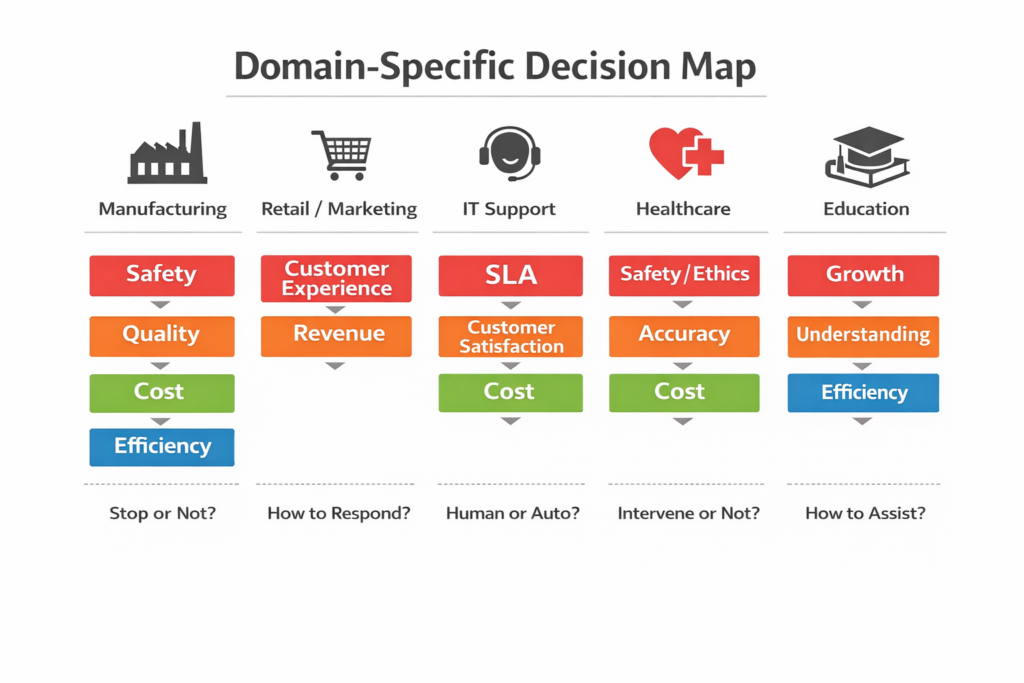
Decision Priorities by Domain
When we organize decisions through this lens, the differences become very clear.
The key point is:
Priorities don’t just differ
They directly shape the form of decisions
■ Manufacturing
👉 Decision: Should we stop?
■ Retail / Marketing
👉 Decision: How should we respond?
■ IT / Customer Support
👉 Decision: Human or automation?
■ Healthcare
👉 Decision: Should a human intervene?
■ Education
👉 Decision: What kind of support should be provided?
Summary

Across industries:
👉 What is prioritized is fundamentally different
And those priorities:
👉 Directly determine how decisions are made
What Light DTM Does
Light DTM takes a very simple approach:
It externalizes decision priorities
In traditional AI systems:
- Signals are generated
- But decisions remain implicit
As a result:
- Decisions vary by person
- Reasons are unclear
- Improvements are difficult
Light DTM fixes this by making it explicit.
For example, in manufacturing:
→ stop_machine
This is not just a rule.
It expresses:
“Safety is prioritized, so we stop when anomalies appear.”
In IT support:
→ human
This expresses:
“Critical cases should be handled by humans.”
What This Really Means
Light DTM is not about writing if statements.
It is about:
Extracting and structuring
what the domain values and prioritizes in decision-making
Importantly:
👉 You don’t need to change the models
You only need to define:
- Which signals to use
- Where to set thresholds
- When to involve humans
- When to stop
Then:
Decision-making shifts from implicit behavior
to explicit design
From Light DTM to Full DTM
Light DTM is just the beginning.
As systems evolve, simple rules are no longer enough.
You start needing:
- Multiple signals
- Sequential decisions
- Conditional flows
- Human approvals
- Context awareness
What Full DTM Enables
Full DTM expands decision-making into a structured system:
1. Multi-signal integration
Decisions based on multiple inputs, not a single score
2. Decision flow control
Order, branching, waiting, resuming
3. Explicit Human & Boundary layers
Who decides, when, and under what conditions
4. Integration of domain knowledge
Ontology-driven decision logic
5. Multi-agent perspectives
Different viewpoints (risk, cost, UX, etc.)
6. Decision traceability
Record, replay, and improve decisions
The Key Shift
Decisions become:
- Reproducible
- Auditable
- Continuously improvable
Relationship Between Light and Full DTM
Light DTM = Entry point
Full DTM = Scalable structure
You don’t need everything from the start.
But if you:
Externalize decisions early
You can expand naturally later.
We present below a comparison between the Light and Full configurations in a complaint inquiry use case.

Conclusion
Even with the same AI, outcomes differ.
Not because of model accuracy.
Not because of algorithms.
But because of:
What is prioritized in decision-making
AI can generate answers.
But it cannot:
- Decide
- Take responsibility
- Define priorities
Those belong outside the model.
Decision-making is not something AI does.
It is something we design.
And that design lives:
Not inside the model
But on our side

Chinoba
Intelligence as Relationship
Research Platform
founded by
Masao Watanabe
AI Systems Architecture
Decision Trace
Human–AI Coordination
Algorithmic Governance
Related Research
This topic is part of the Chinoba Knowledge Base.

コメント