
The spread of generative AI and RAG (Retrieval-Augmented Generation) is rapidly accelerating the adoption of AI in the manufacturing industry.
However, in real-world environments, many PoCs stop before reaching the next stage.
Systems can:
- search information
- summarize documents
- retrieve past cases
- generate AI-based suggestions
And yet, organizations still struggle with the same question:
“So, how should we actually make the decision?”
Why does this happen?
The reason is simple.
What real manufacturing environments require is not merely:
“information retrieval.”
What they actually need is the ability to handle:
- ambiguous situations
- differences in understanding between departments
- safety boundaries
- human review processes
- and decisions about “where to stop”
This is where the:
DTM (Decision Trace Model)
becomes important.
DTM is a framework that treats AI not merely as a:
“generation system,”
but as a:
“runtime for supporting decision-making.”
In this article, we will organize a realistic step-by-step approach for introducing DTM into manufacturing environments.
Importantly, this is not about building a massive system from the beginning.
Rather, it is a roadmap for:
“starting small and evolving into organizational intelligence.”
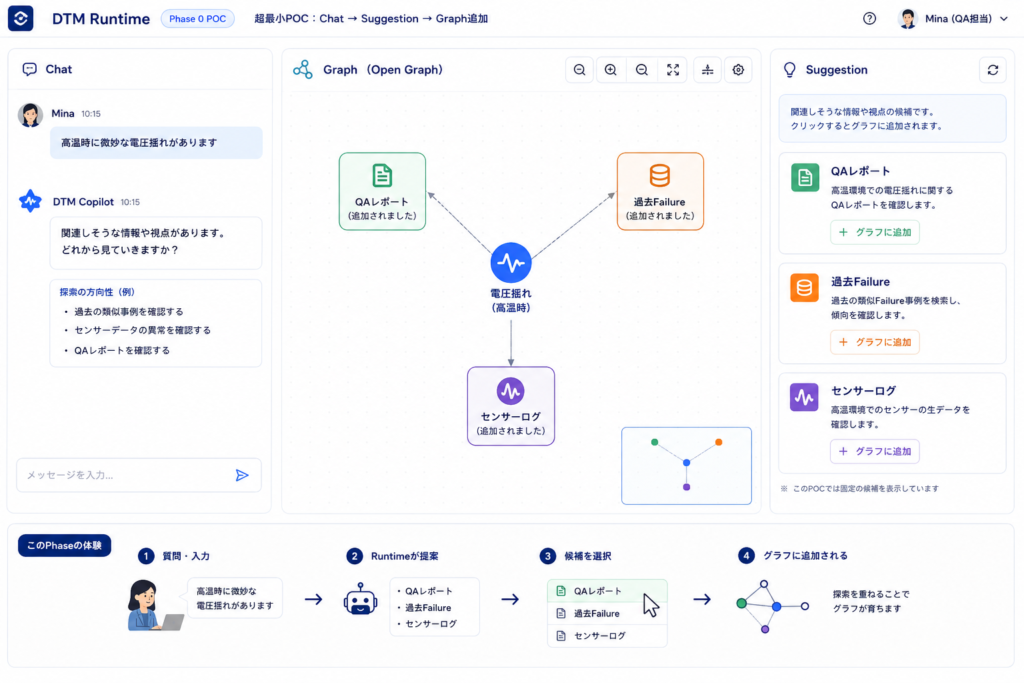
Step 1 Build an Interactive RAG Exploration UI
The first thing to build is not a giant autonomous AI agent system.
What is first required is:
“the ability to explore.”
For example, the system should enable cross-searching across:
- past defects
- design review records
- quality reports
- test logs
- sensor data
- work reports
- field failures
and other manufacturing-related information.
But the important point here is:
this is not just search.
The AI should also:
- suggest related candidates
- recommend similar cases
- identify relevant people
- propose what information should be examined next
Even more importantly:
“selected information should accumulate as a graph.”
In other words, the system creates a cycle of:
Search
↓
Selection
↓
Relationship Formation
↓
Next Exploration
Through this process, organizations gradually begin to understand:
- what should be investigated
- which department should be involved
- who should be consulted next

Step 2 Accumulating Organizational Knowledge
In the next stage, exploration results are no longer treated as isolated individual work.
What becomes important is:
“turning the exploration process itself into an organizational asset.”
For example, the system accumulates into a database:
- who investigated what
- which pieces of information were connected
- which cases were considered important
- what hypotheses were formed
At this stage, organizations begin to enter a state where:
“the organization itself learns how to explore.”
In manufacturing, overdependence on individuals is a major issue.
Experienced engineers often:
- make decisions inside their heads
- detect anomalies through past experience
- sense danger through tacit knowledge
This happens frequently.
DTM treats:
“the exploration process itself”
as something that should be recorded and accumulated.
Step 3 Connecting Not Only to “Knowledge,” but to “People Who Know”
One of the most critical questions in manufacturing is:
“Who should we ask?”
In real environments, it is common that:
- important details are not written in documents
- the nuance of abnormalities exists only as tacit knowledge
- certain individuals remember past failures
- specific production lines have unique characteristics
Because of this, DTM introduces the ability to:
- treat people themselves as Knowledge Nodes
- perform Expert Routing
- suggest “who should be consulted for this issue”
In other words, DTM handles not only:
Knowledge Retrieval
but also:
Human Knowledge Retrieval
This is a concept rarely found in conventional RAG systems.
Step 4 Forming “Context” from Information
In manufacturing, problems rarely exist in isolation.
For example:
- temperature increases
- vibration changes
- microscopic noise
- component replacement history
- patterns specific to a certain factory
only become meaningful when combined together.
DTM places strong emphasis on:
organizing fragmented information into Contexts.
As a result, organizations begin to understand:
- which hypotheses are most plausible
- what should actually be examined
- which signals may indicate danger
This can be viewed as an evolution:
from “Search AI”
to “Situation Understanding AI.”

Step 5 Narrowing Down the “Important Contexts”
In manufacturing, the volume of information is enormous.
The real challenge is:
“What should we actually pay attention to?”
DTM introduces mechanisms such as:
- Context Ranking
- Risk Ranking
- Weak Signal Detection
- Contradiction Detection
Among these, one of the most important targets is:
“cases that are dangerous, yet ambiguous.”
Major accidents often initially appear as:
“mere noise.”
DTM is designed from the beginning to handle:
- uncertainty
- ambiguity
- weak signals
as core elements of the decision process.
Step 6 Moving Beyond Exploration to “Provisional Decisions”
At this stage, the concept of:
Decision
appears for the first time.
For example:
- HOLD
- ADDITIONAL VALIDATION
- TEMPORARY APPROVAL
- ESCALATION
The important point here is:
AI does not make decisions autonomously.
In DTM, the following structure is emphasized:
AI
↓
Context Formation
↓
Human Review
↓
Boundary Verification
↓
Decision
In other words, the goal is:
“to create a state in which decisions can be made responsibly.”

Step 7 Introducing Boundaries and Human Gates
This is one of the biggest differences between conventional AI systems and DTM.
Real manufacturing environments contain:
- safety standards
- regulations
- quality assurance requirements
- responsibility boundaries
- approval processes
In other words, organizations must handle:
“how far something can be allowed.”
DTM explicitly incorporates mechanisms such as:
- Safety Boundaries
- Regulation Checks
- Mandatory Human Review
- Escalation
- Responsibility Tracking
This is critically important for:
“connecting AI to real social and organizational structures.”
Step 8 Evolving Toward Multi-Agent Coordination
The next stage moves beyond a single AI system and introduces:
specialized groups of agents.
For example:
- Thermal Agent
- Safety Agent
- Manufacturing Agent
- Quality Agent
- Cost Agent
The important point is:
agents will inevitably conflict with one another.
In manufacturing, conflicts constantly arise between:
- safety vs. cost
- quality vs. delivery schedule
- performance vs. productivity
The DTM Runtime functions as:
“a coordination layer”
that manages and balances these competing perspectives.
Step 9 Accumulating Decision Traces
Finally, one of the most important capabilities is:
the ability to trace “why a particular decision was made.”
In manufacturing, decisions are often later:
- audited
- analyzed during failure investigations
- reviewed during recalls
- examined for accountability
For this reason, organizations must preserve:
- what information was used
- who performed the review
- where boundary checks occurred
- why escalations were triggered
Only at this stage does:
Failure Learning
become truly possible.
Final Stage A Continuously Learning “Organizational Intelligence Infrastructure”
Ultimately, DTM evolves beyond:
“a one-time AI system”
into:
“an organizational intelligence infrastructure.”
Within this environment:
- exploration results
- decision histories
- failure traces
- human knowledge
- contexts
- boundaries
- decisions
continuously circulate and accumulate.
In other words:
the organization itself becomes capable of learning continuously.

Conclusion The reason many AI initiatives fail to move beyond the PoC stage is not:
insufficient AI accuracy.
The real problem is:
“the inability to connect AI to actual decision-making structures.”
In manufacturing, organizations must deal with:
- responsibility
- safety
- ambiguity
- organizational coordination
- and real-world operational constraints
To handle these realities, a structure like the following becomes necessary:
Search
↓
Context Formation
↓
Boundary Verification
↓
Human Gate
↓
Decision Trace
DTM is a runtime architecture designed precisely for this purpose.
And one of the most important points is:
not trying to build a massive system from the beginning.
Instead, organizations should first start with:
- Exploration
- Graphs
- Contexts
- Human Knowledge
Then gradually evolve toward:
- Ranking
- Decision Support
- Boundary Management
- Multi-Agent Coordination
- Traceability
This is the realistic path for introducing DTM into manufacturing environments.
Chinoba


Chinoba
Intelligence as Relationship
Research Platform
founded by
Masao Watanabe
AI Systems Architecture
Decision Trace
Human–AI Coordination
Algorithmic Governance
Related Research
This topic is part of the Chinoba Knowledge Base.


コメント