
Knowledge Base Archive
This article is part of the Chinoba Knowledge Base.
Explore Chinoba.org →
Machine Learning Artificial Intelligence Natural Language Processing Probabilistic Generative Models Algorithm ICT Technology Computer Architecture IT Infrastructure Digital Transformation Deep Learning Mathematics Computer Hardware DX Case Study Navigation of this blog
Challenges in semiconductor miniaturisation
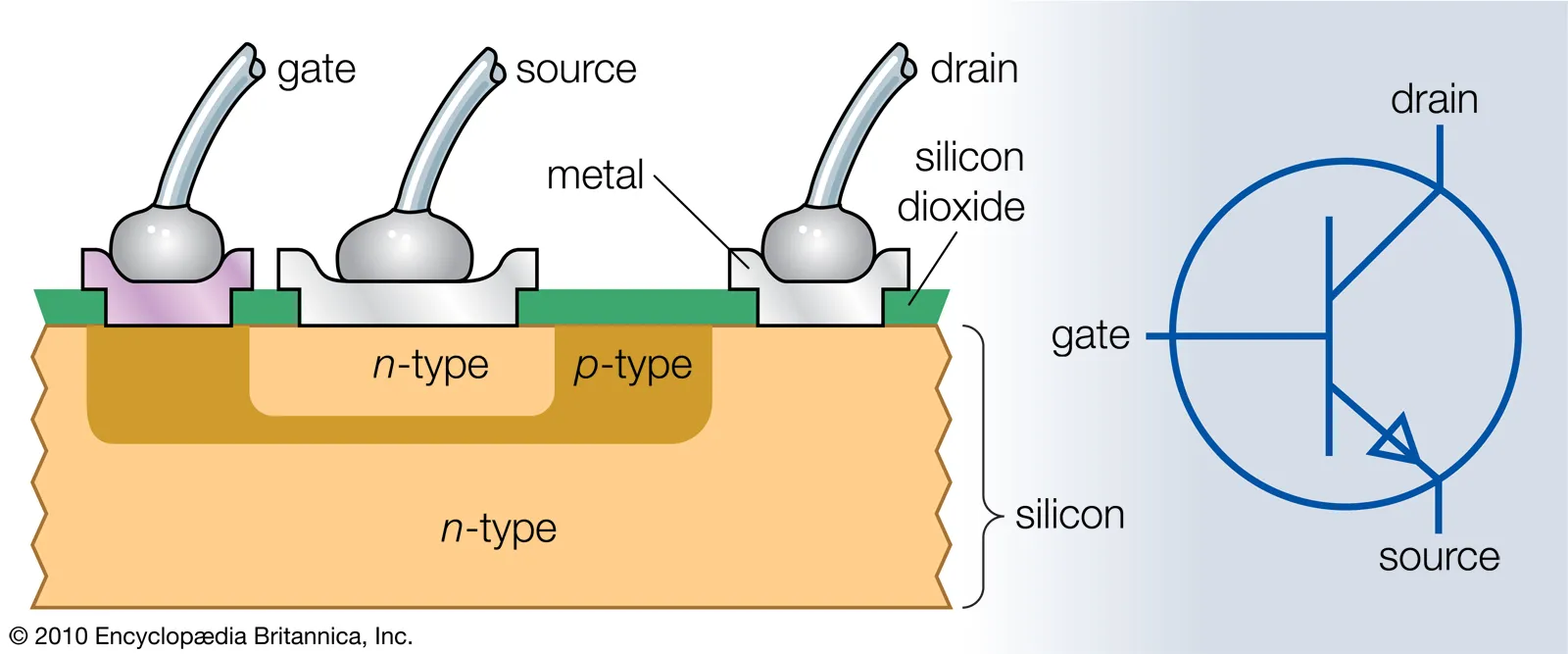
Chip miniaturisation, the most significant challenge in semiconductor technology, involves a number of issues, including many challenges in the manufacturing process and design. As described in ‘Overview of semiconductor manufacturing technology and application of AI technology’, the structure of semiconductors is as follows: switching is controlled by applying a voltage to the gate formed by an insulator above the current flowing in the channel between drain and source.

Measures to address challenges
Various technologies and process improvements are being developed to overcome these challenges associated with the miniaturisation of semiconductor chips. Typical measures are described below. 1. improvement of the transistor structure- Fin Field-Effect Transistors (FinFETs): moving from conventional planar transistors to 3D structured FinFETs reduces short-channel effects and improves power efficiency and performance FinFETs are effective in reducing leakage current and improving switching performance.


- GAAFET (Gate-All-Around FET): a further evolution of the FinFET in which the gate surrounds the transistor channel all the way around. It is more controllable, can be used in even finer processes and is superior in suppressing leakage currents.


- CFET (Complementary Field-Effect Transistor): a transistor manufacturing method being considered for adoption at process nodes of 1 nm and below from 2030 onwards, based on a PMOS/NMOS structure stacked vertically, characterised by small size and high energy efficiency. It is characterised by its small size and high energy efficiency.


Problem solving through AI technology
AI technologies are being used in many fields to solve these challenges. Typical AI solutions are described below. 1. use of AI in EDA tools: – Design optimisation and automation: AI-powered EDA (Electronic Design Automation) tools optimise miniaturised circuit design and contribute to the automatic generation of transistor placement and interconnect layout. This reduces the workload of circuit designers and enables leakage current suppression and signal delays to be reduced. In addition, the AI’s pattern recognition capability enables it to find layouts with high power supply efficiency and optimum circuit layouts. – Error detection and quality control: machine learning models can detect patterns of errors and faults that may occur during design and avoid risks before manufacturing. Anomaly detection models can be used to correct faults at the design stage, leading to a reduction in the number of prototypes and costs. 2. optimising the manufacturing process: – Anomaly detection and yield improvement: AI can monitor parameters in the manufacturing process in real time and fine-tune the process to improve quality and yield. By analysing data on the operation of manufacturing equipment with AI, anomalies can be detected at an early stage, reducing the occurrence of defective products, and AI forms a feedback loop from the data to improve manufacturing accuracy. – Improved EUV lithography accuracy: AI’s image recognition technology improves edge accuracy in the EUV (extreme ultraviolet) lithography exposure process, enabling finer patterns to be formed. This minimises exposure errors, which increase as the limits of miniaturisation are approached. 3. materials development and new materials exploration: – Material simulation using machine learning: semiconductor miniaturisation requires the introduction of new materials, and AI-based material simulation can predict material properties and efficiently find new materials with superior heat resistance and electrical properties. Machine learning models identify candidates from huge data sets, reducing the time and cost of experimentation and prototyping. – Optimisation of high-k materials and metal gates: AI can optimise the properties of high-k materials and metal gates and help design material structures that improve power efficiency and operating speed AI-based molecular simulations predict the molecular-level properties of materials and support efficient material selection. 4. improved thermal management and cooling technology: – Thermal simulation and prediction: as miniaturisation increases heat generation inside chips, AI-based thermal simulation can design efficient thermal dispersion pathways at the design stage to predict and mitigate where heat generation is concentrated, thereby improving cooling system efficiency and material design. – Cooling structure optimisation: AI can optimise the shape of heat-conductive materials and cooling fins to improve cooling performance, and machine learning algorithms can assist in the design of cooling structures, balancing cooling efficiency and cost. 5. process control automation: – Process control through real-time data analysis: real-time data from the manufacturing process is analysed by AI to automatically adjust process variations. This stabilises the entire semiconductor manufacturing process and enables precise control, which is particularly important as miniaturisation progresses, and predictive models optimally adjust process conditions such as temperature, humidity and pressure to maintain consistent quality. – learning of anomaly patterns: AI can learn patterns of defects and anomalies from past manufacturing data, predict similar anomalies before they occur and take appropriate countermeasures, thereby improving the utilisation rate of the manufacturing line and maintaining a stable mass production system. 6. new technology development through the combination of AI and quantum computing: – Enhanced simulation using quantum computing and machine learning: combining quantum computing and machine learning enables fast and accurate simulation of semiconductor materials and structures, in particular, facilitating simulations that take into account quantum effects associated with miniaturisation, thereby exceeding theoretical limits. This helps to improve performance. These AI technologies can make a significant contribution to reducing manufacturing costs and improving quality while addressing the increasing miniaturisation and complexity of semiconductors, and the entire design and manufacturing process is expected to become even more efficient and sophisticated with the evolution of AI.reference book
Reference books on semiconductor miniaturisation and AI technology include the following Books on semiconductor design and manufacturing: 1. 「Introduction to VLSI Design」by Eugene D. Fabricius 2. 「CMOS VLSI Design: A Circuits and Systems Perspective」by Neil H. E. Weste and David Harris 3. 「Semiconductor Manufacturing Handbook」by Hwaiyu Geng AI and machine learning books: 4. 「Machine Learning for Asset Management」by Emmanuel Derman, John Kou, and Christoph Meinert 5. 「Deep Learning」by Ian Goodfellow, Yoshua Bengio, and Aaron Courville 6. 「Artificial Intelligence and Machine Learning for Business」by Scott Chestnut Quantum computation and the future of semiconductor technology: 7. 「Quantum Computation and Quantum Information」by Michael A. Nielsen and Isaac L. Chuang

Chinoba
Intelligence as Relationship
Research Platform
founded by
Masao Watanabe
AI Systems Architecture
Decision Trace
Human–AI Coordination
Algorithmic Governance
Related Research
This topic is part of the Chinoba Knowledge Base.


コメント