
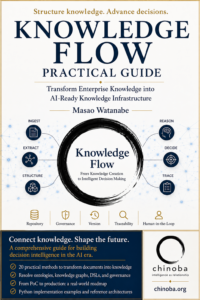

The first stage of Knowledge Flow is to collect enterprise information scattered across an organization and transform it into a format that AI can efficiently understand.
Building an AI-ready knowledge infrastructure requires more than simply allowing an LLM to read documents. The information must first be normalized and transformed into a structured representation that can be analyzed, connected, and continuously evolved.
Why Document Ingestion Matters
Every enterprise has accumulated an enormous amount of knowledge over many years.
Unfortunately, that knowledge is distributed across numerous systems.
Typical sources include:
- SharePoint
- Confluence
- Google Drive
- Microsoft OneDrive
- GitHub
- Box
- Dropbox
- Slack
- Microsoft Teams
- Outlook
- File Servers
- NAS
- Amazon S3
- Corporate Wikis
- Databases
- ERP Systems
- CRM Systems
In addition, enterprise knowledge exists in many different file formats:
- Microsoft Word
- Excel
- PowerPoint
- HTML
- Markdown
- CSV
- JSON
- XML
- CAD Drawings
- Source Code
- Log Files
In other words, organizations possess enormous amounts of knowledge stored in incompatible formats.
Knowledge Flow begins by bringing these heterogeneous information sources into a single processing pipeline.
Connectors
Document Ingestion relies on dedicated connectors for each enterprise system.
Typical connectors include:
- SharePoint Connector
- Confluence Connector
- Slack Connector
- Microsoft Teams Connector
- GitHub Connector
- Google Drive Connector
- Outlook Connector
- Amazon S3 Connector
- File System Connector
Each connector monitors three types of events through the corresponding APIs:
- Document Creation
- Document Update
- Document Deletion
For example, SharePoint integration follows the flow:
SharePoint

↓

Microsoft Graph API

↓

Knowledge Flow
Slack integration:
Slack

↓

Slack Events API

↓

Knowledge Flow
GitHub integration:
Git Push

↓

Webhook

↓

Knowledge Flow
This connector-based architecture makes the platform highly extensible.
Whenever an organization introduces a new system, supporting it typically requires only the development of an additional connector.
Event-Driven Architecture
Knowledge Flow does not periodically reprocess every document through nightly batch jobs.
Instead, it reacts only to newly generated events.
For example:
Word Document Updated

↓

Document Updated Event

↓

Message Queue

↓

Parser
or
Slack Message

↓

Message Event

↓

Message Queue

↓

Parser
Typical messaging technologies include:
- Apache Kafka
- RabbitMQ
- AWS SQS
- Azure Service Bus
This event-driven architecture enables real-time synchronization, even for organizations managing millions of documents.
Document Normalization
After ingestion, every document is converted into a common intermediate representation.
For example:
Contract.pdf

↓

PDF Parser

↓

Markdown
Word documents:
Specification.docx

↓

DOCX Parser

↓

Markdown
PowerPoint presentations:
Architecture.pptx

↓

Slide Parser

↓

Markdown
Excel workbooks:
Inventory.xlsx

↓

Table Extractor

↓

Markdown + JSON
Emails:
Outlook

↓

Mail Parser

↓

Markdown
HTML documents:
HTML

↓

HTML Cleaner

↓

Markdown
Source code:
Python

↓

AST Parser

↓

Markdown
Every enterprise document ultimately becomes a standardized representation.
Why Markdown?
Knowledge Flow uses Markdown as its primary intermediate document format.
For example, a Word document becomes:
# Quality Management Procedure

## Inspection

If the defect rate exceeds 5%,
notify the Quality Assurance department.
Markdown preserves valuable structural information such as:
- Headings
- Lists
- Tables
- Code Blocks
- Hyperlinks
Large Language Models process Markdown extremely well, significantly improving downstream tasks such as semantic chunking and knowledge extraction.
Structured numerical data, however, remains in JSON format.
For example:
{
  "part_number": "A-100",
  "inspection_rate": 0.03,
  "factory": "Tokyo"
}
This allows structured business data to remain machine-readable throughout the pipeline.
Document Metadata
Knowledge Flow stores not only document contents, but also rich metadata.
For example:
{
  "document_id": "DOC-001245",
  "title": "Quality Management Manual",
  "author": "Quality Assurance Department",
  "department": "QA",
  "version": "3.2",
  "created_at": "2026-01-15",
  "updated_at": "2026-06-01",
  "language": "ja",
  "security": "Internal",
  "source": "SharePoint"
}
This metadata becomes essential for downstream reasoning.
It enables capabilities such as:
- Using only the latest version
- Department-specific retrieval
- Excluding confidential documents
- Knowledge analysis by author or department
Metadata provides contextual information that significantly improves AI decision quality.
OCR and Multimodal Processing
Many enterprise documents are not digitally searchable.
Examples include:
- Handwritten notes
- Equipment photographs
- CAD drawings
- Whiteboard photos
- Factory inspection sheets
- Maintenance records
Knowledge Flow processes these resources using OCR and multimodal LLMs.
For example:
Scanned PDF

↓

OCR

↓

Markdown
or
Factory Drawing

↓

Vision LLM

↓

Component List

↓

Markdown
This enables previously inaccessible enterprise knowledge to become part of the organizational knowledge base.
Deduplication and Version Control
Duplicate documents are common within enterprises.
For example:
Specification_v1.docx
Specification_v2.docx
Specification_Final.docx
Knowledge Flow identifies duplicates using:
- File Hashes
- Document Titles
- Semantic Similarity
- Modification Timestamps
It maintains the latest version while preserving historical revisions.
This allows organizations to trace the evolution of their knowledge over time.
Output of the Knowledge Acquisition Layer
Once Document Ingestion is complete, every enterprise information source has been normalized into a common representation.
Enterprise Systems

        │

        ▼

Connectors

        │

        ▼

Parsers

        │

        ▼

Markdown + JSON

        │

        ▼

Metadata

        │

        ▼

Knowledge Flow
At this stage, AI still does not fully understand the organization’s knowledge.
However, every document has been normalized, enriched with metadata, and prepared for downstream processing.
This standardized foundation enables the next stages of Knowledge Flow—including Semantic Document Chunking, Knowledge Extraction, Ontology Construction, and DSL Generation—to operate with significantly higher accuracy.
Document Ingestion is therefore much more than simple data collection.
It is the foundational process that transforms scattered enterprise information into AI-ready knowledge capable of supporting trustworthy reasoning and decision making.


Chinoba
Intelligence as Relationship
Research Platform
founded by
Masao Watanabe
AI Systems Architecture
Decision Trace
Human–AI Coordination
Algorithmic Governance
Related Research
This topic is part of the Chinoba Knowledge Base.


コメント