
As AI adoption accelerates, more and more organizations are deploying generative AI and AI agents across their businesses.
However, as these initiatives move from experimentation to real-world deployment, many organizations encounter the same fundamental challenge.
AI cannot truly understand enterprise knowledge.
Organizations possess enormous amounts of valuable knowledge stored across PDFs, Word documents, Excel spreadsheets, SharePoint, Confluence, Slack, GitHub, design documents, engineering standards, meeting minutes, and many other repositories.
While humans can connect these pieces of information through experience and context, AI cannot easily do the same.
To address this challenge, I have been developing an architecture called Knowledge Flow.
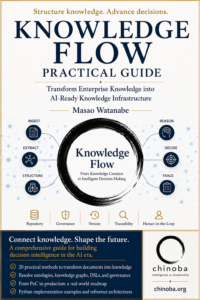
Today, I am pleased to announce the publication of my new book:

What This Book Covers
This book provides a comprehensive guide to designing and implementing an architecture that transforms enterprise knowledge into AI-ready knowledge infrastructure.
Rather than focusing solely on theory, it explains practical implementation techniques, including:
- Document Ingestion
- Semantic Document Chunking
- Knowledge Extraction
- Ontology Construction
- Knowledge Graph Generation
- DSL Generation
- Human-in-the-Loop
- Knowledge Repository
- Integration with the Decision Runtime
- Integration with Runtime OS
- Python Implementation Examples
- Real-world applications in manufacturing, finance, healthcare, and enterprise knowledge management
Instead of presenting another guide to building RAG systems, this book introduces a broader vision of Knowledge Infrastructure—an architecture for continuously evolving enterprise knowledge.
Beyond RAG: Why Knowledge Flow Matters
Modern generative AI excels at retrieving documents.
However, it still struggles to understand organization-specific knowledge such as:
- Decision criteria
- Approval policies
- Design principles
- Operational constraints
- Historical decision-making processes
Knowledge Flow addresses this limitation by creating the following pipeline:
Documents → Knowledge → Decision → Action
Enterprise documents are transformed into structured knowledge that AI systems can use for reasoning, decision-making, and explainable outcomes.
Rather than serving merely as a search engine, AI becomes an intelligent partner capable of supporting organizational decision-making based on accumulated enterprise knowledge.
Relationship with Decision Trace and Runtime OS
Knowledge Flow is not intended to function as a standalone solution.
It is designed to work together with the broader research themes I have been developing:
- Decision Trace
- Runtime OS
- Trust Infrastructure
- Runtime Society
Together, these technologies aim to create an AI platform capable of utilizing enterprise knowledge, explaining decisions, and operating safely within organizations.
Knowledge Flow serves as one of the core components of this next-generation knowledge infrastructure.
Who Should Read This Book?
This book is intended for:
- AI architects and enterprise AI engineers
- Developers exploring architectures beyond traditional RAG
- Researchers interested in knowledge graphs and ontologies
- Engineers building knowledge infrastructure for AI agents
- Professionals working on AI governance and explainable AI
The book combines architectural concepts with practical implementation guidance, making it useful for both researchers and practitioners.
Final Thoughts
AI models will continue to become more powerful.
But competitive advantage in the AI era will not come simply from using larger language models.
It will come from an organization’s ability to transform its unique knowledge into AI-ready knowledge and continuously evolve that knowledge over time.
That is the vision behind Knowledge Flow.
I hope this book provides useful insights for anyone designing the next generation of enterprise AI systems and knowledge infrastructures.


Chinoba
Intelligence as Relationship
Research Platform
founded by
Masao Watanabe
AI Systems Architecture
Decision Trace
Human–AI Coordination
Algorithmic Governance
Related Research
This topic is part of the Chinoba Knowledge Base.


コメント