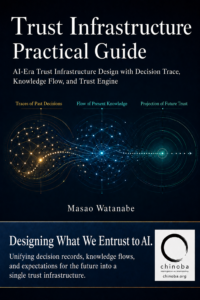
🎥 The YouTube version is also available:
Trust Infrastructure: Building the Foundation for Human–AI Collaboration

Introduction
Based on my recent presentation on Trust Infrastructure, I have published both Japanese and English explanatory videos.
📺 Japanese Version
https://youtu.be/w9v0ktZfEVs
📺 English Version
https://youtu.be/Afvon5qT51A
This article presents the core ideas of that presentation in written form.
For a more comprehensive explanation, please visit the Trust Infrastructure Research Page on Chinoba:

The Age of Information Scarcity Is Over
In the industrial era, information was scarce.
In the information age, the Internet dramatically reduced the cost of sharing information.
Today, with the emergence of AI, we can generate text, images, videos, and even software almost instantly.
In other words,
the cost of generating information is approaching zero.
Our problem is no longer a lack of information.
The AI Era Is About Deciding What to Trust
AI can generate countless answers.
We have search engines.
We have social media.
We have large language models.
Yet the more answers become available, the more important another question becomes:
Which information can we trust?
This is becoming one of the defining challenges of the AI era.
Truth Alone Is Not Enough for Coordination
Truth remains important.
However, in the AI era, the structure changes:
Truth
↓
Trust
↓
Coordination
When humans and AI coexist, the ability to coordinate becomes a source of value.
The Real Bottleneck Is the Cost of Coordination
Organizations spend enormous amounts of time on:
- Meetings
- Approvals
- Reviews
- Coordination
Information is no longer scarce.
Yet as the number of participants increases, the cost of coordination grows exponentially.
AI has significantly reduced the cost of accessing information.
However, it has not yet solved the problem of coordination.
Trust Is Not an Emotion
Trust is not simply a feeling.
Trust is the predictability of future behavior.
We trust because we believe:
- This person will keep their promise.
- This AI system will behave as expected.
- This organization will fulfill its responsibilities.
Predictability makes coordination possible.
Trust is therefore not merely an emotion.
It is a technology that enables society to function.
What Is Trust Infrastructure?
I believe that the AI era requires a new kind of infrastructure.
The communications era was built on TCP/IP.
The financial era was built on payment networks.
Likewise, the AI era requires Trust Infrastructure.
Its fundamental components include:
- Identity
- Trace
- Reputation
- Verification
- Governance
- Coordination
Together, these elements create the foundation for trustworthy collaboration among humans, AI systems, organizations, and communities.
Intelligence as Relationship
We are moving beyond an era in which knowledge alone was considered the primary source of value.
Trust is becoming more important than knowledge.
Relationships are becoming more important than capabilities.
Knowledge is giving way to trust.
I believe intelligence is not something that exists solely within an individual.
Rather, intelligence emerges through relationships.
Conclusion
Trust Infrastructure is far more than a security technology.
It is the social infrastructure that enables humans, AI, organizations, and communities to collaborate safely and effectively.
At Chinoba, we continue to expand this research through interconnected concepts such as:
- Decision Trace Model
- Knowledge Infrastructure
- Runtime Society
- Intelligence Field
Together, these ideas explore how intelligence can emerge through trust, coordination, and relationships in the AI era.
Related Videos
🇯🇵 Japanese Version
https://youtu.be/w9v0ktZfEVs
🇺🇸 English Version
https://youtu.be/Afvon5qT51A
For a more detailed explanation of the concepts presented in this article, please visit the Trust Infrastructure Research Page:

Chinoba
Intelligence as Relationship
Research Platform
founded by
Masao Watanabe
AI Systems Architecture
Decision Trace
Human–AI Coordination
Algorithmic Governance
Related Research
This topic is part of the Chinoba Knowledge Base.

コメント