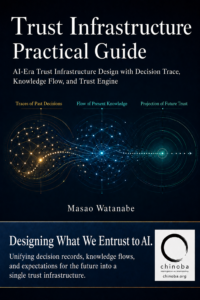
🎥 The YouTube version is also available:
Trust Infrastructure: Building the Foundation for Human–AI Collaboration

Introduction
In previous articles, we have explained that in the AI-era economy, value is created as knowledge flows, states are understood, and relationships among people, AI, and organizations evolve.
But relationships alone do not make an economy stable.
People may not be able to trust the other party.
Companies may be unable to explain the purpose for which data is used.
No one may understand why an AI made a particular decision.
It may be unclear who ultimately bears responsibility.
Under such conditions, neither individuals nor organizations can entrust AI with important decisions.
For economic activity to continue, there must be trust that:
- the other party will act as expected;
- the reasons can be examined when something goes wrong; and
- boundaries that must not be crossed will be respected.
We call the mechanisms that support trust in the AI era Trust Infrastructure.
Trust Infrastructure is not a mechanism for asking people simply to trust AI.
It is a foundation that makes it possible to verify how AI makes decisions, how far it is allowed to act, and when control must return to a human being.
An Economy Cannot Function Without Trust
When we purchase a product, we trust many things.
- The item we order will arrive.
- Payment will be processed at the displayed price.
- Personal information will not be misused.
- We can return the product if there is a quality problem.
- Contract terms will not be changed unilaterally.
If we had to verify every one of these conditions from scratch for every transaction, transactions would require enormous time and cost.
Trust reduces the burden of verification and negotiation, making it possible to repeat transactions.
In other words, Trust is not merely an emotion.
It is a mechanism for reducing the friction required for economic activity.
The same applies to business-to-business transactions.
A partner company will honor its contract.
It will maintain the agreed level of quality.
It will report problems with delivery schedules.
It will handle confidential information appropriately.
Because these expectations can be relied upon, companies can collaborate over the long term.
In a Relationship Economy, value lies not in a single transaction but in an ongoing relationship.
That is why Trust becomes even more important than before.
AI Makes the Trust Problem More Complex
In the conventional economy, the primary decision-makers were people and organizations.
In the AI era, however, we increasingly see situations in which:
- AI recommends products;
- AI reviews contracts;
- AI evaluates lending risk;
- AI determines whether equipment should be stopped;
- AI handles customer interactions; and
- AI agents divide work among themselves.
This creates new questions.
It is not enough to ask whether an AI decision was correct.
We also need to be able to explain:
- what evidence the decision was based on;
- what data was used;
- which rules were applied;
- how confident the system was;
- who granted the AI its authority; and
- who is accountable for the outcome.
Even if the outcome appears correct, it is a problem if the AI used data it was not authorized to use.
Even an efficient action cannot be accepted if it violates organizational rules or social boundaries.
Trust in the AI era cannot be established by accuracy alone.
What Is Trust Infrastructure?
Trust Infrastructure is the system-level implementation of the mechanisms needed for people, AI, and organizations to collaborate with confidence.
Its main components include:
- Identity: Who is acting?
- Role: In what role are they acting?
- Policy: Which rules must they follow?
- Boundary: What are they permitted to do?
- Decision Trace: Why was this decision made?
- Human Gate: At what point must a human review the decision?
- Audit: Can the action be verified afterward?
- Escalation: To whom should an issue be returned?
The purpose of Trust Infrastructure is not to have humans monitor every AI decision in detail.
It is to automate low-risk decisions while returning high-risk decisions to people at the right time.
In other words, Trust Infrastructure is a foundation for:
combining autonomy with governance.
Decision Trace: Preserving the Reasons Behind a Decision
To trust an AI decision, we must be able to trace not only the result but also the process that led to it.
This is a Decision Trace.
Suppose an AI sends a coupon to a customer.
If we record only the outcome, the record might say:
“Coupon B was sent to Customer A.”
But this alone cannot explain:
Why was Customer A selected?
Why was Coupon B selected?
What other options were considered?
Which constraints were checked?
A Decision Trace records information such as:
- Goal: The objective to be achieved
- Context: The situation at the time of the decision
- Intent: The intention of the user or organization
- Evidence: The supporting evidence consulted
- Candidate Actions: The alternatives considered
- Constraint: The restrictions that had to be respected
- Policy: The rules that were applied
- Risk: The risks that were anticipated
- Decision: The choice that was made
- Actor: The person or AI that made the decision
- Result: The execution outcome
- Feedback: The subsequent evaluation
This makes it possible to confirm not only:
“What did the AI do?”
but also:
“Why did it arrive at that decision?”
A Decision Trace is not merely a log.
It is a mechanism for accumulating organizational decisions as reusable knowledge.
Decision Histories Become a New Asset
Important decisions are made in organizations every day.
Approving a discount.
Allowing an exceptional response for a customer.
Stopping equipment.
Changing contract terms.
Delaying a project.
Yet the reasons behind these decisions are often not sufficiently preserved.
When the person in charge is transferred, no one may know why the decision was made.
When the same problem occurs again, the organization starts its analysis from the beginning.
If Decision Traces are retained, organizations can use the next decision to understand:
- what circumstances existed in the past;
- which evidence was prioritized;
- what risks were accepted; and
- what outcome followed.
A decision is therefore not something that is consumed once and disappears.
It becomes an asset that can be accumulated, learned from, and reused.
This can be called Decision Capital.
Boundary: The Lines AI Must Not Cross
When entrusting decisions to AI, the first thing to define is not only:
“What can AI do?”
It is also:
“What must AI not do?”
We call this limit a Boundary.
Examples include:
- the range of data the AI may use;
- the systems it may access;
- the maximum amount it may execute;
- the items it may modify;
- the customers it may contact;
- the information it may send outside the organization;
- the risk level at which automatic execution is allowed;
- the conditions under which a decision must be deferred; and
- the conditions requiring human approval.
For example, consider a sales-support AI that proposes discounts.
It may automatically propose discounts of up to 5%.
Discounts of up to 10% may require manager approval.
Discounts above 10% may require review by the finance department.
Certain products may not be discounted.
Different rules may apply to contract customers.
When Boundaries are clear, AI does not act with unrestricted discretion. It can act autonomously within an authorized range.
A Boundary does not prevent AI from demonstrating its capabilities.
It is a design that enables those capabilities to be used safely.
Boundaries Change with Context
Boundaries are not always fixed.
Even for the same AI, the permitted scope may differ depending on:
- who is using it;
- which organization they belong to;
- what work is being performed;
- the current level of risk; and
- whether an emergency is underway.
For example, broader information sharing may be necessary during a disaster than under normal conditions.
On the other hand, high-risk domains such as healthcare and finance require stricter constraints.
A Boundary should therefore not be designed as a static permission setting. It should be designed as:
a dynamic boundary applied according to Context.
When State Understanding and Boundary are connected, AI can act within the appropriate range for the current situation.
Human Gate: Where Decisions Return to People
Automating every AI decision is not necessarily desirable.
What matters is making clear:
“How far should AI be allowed to act, and from what point should a human make the decision?”
We call this mechanism a Human Gate.
A Human Gate is not simply an approval button.
It is a design for defining the conditions under which AI must return a decision to a human being.
For example, a decision may pass through a Human Gate when:
- the AI’s confidence is low;
- the transaction is high value;
- there are legal implications;
- individual rights may be affected;
- multiple Policies are in conflict;
- there is no similar past case;
- AI agents do not reach the same conclusion;
- social or ethical judgment is required; or
- significant risk is involved.
This means humans no longer need to review every decision.
AI can handle routine, low-risk decisions, while people can focus on ambiguous and consequential ones.
Human Gates Clarify Accountability
When an AI-driven decision causes a problem, it is not acceptable to say:
“The AI made the decision, so nothing could be done.”
It must be clear:
Who granted authority to the AI?
Under what conditions was automation approved?
Which decisions should have been reviewed by a person?
A Human Gate is not a mechanism for shifting all responsibility back to people.
Rather, it structures:
- the scope for which AI is responsible;
- the scope a staff member must review;
- the scope a manager must approve; and
- the scope executives must decide.
This clarifies the division of roles between AI and humans.
Trust Cannot Be Expressed by a Score Alone
There are approaches that quantify Trust and manage it as a Trust Score.
This can be useful for certain purposes, but we should be careful about representing Trust with a single number.
An AI may be highly trustworthy for document summarization but not for contract approval.
A company may be trustworthy in terms of quality but unreliable in terms of delivery.
In other words, Trust differs by subject, purpose, and Context.
For this reason, Trust Infrastructure needs to manage separately:
- whom we trust;
- what we trust them to do;
- under what conditions we trust them;
- how far we delegate to them; and
- for how long that trust remains valid.
Trust is not a fixed attribute of a person or AI.
It is:
something formed within a specific relationship and situation.
An Implementation Model for Trust Infrastructure
To implement Trust Infrastructure, at minimum, the following flow is needed.
Identity
↓
Identify the actor
Role
↓
Confirm the current role
Context
↓
Understand the situation in which the decision is made
Policy
↓
Select the applicable rules
Boundary
↓
Confirm the authorized range
Decision
↓
Evaluate alternatives and make a decision
Human Gate
↓
Return the case to a human when necessary
Execution
↓
Carry out the permitted action
Decision Trace
↓
Record the reasons and outcomes
Audit and Feedback
↓
Verify afterward and apply the learning to future decisions
This flow makes AI’s autonomous behavior explainable and governable.
Trust Infrastructure and the Relationship Economy
In a Relationship Economy, ongoing relationships create value.
But once serious distrust emerges, that relationship can be lost.
Irrelevant advertisements are sent.
An unexplained screening result is issued.
Personal information is used beyond its intended purpose.
An AI changes a contract without authorization.
No one knows who is responsible.
Such experiences may deliver short-term efficiency, but they damage long-term relationship capital.
By contrast, people and organizations can build relationships with AI confidently when there are mechanisms that ensure:
- the reasons for decisions can be explained;
- the boundaries that must be respected are clear;
- people can intervene when problems occur;
- accountability is visible; and
- decision histories can be examined afterward.
This creates the following cycle:
Trust Infrastructure
↓
Safe Decision
↓
Explainable Action
↓
Reliable Experience
↓
Stronger Relationship
↓
Economic Value
Trust is not something added at the end of value creation.
It is a precondition that makes value creation possible.
The Relationship with Knowledge Flow, State Understanding, and Community Graph
The elements of Chinoba Economics introduced so far are all connected.
Knowledge Flow delivers the knowledge that AI uses for decisions.
State Understanding interprets the current Context, Goal, and Intent.
Community Graph represents the relationships among people, AI, and organizations.
Trust Infrastructure controls the range within which that knowledge and those relationships can be used safely.
Decision Trace records the reasons behind a decision.
Human Gate returns situations that should not be decided by AI alone to people.
The overall flow is as follows:
Knowledge Flow
↓
State Understanding
↓
Community Graph
↓
Policy and Boundary
↓
Decision
↓
Human Gate
↓
Action
↓
Decision Trace
↓
Trust
↓
Relationship
↓
Value
Trust is not an independent feature.
It is the foundation that connects Knowledge, Context, Relationship, Decision, and Action.
Conclusion
In the AI era, it is not enough for AI to be highly capable.
What matters is whether people and organizations can use it with confidence.
What evidence did it use to make a decision?
What authority does it have?
What boundaries must it not cross?
At what point must a person review the decision?
Can the action be verified afterward if something goes wrong?
Trust Infrastructure is what implements these requirements as a system.
Decision Trace preserves the reasons behind decisions. Boundary defines the scope of AI behavior. Human Gate designs the points at which people intervene and take responsibility.
Trust may be difficult to see, but it is one of the most important infrastructures supporting economic activity.
As AI takes on roles in society, we must not leave Trust to chance. We need to treat it as something that can be deliberately designed.
That is why we position the design of Trust at the center of the Relationship Economy.

Chinoba
Intelligence as Relationship
Research Platform
founded by
Masao Watanabe
AI Systems Architecture
Decision Trace
Human–AI Coordination
Algorithmic Governance
Related Research
This topic is part of the Chinoba Knowledge Base.

コメント