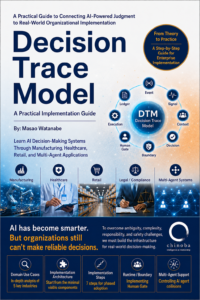
🎥 The YouTube version is also available:
From Explainable AI to Verifiable AI: Building a Foundation for Accountable Decisions | Chinoba PF

When introducing generative AI into business, many organizations first seek Explainable AI.
Why did the AI make this recommendation?
Which documents did it refer to?
What process led it to its conclusion?
It is certainly important for AI to explain its reasoning in natural language and provide supporting information. Compared with an AI that simply returns an answer as a black box, such a system makes it easier for users to understand the result.
However, in domains where decisions carry significant consequences—such as equipment maintenance, quality management, assessment, finance, public services, healthcare, manufacturing, and critical infrastructure—that alone is not enough.
This raises a more fundamental question:
Is that explanation merely plausible?
Or is it a decision that a third party can later review, reproduce, and verify?
This is the difference between Explainable AI and Verifiable AI.
Chinoba PF is not merely a foundation for making AI outputs easier to explain. It is a foundation for connecting people, AI, knowledge, rules, authority, execution, and outcomes—so that the conditions under which a decision was legitimately made can be examined and verified.
Explanations Are What AI Can Describe After the Fact
An Explainable AI system might respond as follows:
“Based on a rise in temperature and past maintenance records, I determined that there is a high likelihood of an anomaly.”
This explanation is useful to users. It helps them understand the AI’s conclusion and consider the next course of action.
Yet this one sentence leaves many important questions unanswered:
- Which temperature data was collected, and when?
- Was the sensor data being acquired correctly?
- Are the maintenance records that were referenced still valid?
- Who approved the rule that was applied?
- Were exceptions and safety constraints checked?
- Who approved the AI’s recommendation?
- What was actually executed, and what was the outcome?
Generative AI can produce highly persuasive explanations. But a fluent explanation is not, by itself, proof of fact or legitimacy.
Even if an AI says, “This decision is safe,” that statement does not guarantee safety. Even if it says, “I followed this policy,” the decision cannot withstand audit or revalidation unless there is a record of which version of the policy was applied and under what conditions.
Explanation is an interface for understanding.
Proof is a structure for trust and accountability.
Verifiable AI Preserves the Conditions Under Which a Decision Was Made
Here, “proof” does not mean proving every decision as a mathematical theorem.
Real-world operations involve many sources of uncertainty: sensor readings, documents, field observations, expert judgment, and exception handling. What matters is not claiming that an AI conclusion is absolutely correct.
What matters is preserving the following in a traceable form:
On which observations, knowledge, rules, authority, constraints, approvals, and execution records was this decision based?
Verifiable AI does not simply return a reason. It preserves the conditions under which a decision was made as records that can be reviewed again.
| Perspective | Explainable AI | Verifiable AI |
|---|---|---|
| Core question | Why did it provide this answer? | Under what conditions was this decision legitimately made? |
| Primary output | Natural-language reasoning, summaries, citations | Traceable records of evidence, rules, authority, approvals, execution, and outcomes |
| Treatment of evidence | Retrieved and cited when answering | Managed with provenance, version, scope of use, and approval status |
| Treatment of rules | Referred to in prompts or responses | Evaluated explicitly as Policies and Constraints |
| Human involvement | Supplementary review | Accountable decision and approval through a Human Gate |
| Relationship to execution | Ends with an answer or recommendation | Evaluates execution authority and feeds results back into decision-making |
| Post-decision review | Reads conversation history and logs | Reproduces, audits, and improves decisions through Decision Trace |
Explanation is necessary for understanding a decision.
Proof is necessary for entrusting, executing, and taking responsibility for a decision.
AI Output Is a Signal, Not a Decision
One of the core principles of Chinoba PF is to separate Signal from Decision.
AI-generated answers, recommendations, summaries, predictions, and anomaly-detection results are valuable Signals. However, they should not immediately be treated as formal Decisions.
For example, even if an AI proposes, “This equipment should be stopped,” at least the following must be checked:
- What is the current condition of the equipment?
- Have the conditions for a safe shutdown been met?
- What will be the impact on production or supply?
- Are there alternative measures?
- Who has the authority to approve the shutdown?
- Does this action cross a boundary that requires human confirmation?
In an architecture that connects AI output directly to execution, the boundary of responsibility for a decision remains unclear—even when an explanation is provided.
Chinoba PF receives AI output as a Signal, then transforms it into a Decision through Context, Knowledge, Policy, Constraint, Authority, and a Human Gate. Only actions within an authorized scope are passed to the execution layer as an Execution Authorization.
This separation enables AI to provide important decision support without becoming an unauthorized actor that can execute actions on its own.
Chinoba PF Connects Meaning, Decision, and Trust
Chinoba PF is not simply a chat interface or a RAG foundation. It is a Context Infrastructure that connects AI, people, organizations, and society. It is also a Semantic and Decision Control Plane for operational AI, including Physical AI.
At its core are five planes.
- Knowledge Plane
This plane ingests documents, manuals, policies, past cases, and field knowledge, and manages their meaning, scope of use, exceptions, versions, and approval status. Rule candidates extracted from documents are not immediately treated as executable rules. - Semantic Twin Plane
This plane represents Entities, Relationships, States, Events, and Observations for equipment, people, processes, customers, cases, and organizations. It transforms observations from the real world into Context that can support decisions. - Decision Plane
This plane connects AI Signals, observations, knowledge, rules, and constraints to determine which options should be considered. It explicitly separates recommendations from formal Decisions. - Trust and Governance Plane
This plane manages Provenance, Authority, Policy, Human Gate, Autonomy Control, and Decision Trace. It preserves who made or approved a decision, on what evidence, and under which authority. - Physical Integration Plane
This plane connects sensors, business systems, robots, machines, and external services. However, it does not allow AI to issue commands directly; it connects only Actions that have been properly authorized.
Through this architecture, operational events are handled through the following flow:
Observation → Contextualization → Knowledge and Policy Evaluation → Decision Formation → Human Gate and Authorization → Action → Result Observation → Decision Trace
What matters is that recording does not stop after the Action.
By observing outcomes and comparing them with the predictions and assumptions made at the time of decision, an organization can do more than merely use AI. It can continuously learn and improve the quality of its decisions.
Decision Trace Is Not an Explanation History
A Decision Trace is not a conversation log that stores the text produced by an AI.
It is a record that connects the elements that constitute a decision:
- Which Observations were received
- Which Knowledge was referenced
- Who approved that Knowledge, and which version was used
- Which Policies and Constraints were applied
- Which Signals were produced by AI
- What people confirmed, approved, or rejected
- Which Execution Authorizations were issued
- Which Actions were actually performed
- What outcomes occurred and what should be reconsidered
A Decision Trace recorded in this way can be used not only for explanation, but also for audit, reproduction, improvement, accountability, training, and rule revision.
For example, when an incident or anomaly occurs, an organization cannot learn much by simply concluding that “the AI was wrong.”
What must be examined is not only the model output:
- Was the referenced knowledge outdated?
- Was the scope of a rule applied incorrectly?
- Did the system fail to detect missing sensor data?
- Were the approval conditions ambiguous?
- Was the boundary of execution authority too broad?
- Were outcome feedback loops failing to inform subsequent decisions?
Decision Trace makes it possible to improve the entire decision system, rather than reducing a failure to the responsibility of an individual or an AI model.
Evidence-Grounded Answers Alone Cannot Build Trust in Operational AI
AI systems that provide evidence through RAG and Knowledge Graphs are already creating substantial value. Improving retrieval accuracy, showing sources, and reducing incorrect answers are all important.
However, there is still a gap between an evidence-grounded answer and a verifiable decision.
An evidence-grounded answer shows which documents were referenced.
A verifiable decision also addresses why those documents were allowed to be used, who approved the applicable rule, who had the authority to execute the action, and what outcome followed.
In other words, retrieval accuracy alone is not enough.
- Knowledge Flow for managing the provenance of knowledge
- Ontology and Semantic Digital Twin for sharing meaning and state
- DSL and Policy for explicitly representing rules and constraints
- Human Gate for accountable human involvement
- Trust Engine for evaluating authority and trust
- Decision Trace for preserving decision pathways
- Boundary Design for controlling autonomy
Only when these elements are connected can AI move from being an “assistant that explains well” to becoming a decision foundation that organizations can use responsibly.
What Chinoba PF Seeks to Achieve
Chinoba PF does not seek to make AI produce universally correct answers.
Rather, it seeks to appropriately connect people, AI, knowledge, rules, and organizational responsibility within an uncertain reality.
AI generates hypotheses.
Knowledge provides evidence.
Rules define boundaries.
People make accountable decisions.
Execution systems operate only within authorized scope.
Decision Trace preserves the entire process for future verification and learning.
At that point, AI is no longer merely an entity that explains why it gave an answer.
It becomes an entity that can show the evidence, rules, authority, approvals, and execution outcomes through which a decision was made.
Explainability is the starting point for understanding AI.
Verifiability is the foundation for making decisions, taking action, and improving together with AI.
Chinoba PF is the platform that supports this transition.

Chinoba
Intelligence as Relationship
Research Platform
founded by
Masao Watanabe
AI Systems Architecture
Decision Trace
Human–AI Coordination
Algorithmic Governance
Related Research
This topic is part of the Chinoba Knowledge Base.

コメント